Your Website Looks Good, So Why Isn't Google Sending You Traffic?
A website can look professional, load quickly, and still get almost no Google traffic. The problem is often not the design itself. It can be the search intent, content structure, crawlability, authority, internal linking, or simply the fact that the website gives Google too little reason to surface it. Here is how to find the real problem and what to fix first.
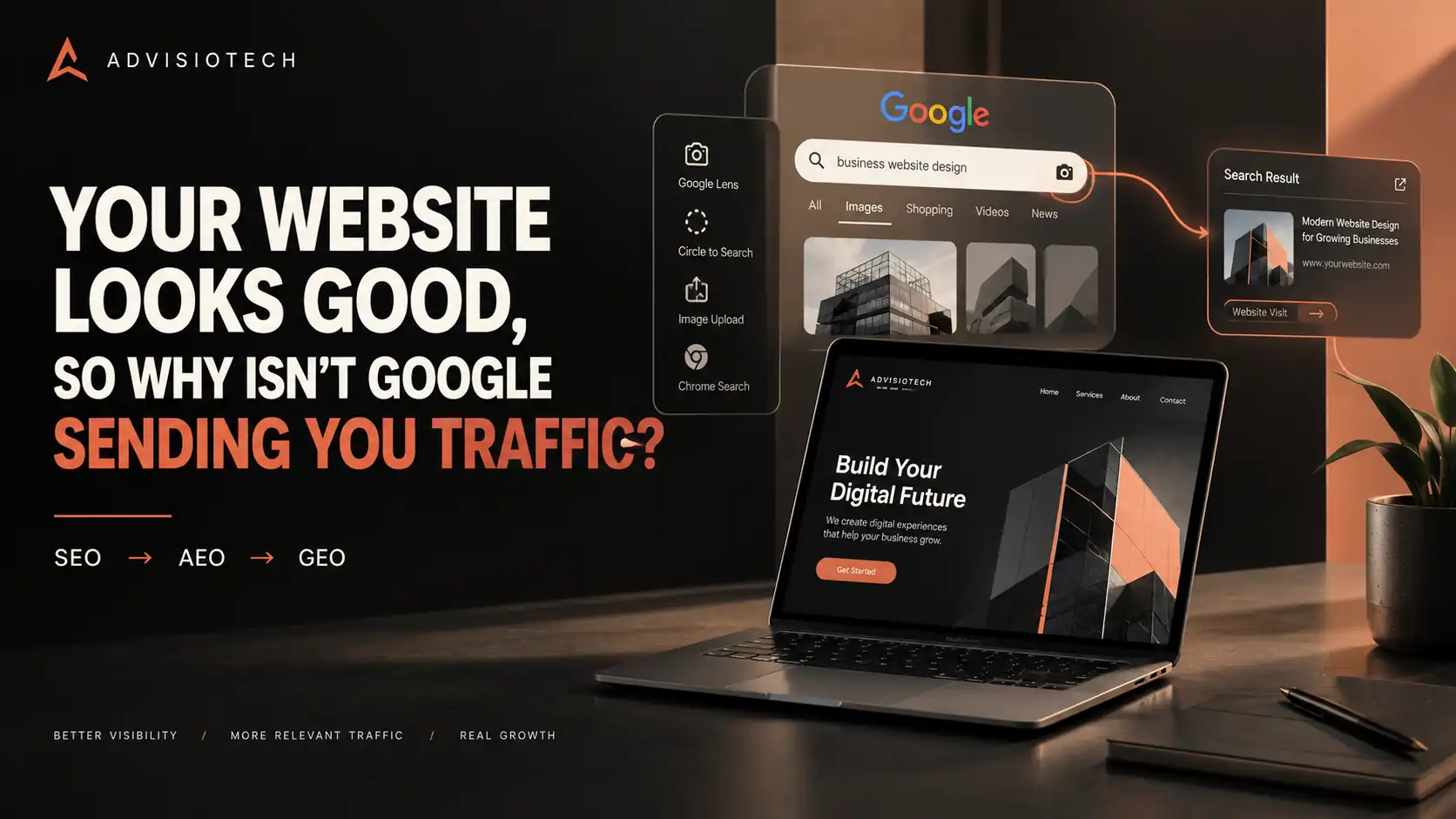
Your Website Looks Good, So Why Isn't Google Sending You Traffic?
One of the most frustrating things about launching a website is watching the analytics after everything is finished.
The website looks professional. The pages load. The business has good services. The logo looks right. The contact form works. The website is online.
And then almost nobody visits it.
This happens to businesses far more often than people realize. A website being online does not automatically make it discoverable, and looking good does not automatically make it useful for the searches that matter.
The harder question is not "Why isn't my website beautiful enough?" It is "Why would Google show this page to someone searching for what my business offers?"
That question leads to a very different SEO strategy.
A Good Website and a Searchable Website Are Not the Same Thing
Web design and search visibility solve different problems.
Design determines how a visitor experiences your website once they arrive. Search optimization helps search engines understand what your website is about, which questions your pages answer, and when those pages may be useful to searchers.
A business can therefore have an attractive website with almost no organic traffic.
Imagine a company that offers website design and digital marketing. Its homepage might say "We help businesses grow online" and contain beautiful animations, impressive graphics, and a contact button.
That sounds good to a human visitor who already knows the company.
But it may not give Google enough specific information about the questions the page can answer.
A potential customer might be searching for "website design services for small businesses," "how much does a business website cost," "SEO and website design agency," or "how to improve a business website's Google visibility."
If the website never clearly addresses those subjects, there is a gap between what the business sells and what people actually search for.
The First Problem: You May Be Targeting What You Sell Instead of What People Search
This is one of the most common mistakes businesses make.
Companies naturally write about themselves. Customers search for solutions to their problems.
A business might create a page called "Our Digital Solutions." A potential customer may never search for that phrase.
They might search for "digital marketing agency," "SEO services," "how to get more website traffic," or a much more specific question related to their situation.
This does not mean every page needs to be stuffed with keywords. It means the language on the page should naturally match the problems, questions, products, and services that people actually care about.
Before creating another article, ask a simple question: What would someone type into Google if they needed exactly what this page provides?
If you cannot answer that clearly, the page probably needs a stronger purpose.
The Second Problem: Your Pages May Be Too Similar
Another problem appears when a website has many pages that say almost the same thing.
For example, a company might publish several articles about digital marketing, SEO, online growth, AI marketing, and website marketing, but every article eventually says the same basic things.
Adding more pages does not automatically create more opportunities.
Each page should have a reason to exist.
One page might explain how SEO works. Another might answer how long SEO takes. Another might explain why a website is not getting traffic. Another could compare SEO with paid advertising.
Those pages can cover related subjects while answering different search intents.
That distinction matters because Google needs to understand what makes each page useful rather than simply seeing another version of the same article.
The Third Problem: Your Website May Not Have Enough Evidence of Expertise
A company can claim that it provides excellent services, but claims are different from evidence.
A website becomes more useful when it demonstrates what the business actually knows.
Instead of writing another generic article saying that SEO is important, show how you approach a real SEO problem. Explain what you check when a website receives impressions but no clicks. Show how you diagnose weak pages. Explain how you decide whether a page should be rewritten, consolidated, or removed.
This is where original content becomes valuable.
Your experience, observations, examples, processes, screenshots, experiments, and explanations can make an article substantially different from hundreds of generic pages that repeat the same advice.
The Fourth Problem: Google May Not Be Discovering All of Your Important Pages
Before worrying about rankings, make sure Google can actually discover and index the pages that matter.
Google Search Console is one of the first places a website owner should look when investigating this.
Look at which pages are indexed, which pages have impressions, which pages receive clicks, and whether important URLs have technical problems.
A page that cannot be properly discovered or indexed cannot build normal organic visibility in Google Search.
This is why SEO should not begin with publishing fifty new blog posts. Sometimes the most valuable improvement is fixing the pages you already have.
The Fifth Problem: You Have Content, But No Internal Connection
A website can contain useful articles and still make those articles difficult to understand as part of the larger site.
Internal links help connect related pages.
Suppose you publish an article explaining why a website is not getting Google traffic. That article could naturally link to a page explaining your SEO services, another article about Search Console, and a guide about improving website content.
The links should exist because they help the reader, not because you want to insert as many links as possible.
Over time, these relationships can also make the structure of the website clearer to search engines.
The Sixth Problem: You Are Publishing About Topics Nobody Is Looking For
This is particularly important for company blogs.
A topic can be interesting without having meaningful search demand.
This is one reason publishing only breaking technology news can produce disappointing traffic. A story may be fresh today and almost irrelevant to searchers a few weeks later.
There is nothing wrong with timely content, especially when it is genuinely useful and original. But a business blog also needs content that answers problems people continue to have.
A strong editorial strategy can combine current topics with evergreen questions.
For example, instead of only writing about the latest Google update, a business could publish an original guide explaining how to diagnose a sudden traffic drop in Search Console.
The update can become part of the explanation, while the underlying problem remains useful after the news cycle ends.
The Seventh Problem: Your Article Answers the Question Too Late
People increasingly search with complete questions.
If someone asks "Why isn't my website getting traffic?" they should not have to read six paragraphs about the history of SEO before getting an answer.
Give the reader the core answer early.
Then explain why it happens, how to diagnose it, and what to do next.
This structure is useful for humans and also makes content easier to understand when search systems need to identify the answer to a specific question.
The Eighth Problem: You Are Measuring the Wrong Thing
Traffic is important, but traffic alone does not explain what is happening.
Imagine that a page receives 1,000 impressions and only five clicks.
That tells you something very different from a page receiving twenty impressions and ten clicks.
The first page may have a visibility problem, a relevance problem, or a title and snippet problem. The second page may have strong engagement but very little exposure.
Search Console can help you separate these situations by showing impressions, clicks, click through rate, and other performance information.
The goal is to understand the problem before changing the page.
A Simple Website Traffic Diagnosis
If your website is receiving almost no Google traffic, start with five questions.
Is Google discovering and indexing the important pages?
Are those pages targeting real questions, problems, products, or services?
Does each important page provide something genuinely useful or distinctive?
Are related pages connected through useful internal links?
Are you measuring impressions and clicks separately instead of looking only at total traffic?
These questions can reveal whether your main problem is technical visibility, search intent, content quality, site structure, or simply insufficient exposure.
What Original Content Should Look Like
Original content does not mean inventing information that nobody else has ever discussed.
It means adding something of your own.
That could be a real experiment, a business example, a detailed explanation, a unique process, original screenshots, first hand observations, a comparison based on your own testing, or a clear framework that helps readers solve a problem.
For example, instead of publishing "10 SEO Tips for 2026," a digital agency could publish "We Checked Why Five Business Websites Were Getting Impressions but No Clicks, Here's What We Found."
The second idea has a much stronger opportunity to demonstrate experience because the article can contain actual observations and evidence.
That is the direction we would take if the goal is to build a durable AdvisioTech content library rather than simply fill a blog.
Where AI Fits Into This
AI can make research, outlining, editing, coding, analysis, and content production much faster.
But speed does not automatically create value.
If an AI system takes information that already exists online, changes the wording, and produces another generic article, the result may add very little for readers.
The stronger approach is to use AI as a production and research assistant while adding genuine human judgment, examples, analysis, and business experience.
That distinction is especially important when building a company website that needs to establish trust.
What We Would Fix First on a Low Traffic Website
If a website were receiving very little organic traffic, we would not immediately publish dozens of new articles.
First, we would understand what Google currently knows about the website.
Then we would identify the pages that matter commercially and make sure their purpose is clear.
After that, we would identify the questions and problems that potential customers actually search for and build content around those needs.
Finally, we would connect the content through a clear internal structure and measure what happens in Search Console over time.
The important word is over time. Search visibility is not an instant switch that turns on immediately after publishing a page.
The Bigger Lesson
A website does not get traffic simply because it exists.
It gets discovered when search engines can understand what it offers, when its pages are relevant to searches, and when the content provides enough value for those pages to deserve visibility.
That is why a beautiful website can receive almost no traffic while a much simpler website can attract thousands of visitors.
The difference is often not how the website looks.
It is what the website gives people a reason to search for, click, read, trust, and return to.
FAQ
Why is my website not getting traffic from Google?
There can be several reasons, including indexing problems, weak search intent targeting, low quality or repetitive content, limited authority, poor internal linking, technical problems, or simply not having enough relevant content for the searches you want to appear for.
How long does it take for a new website to get Google traffic?
There is no fixed timeline. Google needs to discover, crawl, understand, and evaluate pages, while the website also needs to establish relevance and visibility for particular searches. Results can vary substantially between websites and topics.
Does having a beautiful website help SEO?
Good design can improve usability and the visitor experience, but visual quality by itself does not guarantee organic search visibility. A website also needs useful content, clear information architecture, technical accessibility, and pages that satisfy relevant search intent.
Should I publish more blog posts if my website gets no traffic?
Not automatically. First determine whether the existing website has indexing, search intent, content quality, technical, or structural problems. Publishing more pages can help when those pages solve real search needs, but publishing more of the same content does not necessarily solve the underlying problem.
Does AI generated content rank on Google?
Google's guidance focuses on the quality and usefulness of content rather than treating AI involvement itself as an automatic ranking advantage or disadvantage. Content created primarily to manipulate search rankings can violate Google's spam policies, while AI can also be used as a tool in creating useful content.
What should I check first in Google Search Console?
Start with indexing and performance. Check whether important pages are indexed, whether they are receiving impressions, which queries are generating visibility, which pages receive clicks, and whether there are technical issues that need attention.
What is more important, SEO or website design?
They solve different problems. Design helps people use and trust a website once they arrive, while SEO helps the right people discover relevant pages through search. A business website benefits from both working together.
The Bottom Line
If your website looks good but Google is not sending you traffic, do not assume you need a completely new website or hundreds of new blog posts.
Start by finding the actual bottleneck.
Make sure Google can discover your important pages. Make sure those pages answer real questions. Make the content genuinely useful. Connect related information. Measure impressions and clicks. Then improve the areas where the data shows a problem.
The goal is not to create a website that simply looks good.
The goal is to create a website that gives search engines and real people a clear reason to discover it.