WhatsApp Is About to Start Charging for Messages That Used to Be Free, Here's What Changes on October 1 and What to Do Before Then
If your business uses WhatsApp's Business API to reply to customers, a change taking effect October 1, 2026 could start charging you for conversations that have always been free, and could even stop your messages from delivering if you're not prepared. Here's exactly what's changing, explained without the developer jargon.
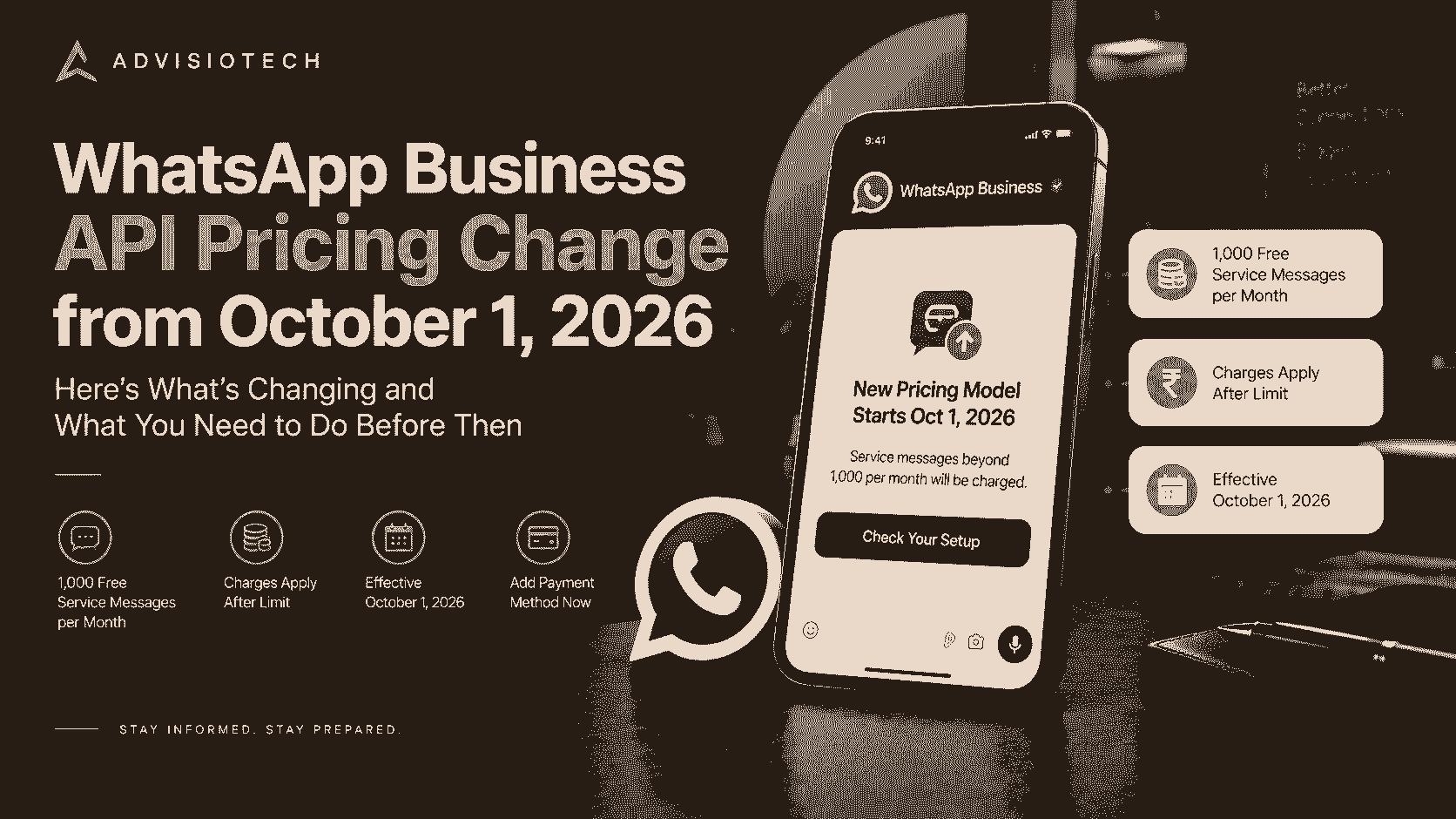
WhatsApp Is About to Start Charging for Messages That Used to Be Free, Here's What Changes on October 1 and What to Do Before Then
Here's something worth knowing if your business uses WhatsApp to talk to customers through any kind of automated system, a chatbot, a support tool, an order confirmation flow: starting October 1, 2026, Meta is changing how it charges for WhatsApp Business messaging, and it directly affects replies that have been completely free for the past two years. If you haven't heard about this yet, you're not alone, most of the coverage so far has been written for software developers, not for the business owners actually affected by it.
This is the plain-English version: what's actually changing, why it's confusing even to people who follow this closely, and what you need to check before the deadline hits.
First, a Quick Distinction That Actually Matters
This change only affects businesses using the WhatsApp Business API, sometimes called the WhatsApp Business Platform, typically accessed through a third-party provider or "Business Solution Provider" like Twilio, Gupshup, Wati, or similar tools. If you're a small business simply using the free WhatsApp Business app on your own phone to chat with customers directly, this specific change does not apply to you. It's aimed at businesses running automated systems, larger support operations, or bulk customer communication through the API.
What's Actually Changing on October 1
Since November 2024, one specific type of message, called a "service message," has been completely free with no limit. A service message is any free-form reply your business sends within a 24-hour window after a customer messages you first, things like "Let me check that order for you" or "Your package ships tomorrow." This has covered the bulk of everyday customer support conversation on WhatsApp.
Starting October 1, 2026, that changes. Each business phone number will get 1,000 free service messages per month, and every delivered service message beyond that gets charged individually, based on the recipient's country. Utility template messages sent within that same 24-hour window are also losing their free status under the new rules. There's no rollover either, unused free messages simply expire at the end of each month rather than carrying forward.
To put it simply: the free-form conversation your support team has been having with customers, at no cost, for the past two years, is about to have a meter running on it once you cross 1,000 messages in a month, for that specific number.
Why Even the Experts Are Confused
This is genuinely one of the more disorienting rollouts in recent memory, and it's not just small businesses struggling to keep up. Multiple industry sources have specifically warned that Meta's own business-facing pricing page, and several provider pages, were still describing service messages as free even in mid-September, just weeks before the change takes effect. The accurate, up-to-date information is buried in Meta's developer documentation rather than anywhere a typical business owner would think to look.
It also doesn't help that this isn't the first pricing change WhatsApp Business has gone through recently. The billing model shifted from per-conversation to per-template-message back in mid-2025, and country-specific currency billing changes have rolled out gradually since. If you found information about WhatsApp Business API pricing from even a few months ago, there's a real chance it's already outdated.
The Part That Should Actually Worry You
This isn't just a "your bill might go up" situation. According to current implementation guidance, if there's no valid payment method attached to your WhatsApp Business Account in Meta's Billing Hub once the new model kicks in, Meta may simply stop delivering service messages once you hit your free allowance, not just start charging you, but potentially cut off delivery entirely. For a business relying on WhatsApp for order updates, support replies, or time-sensitive customer communication, that's a genuinely serious risk, and one that's easy to miss if you're not the person directly managing the technical side of your WhatsApp setup.
There's also a detail worth flagging if you use any AI chatbot or automated assistant connected to WhatsApp: a reply generated by a third-party AI agent counts as a service message too, and depending on the tool, may carry an additional cost layered on top of Meta's own per-message charge.
What You Should Actually Do Before October 1
- **Confirm a valid payment method is attached to your WhatsApp Business Account in Meta's Billing Hub.** This is the single most important, time-sensitive action item, since missing this could interrupt message delivery, not just delay a bill.
- **Ask whoever manages your WhatsApp Business API, whether that's an in-house team, a freelancer, or an agency, whether they're aware of this change and have already handled the payment setup.** Don't assume it's been taken care of simply because your messages are currently working fine.
- **Get a rough sense of your monthly service message volume.** If your business handles a high volume of support conversations through WhatsApp, this is worth knowing before the meter starts running, rather than finding out from an unexpectedly large invoice.
- **Look at consolidating fragmented replies into fewer, more complete messages** where practical, since each individual delivered message counts separately under the new model, several short back-and-forth replies can add up faster than one clear, complete response.
- **If you're using WhatsApp Flows or structured forms for things like collecting order details**, these can sometimes capture information in fewer total message exchanges than a long free-form back-and-forth, which is worth exploring if cost becomes a real factor for your business.
Why This Matters Even If You're Not Technical
It's tempting to file this under "something the IT person handles," but the actual business risk sits squarely with whoever owns the customer relationship, not just whoever manages the integration. A missed payment method isn't an abstract technical oversight, it's a real possibility that your customers stop receiving order updates or support replies with no warning, right as the busy festive shopping season ramps up. Given the timing, this is worth a five-minute conversation with whoever manages your WhatsApp setup, even if that's someone else entirely.
The Bottom Line
WhatsApp's pricing changes have a genuine pattern behind them: over the past two years, Meta has steadily moved from charging per conversation, to charging per template message, to now charging for nearly every type of business message delivered through the API. October 1 is simply the next step in that pattern, but it's a meaningful one, because it touches the free-form replies that make up the bulk of everyday customer support. Whether or not the cost itself ends up being significant for your business, the real deadline that matters is getting a payment method confirmed before the change takes effect, since that's the difference between a slightly higher bill and your messages simply not going through.
FAQ
Does this pricing change affect the free WhatsApp Business app?
No. This change specifically applies to the WhatsApp Business API (also called the WhatsApp Business Platform), typically used by businesses through a third-party provider. The standard, free WhatsApp Business app used directly on a phone is not affected by this particular change.
What is a WhatsApp "service message"?
It's any free-form, non-template reply your business sends within the 24-hour window that opens after a customer messages you first, such as a support reply or an answer to a question, as opposed to a pre-approved marketing or utility template message.
How many free service messages do I get per month?
Each business phone number receives 1,000 free service messages per month starting October 1, 2026. Messages beyond that are charged individually, and unused free messages do not roll over to the next month.
What happens if I don't have a payment method set up in time?
According to current implementation guidance, Meta may stop delivering service messages once your free allowance is used if no valid payment method is on file, meaning your business could lose the ability to reply to customers through the API, not just face a delayed bill.
Does this affect messages sent within the 72-hour entry point window?
Messages sent within that specific free entry-point window generally remain free under the new model. The change primarily affects standard service replies and in-window utility template messages beyond the monthly free allowance.
Who should I talk to about making sure my business is prepared?
Whoever manages your WhatsApp Business API integration, whether an internal team, a freelance developer, or a marketing agency, should confirm a valid payment method is attached in Meta's Billing Hub before October 1, 2026.