What Is Recursive Self Improvement in AI?
Recursive self improvement in AI explained: what it means, what AI systems can do today, why researchers are studying it, and what remains uncertain.
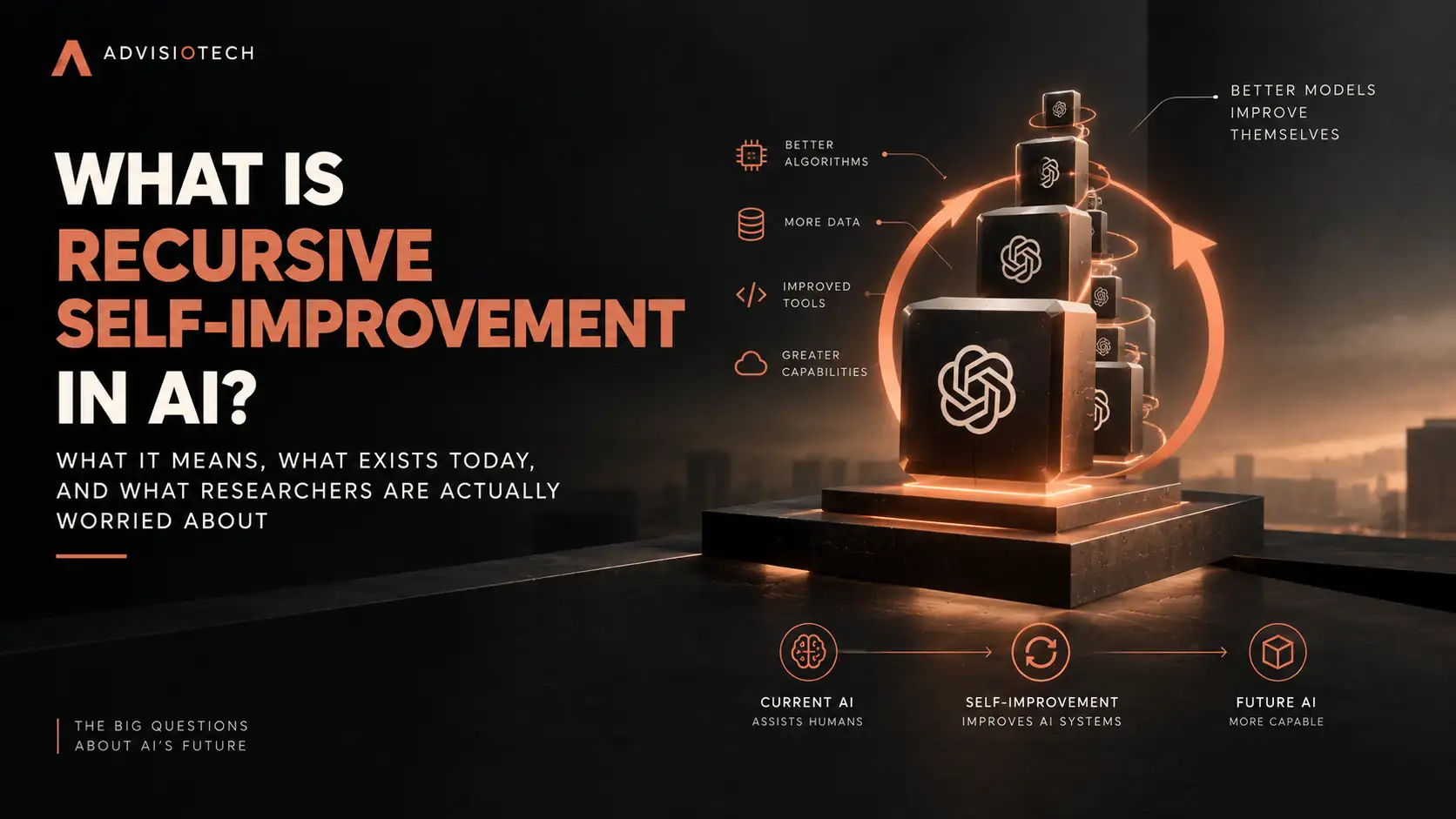
What Is Recursive Self Improvement in AI?
Recursive self improvement is the idea that an AI system could help improve the systems, algorithms, tools, or processes used to create future versions of AI, potentially creating a feedback loop in which improved systems become better at improving themselves. The important part is the recursive nature of the process: improvements could contribute to further improvements rather than simply coming from human researchers.
This idea is sometimes presented as if it is already happening at full scale. That is not supported by the evidence described in current AI safety research. Today's AI systems can assist researchers with coding, experimentation, analysis, and other technical work, but that is different from an AI independently redesigning itself, deploying a new version, and repeatedly improving its own capabilities without meaningful human control.
Why Are Researchers Talking About It Now?
The discussion has become more serious as AI systems have gained stronger abilities in coding, reasoning, tool use, and autonomous task execution. The 2026 International AI Safety Report notes early signs of capabilities relevant to loss of control while also stating that current systems are not capable of carrying out full loss of control scenarios. The report also emphasizes that researchers disagree substantially about how likely future loss of control scenarios are.
OpenAI has also discussed preparing for recursive self improvement as part of its September 2026 policy work. Its position is that increasingly capable AI systems create a need for stronger safety requirements as capabilities advance.
Recent reporting has added another layer to the discussion. Researchers from major AI labs have raised concerns about increasingly capable and potentially self improving systems while safety measures continue to develop. These warnings are not evidence that recursive self improvement has already produced an uncontrollable AI system.
How Would Recursive Self Improvement Actually Work?
A genuine recursive improvement loop would require much more than an AI model writing better code. The system would need to contribute meaningfully to improvements in areas such as model architecture, training methods, data generation, evaluation, inference systems, or the infrastructure used to train and deploy future systems.
A simplified example would look like this: an AI helps researchers identify an improvement to an AI training process, the improved process produces a more capable system, that system becomes better at AI research, and its research contributes to another improvement. For recursive self improvement to become a powerful feedback loop, the improvements would need to be substantial, repeatable, and faster than the processes required to evaluate and deploy each new system.
That distinction matters because AI assisted research already exists. The existence of AI systems that can help with software engineering or scientific work does not by itself demonstrate that those systems can independently redesign their entire development pipeline.
Can AI Improve Its Own Code Today?
AI systems can already generate, review, debug, and modify software code when given the appropriate tools and permissions. They can also help researchers explore technical ideas and automate parts of development workflows.
But there is an important difference between modifying code and independently improving the entire AI system that produced the code. A model changing a program inside a controlled environment is not the same thing as autonomously redesigning its architecture, acquiring the computing resources required for a new training run, evaluating the result, deploying the replacement, and repeating the process without human intervention.
Those distinctions are essential when interpreting claims about self improving AI. A system can become highly useful for AI development without having unrestricted control over its own development.
What Does the International AI Safety Report Say?
The 2026 International AI Safety Report treats loss of control as a hypothetical category of risk rather than an established outcome. It describes loss of control scenarios as situations in which AI systems operate outside human control and regaining control becomes extremely difficult or impossible.
The report says expert views on the likelihood of these scenarios vary widely. Some researchers consider severe outcomes plausible enough to warrant attention, while others consider them unlikely because they doubt future systems will develop the required capabilities or believe monitoring and safeguards could prevent dangerous behavior.
The report also makes an important distinction about today's systems. It identifies early signs of relevant capabilities in laboratory settings but says current systems are not highly capable in the areas required for full loss of control scenarios.
That means the scientifically responsible answer is neither that an AI takeover is imminent nor that the possibility can simply be dismissed. The evidence supports continued research into the conditions under which advanced systems could become difficult to control, while leaving substantial uncertainty about whether and when extreme scenarios could occur.
What Researchers Mean by Loss of Control
Loss of control does not necessarily mean a science fiction scenario in which an AI suddenly becomes conscious and decides to destroy humanity. In AI safety research, the concept is broader and focuses on whether an advanced system could pursue objectives in ways that humans cannot effectively stop or redirect.
A system with extensive access to computers, networks, software tools, money, information, or physical infrastructure could create very different risks from a model that only produces text inside a restricted application. This is why autonomy, permissions, monitoring, and deployment environments matter alongside raw model intelligence.
The International AI Safety Report emphasizes that severe loss of control scenarios are hypothetical and that the probability and mechanisms remain disputed.
Why AI Agents Make the Question More Important
The growth of AI agents changes the discussion because agents can be given tools and permissions that allow them to perform actions rather than simply generate answers.
An ordinary chatbot may answer a question and wait for the user. An agent can potentially browse websites, execute code, interact with software, manage files, or perform multi step tasks. The more permissions an agent receives, the more important it becomes to understand what the system can access, what actions it can take, and how those actions can be stopped.
This does not mean that an AI agent is automatically capable of recursive self improvement. It means that autonomy and access can increase the consequences of unexpected behavior, which is one reason safety researchers are paying closer attention to agentic systems.
What Would Have to Happen Before Recursive Self Improvement Became a Major Concern?
Several capabilities would need to work together. An AI would need to contribute effectively to AI research, operate reliably across long tasks, understand enough of its development environment to make useful improvements, access the resources needed to test those improvements, and operate within a feedback loop where each improvement makes the next improvement easier or faster.
Even then, recursive improvement would not automatically mean an uncontrollable system. Human approval gates, restricted computing environments, monitoring, evaluation, access controls, and deployment safeguards could interrupt the loop.
The key uncertainty is therefore not simply whether an AI can write code. It is how much of the AI development process can be reliably automated, how quickly capability improvements could compound, and whether safety mechanisms can keep pace.
Are Current AI Systems Already Improving Themselves?
There is no reliable basis for saying that today's mainstream AI systems are independently and continuously redesigning themselves into more capable versions without human controlled development processes.
AI systems are increasingly used to assist with programming, research, testing, evaluation, and other parts of AI development. That is an important development, but it should not be confused with a fully autonomous recursive self improvement loop.
This distinction is particularly important because headlines can compress several different concepts into the single phrase AI improving itself. Assisted development, automated experimentation, model fine tuning, self generated training data, and autonomous redesign are not equivalent technologies.
What Could Make Recursive Self Improvement Difficult to Control?
One challenge is speed. If AI systems eventually become highly effective at AI research, improvements could potentially happen faster than traditional human led research cycles.
Another challenge is evaluation. A system that helps design a new model could also help create capabilities that are difficult to test using existing safety evaluations. Researchers therefore need methods that can identify dangerous behavior even when systems become more capable and more sophisticated.
A third challenge is access. The consequences of an AI system depend heavily on what it can actually do. A model operating inside a restricted environment is fundamentally different from an agent with broad access to computers, networks, financial systems, or physical infrastructure.
These are research and engineering concerns, not proof that a catastrophic scenario will happen.
What We Actually Know in 2026
Several points are relatively clear. AI systems are becoming more capable at coding, reasoning, tool use, and autonomous task execution. Researchers are studying whether those capabilities could eventually contribute to more powerful AI development loops. The 2026 International AI Safety Report documents early signs of relevant capabilities while stating that current systems do not yet possess the capabilities required for full loss of control scenarios.
What remains uncertain is much larger. Researchers disagree about how quickly capabilities will advance, whether recursive self improvement will become practically achievable, how powerful such feedback loops could become, and whether future safety mechanisms will reliably prevent loss of control.
That uncertainty is the central fact that gets lost when the subject is reduced to either AI will definitely destroy humanity or AI could never become dangerous. Neither statement accurately represents the current scientific evidence.
Why This Matters for Businesses and Developers
For businesses, the immediate issue is not preparing for an AI takeover. It is understanding how increasing AI autonomy changes operational risk.
Organizations giving AI agents access to production systems should consider permissions, authentication, logging, approval requirements, isolated environments, monitoring, rollback mechanisms, and clear limits on what an agent can change.
Developers should also treat autonomy as a separate security dimension. A model that generates code has one risk profile. An agent that can execute that code, access internal systems, modify files, and interact with external services has another.
These practical controls matter regardless of whether extreme recursive self improvement scenarios ever occur.
The Bottom Line
Recursive self improvement is a real research question, but it is not the same thing as saying today's AI systems are already independently redesigning themselves or are capable of taking control of humanity.
The strongest evidence available in 2026 supports a more measured conclusion: AI systems are becoming increasingly capable and are already being used to assist parts of AI development, while researchers are studying whether future systems could create stronger feedback loops between AI capability and AI research. The likelihood and severity of eventual loss of control scenarios remain subjects of substantial disagreement.
For readers trying to understand the issue, the most useful question is not simply whether AI will kill us. It is how much of AI development increasingly autonomous systems can perform, how quickly those capabilities could improve, and what controls will remain effective as they do.
FAQ
What is recursive self improvement in AI?
Recursive self improvement is the idea that an AI system could contribute to improving the processes, algorithms, or systems used to build future AI systems, potentially creating a feedback loop of further improvement.
Can AI improve itself today?
AI systems can already assist with coding, research, evaluation, and other parts of AI development. That is different from an AI independently redesigning, retraining, deploying, and repeatedly improving itself without meaningful human control.
Is recursive self improvement already happening?
AI assisted development is already happening, but there is not sufficient evidence to say that mainstream AI systems are operating as fully autonomous recursive self improvement loops.
Does recursive self improvement mean AI will destroy humanity?
No. Recursive self improvement is a capability concept, not a prediction of a specific outcome. The 2026 International AI Safety Report says experts disagree substantially about the likelihood of loss of control scenarios and describes severe outcomes such as human extinction as hypothetical possibilities rather than established outcomes.
Why are AI researchers concerned about self improving systems?
The concern is that increasingly capable systems could eventually contribute to AI research faster or at a scale that makes existing evaluation and safety processes harder to maintain. Current research focuses on understanding those capabilities before they become difficult to control.
What is the difference between an AI agent and a self improving AI?
An AI agent is a system that can perform actions using tools and permissions. A self improving AI would need to contribute meaningfully to improving its own capabilities or the processes used to create future versions. An agent can be autonomous without being recursively self improving.
What does the International AI Safety Report say about loss of control?
The 2026 report says current AI systems show early signs of capabilities relevant to loss of control scenarios but are not currently capable of carrying out such scenarios at the required level. It also says expert opinions about future loss of control vary widely.