What Is Meta Muse? The AI Agent That Can Shop, Send Emails and Actually Do Things for You
Meta Muse is not just another AI chatbot. It is a personal AI agent designed to browse the web, complete tasks, shop online, manage information and take action on your behalf. Here's what Meta Muse is, how it works, what it can do, and why it matters.
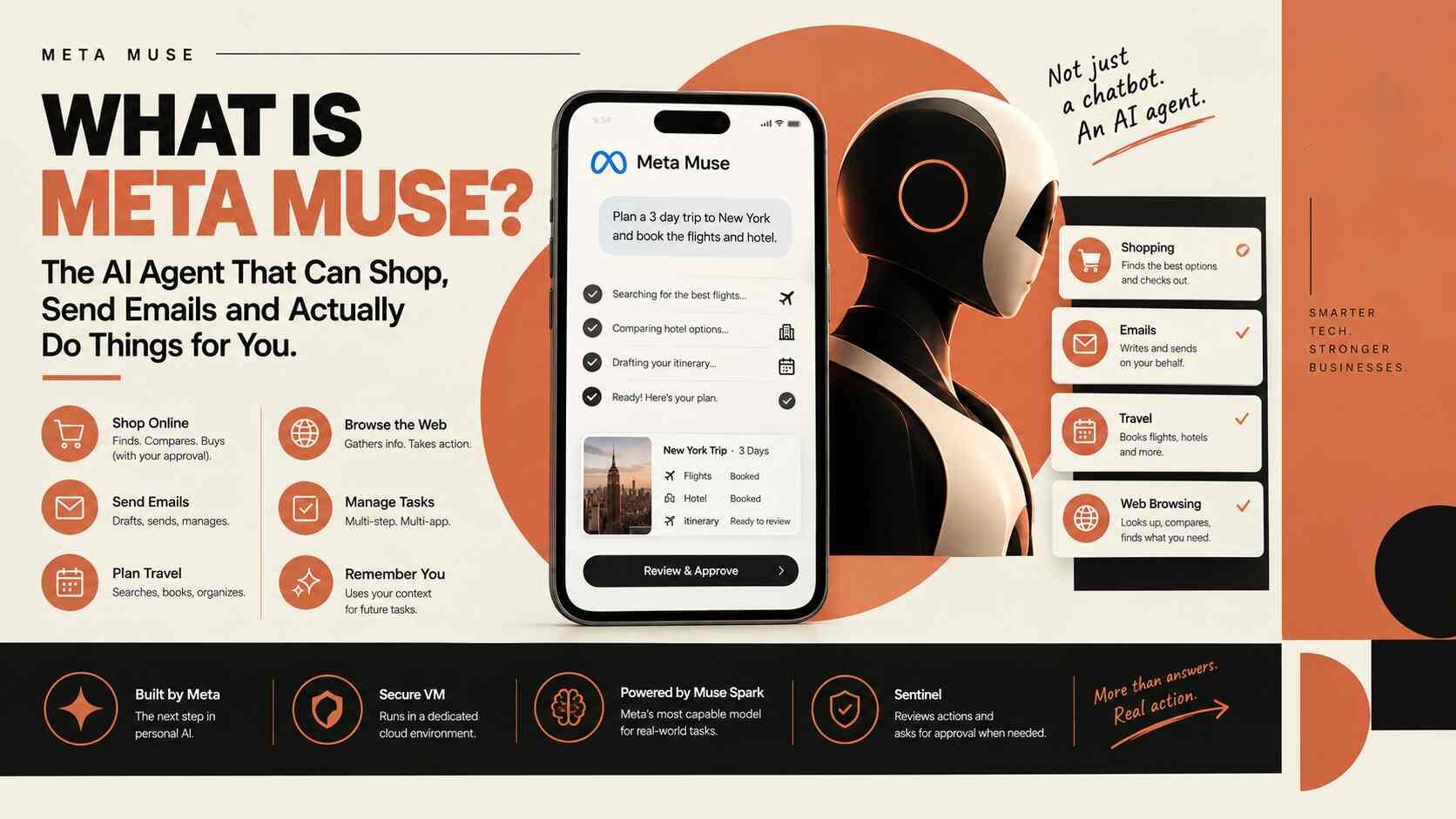
What Is Meta Muse? The AI Agent That Can Shop, Send Emails and Actually Do Things for You
If you've been hearing about Meta Muse and wondering what makes it different from ChatGPT, Gemini, or a normal AI assistant, the simplest answer is this: Muse is designed to do things, not just talk about them.
Meta introduced Muse on September 8, 2026, as a personal AI agent that can work on tasks for you. Instead of asking an AI a question and then doing everything yourself, you can give Muse a goal and let it take multiple steps toward completing it.
Muse can browse the web, fill out forms, work with connected services, send emails, help with travel, shop online, and continue working on longer tasks after you close the app. Meta says Muse can also ask for your approval before sensitive actions such as sending an email or making a purchase.
And there is already a major real-world test of what this means for the internet: Amazon has blocked Muse from shopping on Amazon.com, saying the agent was accessing its site without authorization. Meta and Amazon have different positions on how these agents should interact with websites, making Muse part of a much bigger debate about who controls the web when AI starts acting on behalf of people.
First, What Is Meta Muse?
Meta Muse is a personal AI agent created by Meta. It is designed to go beyond the traditional chatbot model, where an AI generates an answer and waits for the user to take the next step.
With Muse, the idea is different. You give it a task or a goal, and it can plan the steps required to accomplish it and carry out those steps using digital tools.
For example, instead of asking an AI, "What flights should I take to New York?", you could ask Muse to help plan the trip and take actions related to that plan.
Instead of asking how to sell a car, Muse can help work through the process itself.
Instead of asking which product you should buy, Muse can research products and, when appropriate, complete a purchase after getting your approval.
That is what makes Muse an AI agent rather than simply an AI chatbot.
How Does Meta Muse Work?
Meta says Muse runs inside something called Muse Secure VM, a dedicated virtual computer in the cloud.
The virtual machine gives Muse its own computing environment and browser. This allows the agent to interact with websites and services in a way that is closer to how a person uses a computer.
Muse is powered by Muse Spark, which Meta describes as its most capable model for real-world agentic work.
There is also a separate monitoring system called Sentinel. According to Meta, Muse cannot simply send actions to the internet whenever it wants. Sentinel reviews what Muse is attempting to do and can require user approval when necessary.
The basic idea looks like this:
- **You give Muse a goal.**
- **Muse creates a plan.**
- **Muse uses its browser and connected services.**
- **Muse performs multiple steps.**
- **Muse asks for approval when a sensitive action requires it.**
- **Muse reports what it has done.**
This changes the relationship between a person and an AI system. You are no longer necessarily telling the AI every individual step. You are giving it a goal and allowing it to figure out the path.
What Can Meta Muse Actually Do?
Meta designed Muse to handle tasks that normally require several different websites, applications, and manual actions.
According to Meta, Muse can:
- Browse websites
- Fill out online forms
- Send emails
- Help manage calendars
- Plan travel
- Research products
- Shop online
- Help with dining plans
- Work with connected services
- Build plans around longer-term goals
- Continue working on certain tasks after you close the app
Muse can also remember information that you have shared with it, allowing it to use previous context when helping with future tasks.
For example, Meta says Muse could take a recipe someone saved on Instagram, turn it into a grocery list, and use remembered information about guests' dietary restrictions when helping organize a dinner.
Is Meta Muse Just Another Chatbot?
No. The biggest difference is the ability to act.
A traditional chatbot might respond:
"Here are five products that could work for you."
An AI agent can potentially go further:
"I found five products, compared their prices, checked the options available to you, and I'm ready to place the order after you approve it."
The distinction may sound small, but it is one of the biggest changes happening in consumer AI.
Chatbots primarily produce information.
Agents can use information to perform actions.
That means an AI agent needs access to more than a language model. It needs tools, permissions, a browser or APIs, credentials, memory, and systems that allow it to actually do something.
How Does Muse Handle Payments?
Meta says Muse can use Link by Stripe for checkout. Link can generate a one-time-use card number so the user's actual card details remain hidden during eligible purchases.
Meta says Muse can also use purchase protections provided through Link for eligible transactions.
Meta has also said Shop Pay support is coming, along with 1Password support so Muse can work with logins a person already has.
This is important because AI shopping requires an agent to move from researching a product to actually completing a transaction.
Why Did Amazon Block Meta Muse?
This is where Muse suddenly became much bigger than another AI product launch.
On September 20, 2026, Amazon began blocking Muse from shopping on Amazon.com.
Amazon said it had not authorized Muse to access its marketplace and argued that third-party AI shopping agents should operate openly and respect a website's decision about whether to participate.
Amazon also raised concerns about Muse identifying itself while browsing and about how customer credentials and account information are handled.
Meta has disputed the security characterization. In its Muse launch announcement, Meta said Muse cannot see users' passwords or payment methods and that credentials users provide are stored securely so Muse can use them without seeing them.
The disagreement is important because it exposes a new problem that did not exist in quite the same form when websites were designed primarily for human visitors:
**Who gets to decide whether an AI agent is allowed to act as your representative on a website?**
Amazon says websites should be able to decide whether third-party agents are allowed. Meta has built Muse to act on behalf of the user across the web.
The answer could shape how online shopping works in the next few years.
Why Meta Muse Matters for the Internet
Muse is part of a much bigger transition from search engines and chatbots toward AI agents.
For decades, websites were designed around a simple assumption: a human visits the website, reads the information, clicks buttons, fills out forms, and completes a transaction.
AI agents challenge that model.
A person could tell an AI agent what they want, and the agent could potentially visit multiple websites, compare information, fill out forms, and complete actions without the person manually visiting every website.
That could fundamentally change how websites compete for customers.
A customer might no longer spend 30 minutes browsing ten websites.
Their AI agent could do it in the background and present them with the final options.
That means the future customer might not always be the person physically interacting with your website.
**Sometimes, the customer interface could be an AI agent.**
What Does Meta Muse Mean for Businesses?
This is where the rise of AI agents becomes particularly important for businesses.
If more consumers start using agents like Muse, businesses may need to think about whether their websites are easy for AI systems to understand and interact with.
That could include:
- Clear and structured product information
- Accurate pricing and availability data
- Machine-readable content
- Reliable APIs where appropriate
- Clear authentication systems
- Agent-friendly checkout flows
- Explicit rules for automated access
- Strong bot and security controls
- Structured business information
This is closely connected to the broader shift from traditional search engine optimization toward making information understandable and usable by AI systems.
A website may eventually need to serve two audiences at the same time: humans and AI agents.
Is Meta Muse Safe?
Meta has designed several safety mechanisms into Muse, but no AI agent should be treated as completely risk-free.
Meta says Muse runs inside a dedicated virtual machine, uses Sentinel to monitor actions, stores credentials securely, asks for approval before sensitive actions, and provides an audit trail of what it has done and plans to do.
At the same time, the Amazon dispute demonstrates why agent security is complicated. An agent can have permission from its user to perform an action while the website being accessed may not want that agent operating on its platform.
That creates a new layer of security and authorization questions that the industry is still working through.
Meta Muse vs a Normal AI Assistant
The easiest way to understand the difference is to look at what happens after you ask for something.
- **Normal AI chatbot:** Gives you an answer.
- **AI assistant:** May help you organize or understand the task.
- **AI agent:** Can potentially execute multiple steps and complete parts of the task itself.
Muse is designed around the third category.
That is why its launch matters. The important development isn't simply another AI model becoming smarter. It is the shift from AI that responds to AI that acts.
What Happens Next?
The dispute between Amazon and Meta is likely to be just one example of a much larger issue.
As AI agents become more common, websites will have to decide whether they want these agents to access their services, under what conditions, and how they should identify themselves.
At the same time, AI companies will need reliable ways for agents to authenticate, make purchases, access information, and respect the rules of the websites they interact with.
The internet was built around human users. AI agents introduce a new kind of user: software acting on behalf of a person.
How websites, AI companies, payment providers, and users handle that relationship could become one of the defining technology debates of the next few years.
The Bottom Line
Meta Muse is Meta's attempt to turn AI from something you primarily talk to into something that can actually work for you.
It can plan tasks, browse the web, fill out forms, work with connected services, help with shopping, and perform actions with user approval.
But the most interesting part of Muse may not be the product itself.
It is what happens when millions of people start sending AI agents onto the internet to act on their behalf.
Amazon's decision to block Muse shows that the web is not automatically ready for that transition.
The next phase of the internet may not simply be about websites competing for human attention.
It may be about websites learning how to interact with the AI agents acting for those humans.
FAQ
What is Meta Muse?
Meta Muse is a personal AI agent launched by Meta in September 2026. It is designed to perform tasks on a user's behalf rather than simply answer questions.
What can Meta Muse do?
Muse can browse websites, fill out forms, send emails, help with travel and dining, research products, shop online, and work on longer-term tasks.
Is Meta Muse free?
Meta says Muse is free for most everyday use, with subscription plans available for people who want additional capabilities.
Is Meta Muse available on WhatsApp?
Yes. Meta designed Muse to work through its dedicated experience and directly through WhatsApp, with availability beginning in the United States.
Can Meta Muse buy things for me?
Yes. Muse is designed to handle online shopping and can complete purchases after appropriate user approval. Meta says it can use Link by Stripe for checkout.
Why did Amazon block Meta Muse?
Amazon blocked Muse from its retail website in September 2026, saying Muse was an unauthorized third-party AI agent and that third-party shopping agents should respect a retailer's decision about whether to participate.
Can Meta Muse see my passwords?
Meta says Muse does not have visibility into users' passwords or payment methods. It says credentials are stored securely so Muse can use them without seeing them.
Is Meta Muse the same as ChatGPT?
No. Both are AI products, but Muse is specifically designed as a personal agent that can perform multi-step tasks and interact with external services on a user's behalf.
What is an AI agent?
An AI agent is a system that can use AI reasoning together with tools, applications, browsers, or other systems to perform actions rather than simply generate an answer.
Why is Meta Muse important?
Muse represents a broader shift toward AI agents that can act on behalf of users. That could change online shopping, websites, search, advertising, customer service, and how businesses design their digital platforms.