Meta Just Put an AI Agent on a Keychain, Meet Muse Charm
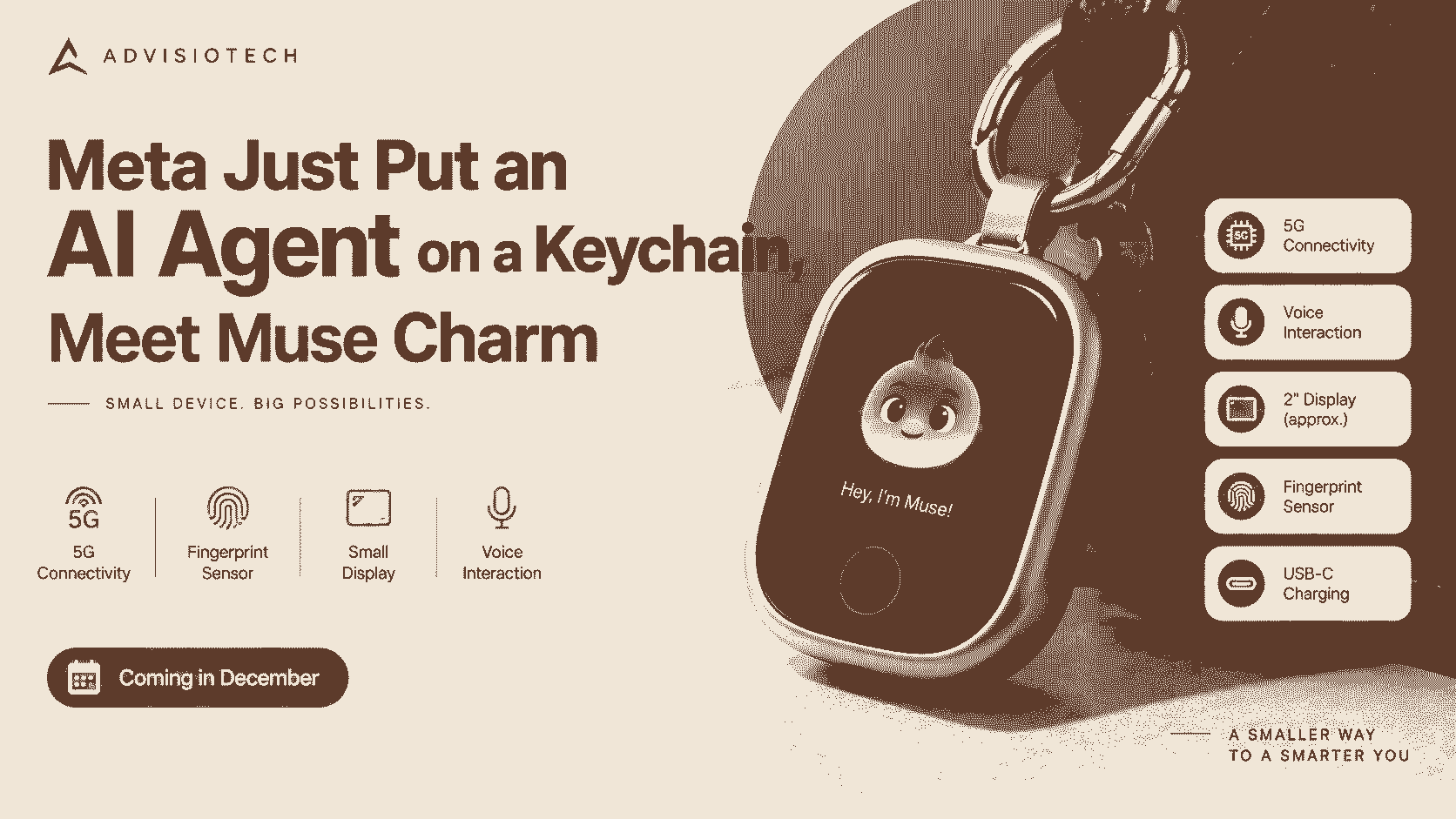
Meta just unveiled one of its strangest AI products yet: a tiny keychain-sized device built specifically to talk to its Muse AI agent. It has a small screen, 5G, a fingerprint sensor, and a virtual AI character, and Meta says it is coming in December. Here's what Muse Charm actually is, what it can do, and why Meta thinks people need a separate gadget for AI.
Meta Just Put an AI Agent on a Keychain, Meet Muse Charm
Meta has just unveiled a product that sounds like something from a 1990s toy store and a 2026 AI lab at the same time.
It's called **Muse Charm**, a tiny dedicated device designed specifically for Meta's Muse AI agent.
Mark Zuckerberg revealed the device during Meta Connect 2026, describing it as a small way to talk to Muse when you're not using your phone or wearing Meta's AI glasses. Meta says the device is planned for December, although the company has not announced its final price yet. :contentReference[oaicite:1]{index=1}
And yes, it really is designed to attach to a keychain.
So, What Exactly Is Muse Charm?
Muse Charm is a small, palm-sized device built around Meta's Muse personal AI agent.
Instead of opening an app on your phone, the idea is that you can simply pick up the Charm, interact with it, and talk to Muse.
The device has a small roughly 2-inch display that can show an animated version of your Muse character. It also includes a fingerprint sensor, microphones, speakers, USB-C charging, and an onboard 5G connection according to reporting from the Connect announcement. :contentReference[oaicite:2]{index=2}
The interesting part is that Meta isn't really trying to create another smartphone.
It is creating a physical doorway into an AI agent.
Why Does Meta Need a Separate AI Device?
This is the biggest question surrounding Muse Charm.
You can already use Muse through Meta's app and other supported interfaces, so why buy another device just to talk to the same AI?
Meta's answer is convenience.
The company wants Muse to become something you can access almost instantly instead of something you have to deliberately open.
Think about the difference between opening your phone, unlocking it, finding an app, and starting a conversation versus simply touching a device attached to your bag or keys.
The Charm is essentially designed to remove those steps.
Meta executives have described it as a dedicated and experimental device rather than the center of the company's entire AI hardware strategy. :contentReference[oaicite:3]{index=3}
Muse Is More Than a Normal Chatbot
The Charm makes more sense when you understand what Meta is trying to make Muse become.
Meta introduced Muse on September 8 as a personal AI agent rather than simply another chatbot.
According to Meta, Muse can take action on a user's behalf, including tasks such as sending emails, booking travel, researching information, and working across connected applications. It operates through a dedicated secure virtual machine that gives the agent its own computer environment. :contentReference[oaicite:4]{index=4}
That distinction matters.
A chatbot generally waits for you to ask a question and then gives you an answer.
An AI agent is designed to actually do things.
And that makes a dedicated physical interface much more interesting.
It Looks a Lot Like a Modern Tamagotchi
One of the strangest parts of Muse Charm is its appearance.
The device has a small display with an animated Muse character, giving it a look that several reports have compared to a modern Tamagotchi.
The comparison isn't completely random.
Like a Tamagotchi, the device is small, portable, visually expressive, and designed to become something you carry around rather than something you occasionally use. :contentReference[oaicite:5]{index=5}
But instead of feeding a digital pet, you're interacting with an AI agent that is supposed to help you accomplish real tasks.
What Can Muse Actually Do?
Muse's capabilities are more important than the Charm's tiny screen.
Meta says Muse is designed to work across connected services and take action on a user's behalf.
Depending on the supported service and permissions, Muse can handle things such as:
- **Sending emails**
- **Booking travel**
- **Researching information**
- **Managing tasks and projects**
- **Working with connected applications**
- **Making purchases after user approval**
Meta says users remain in control of connected services and that Muse asks for confirmation before sensitive actions such as sending an email or making a purchase. :contentReference[oaicite:6]{index=6}
That means the Charm isn't really the AI itself.
It is the physical interface for an AI that can potentially do much more elsewhere.
The Tiny Device Has 5G
One of the more interesting hardware details is connectivity.
Reporting from the announcement says Muse Charm includes an onboard 5G modem, allowing it to communicate with Muse while away from Wi-Fi. :contentReference[oaicite:7]{index=7}
That is important because Meta is trying to make the device portable.
If it required Wi-Fi everywhere, the idea of carrying it around as an always-available AI companion would become much less practical.
However, Meta has not yet finalized all of the commercial details around cellular connectivity, including how carrier fees will work. :contentReference[oaicite:8]{index=8}
Meta Hasn't Revealed the Price Yet
This is one of the biggest unanswered questions.
Meta has announced the product and says it is targeting December, but it has not finalized the consumer price. :contentReference[oaicite:9]{index=9}
That makes it difficult to judge the product as a purchase right now.
A $99 AI companion would be a very different proposition from a $399 device that also requires a cellular subscription.
Until Meta announces the price, battery life, exact availability, and other final specifications, there is still a lot we don't know.
This Is Not Meta's Main AI Strategy
It would be easy to look at Muse Charm and assume Meta wants everyone to replace their phones with a tiny AI keychain.
That doesn't appear to be the company's position.
Meta executives have described the Charm as an exploration and an early version of a new kind of device. Reporting from The Irish Times says Meta expects substantially more people to use Muse through phones and smart glasses than through a dedicated Charm. :contentReference[oaicite:10]{index=10}
That makes the Charm more interesting as an experiment.
Meta is testing whether people actually want a dedicated physical interface for an AI agent.
Why This Could Become a Bigger Idea Than the Device
The most interesting part of Muse Charm isn't necessarily the hardware.
It's the idea behind it.
For decades, computers have become easier to access by reducing the number of steps between a person and a task.
First we had desktop computers.
Then laptops.
Then smartphones put computing into our pockets.
Now companies are experimenting with AI that can understand what we want and perform tasks for us.
Muse Charm takes that idea one step further:
**What if the interface to your AI was always physically available?**
You wouldn't necessarily open an app.
You wouldn't necessarily type a prompt.
You would simply talk to it.
Meta Is Also Bringing Muse to More Hardware
Muse Charm isn't appearing alone.
Meta is also expanding its AI hardware strategy through its smart-glasses lineup.
The company has said Muse is coming to AI glasses, giving users another hands-free way to interact with the agent. :contentReference[oaicite:11]{index=11}
That creates a much bigger ecosystem.
You could potentially use Muse through your phone when you need a traditional screen, through glasses when you want hands-free interaction, and through a small dedicated device when you want quick access.
The Charm is therefore less about one gadget and more about giving the same AI agent multiple physical interfaces.
But There Is a Big Question About Privacy
An AI that can access your email, connected applications, browsing environment, and potentially purchasing systems needs considerably more trust than a normal chatbot.
Meta says Muse has been designed with permissions and security controls. According to Meta, users choose which apps Muse connects to, can change permissions, and can disconnect services. Meta also says Muse uses a dedicated secure virtual machine and asks for approval before sensitive actions. :contentReference[oaicite:12]{index=12}
Those are Meta's stated safeguards.
The larger issue remains important: the more capable AI agents become, the more valuable the permissions they receive become.
A chatbot that gives you the wrong answer is one problem.
An agent that takes the wrong action is a much different problem.
What We Still Don't Know
Despite the announcement, there are several important details that remain unclear.
- **Price:** Meta has not announced the final consumer price.
- **Battery life:** The company has not yet provided a final battery-life figure.
- **Cellular costs:** The commercial details around 5G connectivity have not been finalized.
- **Final specifications:** The hardware shown is still part of an early product rollout.
- **Availability:** Meta has said December, but exact launch markets and timing still need clarification.
That means the Muse Charm is currently easier to understand as a preview than as a product you can immediately compare against other devices.
Is Muse Charm Actually the Future of AI Devices?
It is too early to know.
The device could become a genuinely useful new interface for AI agents.
It could also become another example of technology that looks fascinating on stage but feels unnecessary once people already have the same AI on their phones.
The deciding factor may not be what the device can technically do.
It may be whether Meta can make interacting with Muse feel substantially easier than opening an app.
If it can, the Charm could demonstrate why AI agents need new interfaces.
If it can't, people may simply continue using Muse through their phones.
The Bottom Line
Meta Muse Charm is one of the strangest AI products announced at Connect 2026, but the idea behind it is more serious than its Tamagotchi-like appearance suggests.
Meta is trying to turn Muse from an AI service you open into something you can carry with you and access almost instantly.
The device has a small display, voice interaction, 5G connectivity, a fingerprint sensor, and a dedicated connection to Muse. Meta says it is targeting December, but pricing and several commercial details are still unknown. :contentReference[oaicite:13]{index=13}
The bigger story isn't really the keychain.
It's the direction AI is moving in.
**AI assistants are starting to move from apps you use to agents you interact with throughout the day.**
And Meta is betting that the next step might not be another app at all.
It might be a tiny device hanging from your keys.
FAQ
What is Meta Muse Charm?
Muse Charm is a small dedicated device designed to provide direct access to Meta's Muse AI agent without requiring users to open the Muse app on a phone.
When will Meta Muse Charm launch?
Meta says Muse Charm is planned for December 2026. The company has not yet provided a final launch date. :contentReference[oaicite:14]{index=14}
How much will Muse Charm cost?
Meta has not announced the final price yet. :contentReference[oaicite:15]{index=15}
Does Muse Charm work without a phone?
Muse Charm is designed as a dedicated device with its own connectivity, including reported 5G support, but it is also set up and synchronized through the Muse app on a smartphone. :contentReference[oaicite:16]{index=16}
What is Meta Muse?
Muse is Meta's personal AI agent introduced in September 2026. Meta says it can perform tasks such as sending emails, booking travel, researching information, and working with connected services. :contentReference[oaicite:17]{index=17}
Is Muse Charm a Tamagotchi?
No. Its design has been compared to a Tamagotchi because it has a small screen and an animated character, but Muse Charm is designed as an interface for Meta's AI agent rather than a virtual-pet product.
Can Muse make purchases?
Meta says Muse can perform sensitive actions such as purchases with user approval, depending on the connected services and permissions available. :contentReference[oaicite:18]{index=18}
Does Muse Charm have a camera?
Reports on the early device indicate that it includes camera functionality, but Meta has not yet published a complete final specification sheet for the commercial product. :contentReference[oaicite:19]{index=19}
Why did Meta make Muse Charm?
The main idea is to provide a faster, more direct physical interface for Muse. Instead of opening an app or wearing smart glasses, users can carry the dedicated device and interact with the AI directly.