Meta Just Launched Camera-Free Smart Glasses to Escape the 'Pervert Glasses' Backlash, But Does Removing the Lens Actually Fix Anything?
After months of bans, boycotts, and a nickname that made it into the Financial Times, Meta unveiled a camera-free version of its smart glasses this week. It's a genuine fork in the product line, some Meta glasses now have cameras, some don't, and it raises a real question nobody's fully answered yet: does taking away the lens actually solve the privacy problem, or just make it less visible?
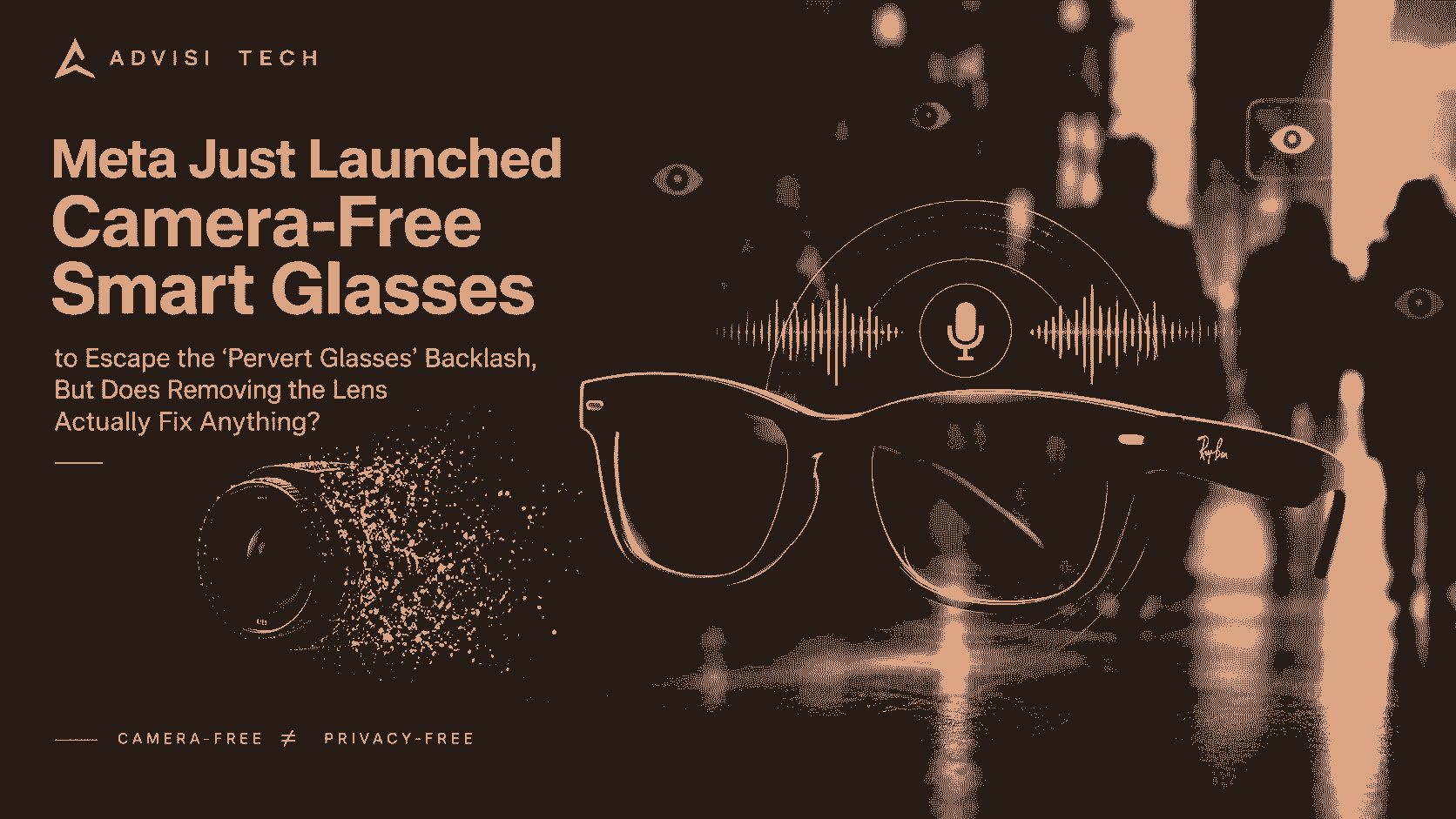
Meta Just Launched Camera-Free Smart Glasses to Escape the 'Pervert Glasses' Backlash, But Does Removing the Lens Actually Fix Anything?
Three years after Meta launched its AI-powered Ray-Ban smart glasses, the backlash against them got loud enough that even the Financial Times printed the nickname critics had settled on: "pervert glasses." This week, at its annual Connect event, Meta answered with something that would have seemed almost beside the point back when the glasses first launched: a version with no camera at all.
It's a genuinely interesting moment, not because camera-free glasses are some huge technical leap, they're not, but because of what the decision reveals about how badly the backlash actually landed, and because it opens up a real question worth sitting with: does removing the lens fix what went wrong, or does it just move the same underlying problem somewhere less visible?
How the Backlash Actually Got This Bad
The "pervert glasses" label wasn't just internet snark that stuck. Meta's camera-equipped smart glasses let wearers discreetly record video and photos of the people around them, often with only a small, easy-to-miss LED light as any visible indicator that recording was happening at all. That design made it simple to secretly film people without their knowledge or consent, and it was misused often enough that the backlash spread well beyond tech-critical circles and into mainstream press and everyday public life.
It escalated further in June 2026, when it was reported that Meta had quietly built a facial-recognition feature, internally called NameTag, into its AI app, capable of identifying people captured through the glasses' camera. More than 70 civil liberties, domestic violence prevention, LGBTQ+, and immigrant advocacy organizations, including the ACLU and the Electronic Privacy Information Center, publicly demanded Meta kill the feature entirely, arguing the risks couldn't be fixed through opt-outs or design tweaks, only by removing it.
The real-world response followed quickly. Pubs, cinema chains, comic conventions, several UK theatres, some schools, and even Faslane, the British naval base that houses the UK's nuclear submarines, all moved to ban smart glasses outright. Regulators got involved too: the Dutch Consumers' Association called for an outright EU ban on camera-equipped smart glasses as recently as September 10, just weeks before Meta's announcement.
What Meta Actually Announced
At Connect 2026, held September 23 and 24, Meta unveiled the Ray-Ban Meta Audio, its first entry into camera-free smart glasses. They keep the AI voice assistant and Meta's new personal AI agent, called Muse, reachable through six built-in microphones, along with music and call functionality, essentially positioning them as a more capable, face-worn alternative to something like AirPods. Without a camera, though, the AI loses the ability to actually see what the wearer sees, a real functional trade-off, not just a cosmetic one. The glasses start at $349 and begin shipping October 13.
Meta didn't stop at audio-only glasses. The event also included a full VR headset shaped more like an oversized pair of glasses than a traditional bulky headset, weighing around 100 grams, roughly an eighth the weight of Apple's Vision Pro, using 5K micro-OLED displays. It's priced at $1,299 and expected to ship next spring, alongside a separate $799 pair of Display glasses launching September 30, which include a small screen in one lens for notifications and basic tasks, controlled partly through a wristband that translates hand gestures into commands.
Meta has publicly insisted the camera-free glasses aren't a hasty reaction to the backlash, stating the audio-only model has actually been in development for two years. Whether or not the timing is coincidental, the launch lands squarely in the middle of the exact controversy it happens to sidestep.
So, Does This Actually Fix the Problem?
This is genuinely the more interesting question, and it doesn't have a clean answer yet. On one hand, a camera-free version of the glasses simply cannot be used for the specific kind of covert recording that caused the backlash in the first place, that's a real, meaningful difference, not just a marketing angle.
On the other hand, industry analysts have pointed out something worth sitting with: Meta hasn't discontinued its camera-equipped models. It's created a split product line, some Meta glasses now have cameras and some don't, which means the underlying product category, and the underlying trust problem, hasn't actually gone away. A stranger sitting across from you still can't easily tell, just by looking, whether the smart glasses they're wearing have a camera or not. The visible product might look reassuring, but the ambiguity that fueled a lot of the original public anxiety is still very much intact.
There's also a subtler shift buried in this launch that's arguably a bigger deal than the camera question. Even without a camera, Meta's glasses are now built around an always-listening AI voice assistant and a new personal AI agent, positioned explicitly, in Mark Zuckerberg's own words at the event, as a device meant to keep users "present in the moment while getting access to all of these AI capabilities." Swapping a camera for an always-on microphone and an AI agent that's meant to be woven into daily conversation isn't obviously a smaller privacy question, it's arguably just a different one, focused on audio rather than video.
Why This Matters Beyond Just Meta
Smart glasses are still a young enough product category that how Meta navigates this moment will likely shape how every other company building similar devices approaches privacy and design going forward. If camera-free audio glasses sell well and the backlash meaningfully cools off, expect competitors to treat that as validation that the camera itself was the core problem. If public and regulatory pressure continues regardless, it suggests the deeper concern was never really about the lens specifically, it was about wearable AI devices, generally, quietly listening, recording, and identifying the people around their wearer without those people ever agreeing to it.
The Bottom Line
Meta's camera-free glasses are a real, meaningful product change, not just a rebrand, and they'll likely take some genuine heat off a controversy that had escalated into public bans and international regulatory pressure. But they don't resolve the deeper tension driving that backlash in the first place: a fast-growing category of wearable AI devices that are, by design, built to observe, listen to, and interpret the world around the person wearing them, including everyone who never consented to being part of that interaction. Removing the camera answers one very specific complaint. It doesn't answer the broader one.
FAQ
Why were Meta's smart glasses called "pervert glasses"?
The nickname stemmed from widespread reports of people using the camera-equipped glasses to secretly record others without their knowledge or consent, with only a small, easily missed LED light indicating that recording was active.
What is the Ray-Ban Meta Audio?
It's Meta's first camera-free smart glasses model, announced at Connect 2026, featuring six built-in microphones for AI voice assistant access, music, and calls, but no camera. It starts at $349 and ships October 13.
Did Meta discontinue its camera-equipped smart glasses?
No. Meta now offers both camera-equipped and camera-free models simultaneously, creating a split product line rather than fully replacing the original design.
What was the NameTag controversy?
It refers to a facial-recognition feature reportedly built into Meta's AI app that could identify people captured through the glasses' camera, which drew strong public criticism and formal opposition from more than 70 civil liberties and advocacy organizations.
Have any places banned Meta's smart glasses?
Yes. Reported bans include various UK pubs, cinema chains, Comic-Con, several UK theatres, some schools, and Faslane, the British naval base housing the UK's nuclear submarines.
Does removing the camera fully solve the privacy concerns around smart glasses?
Not entirely, according to industry analysts. While it eliminates covert recording specifically, the glasses still function as an always-listening AI device, and Meta continues to sell camera-equipped models alongside the new camera-free ones, meaning the broader trust and consent questions remain largely unresolved.