Hollywood Is Now Training AI-Native Filmmakers, Here's Why the Next Generation of Directors May Learn AI Alongside Cinema
Hollywood is no longer treating AI filmmaking as something creators can simply figure out later. Film schools, studios, AI companies and industry organizations are building courses, fellowships and creative programs around generative AI, creating a new generation of filmmakers who understand both traditional cinema and AI-native production workflows.
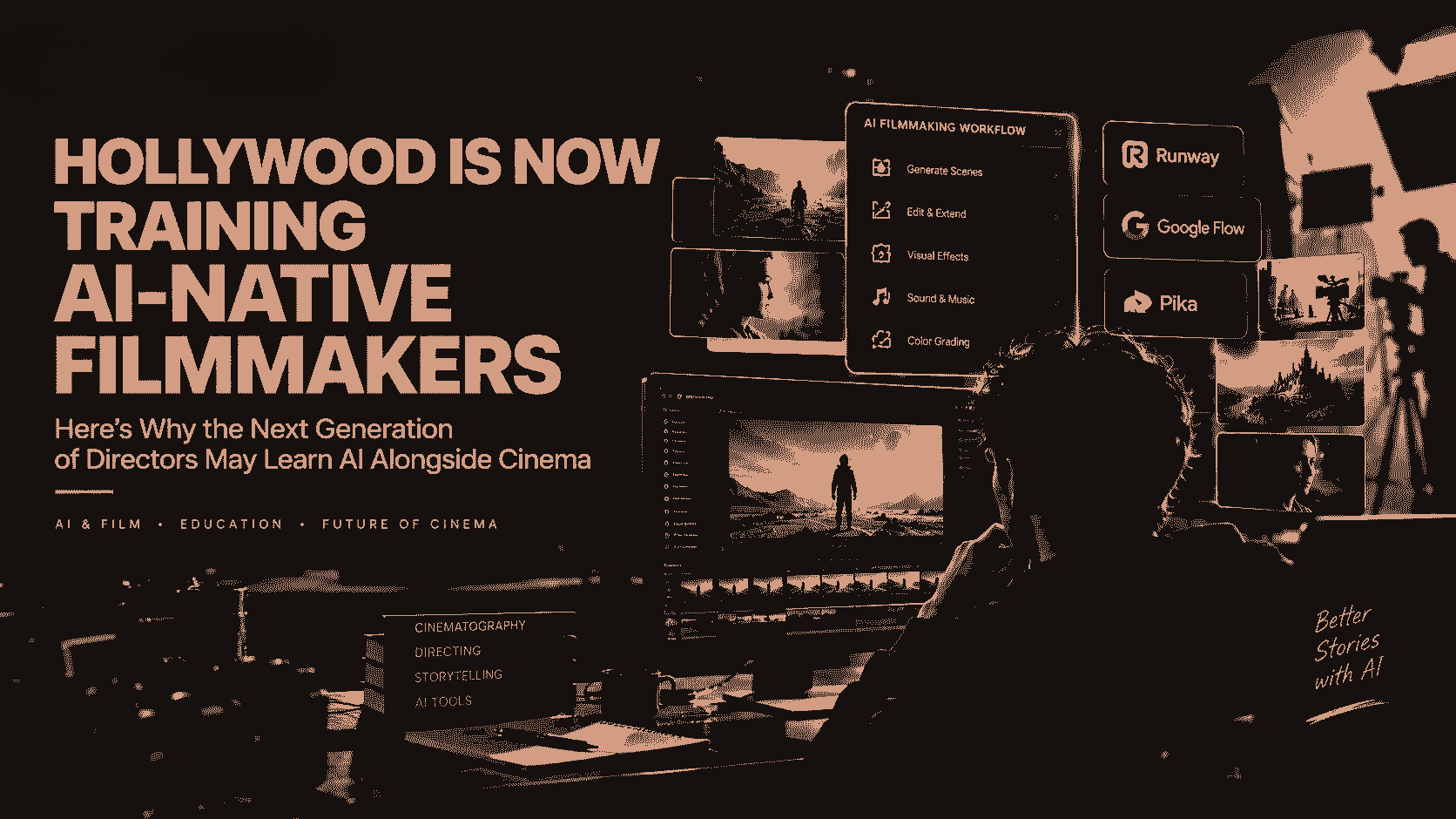
Hollywood Is Quietly Building a New Kind of Filmmaker
For decades, becoming a filmmaker meant learning the language of cinema: screenwriting, directing, cinematography, lighting, editing, sound, production design and visual effects. Now there is another layer being added to that education: artificial intelligence.
Across Hollywood and the wider film industry, filmmakers are being trained to use generative AI as part of the creative process. This is not simply about learning how to type prompts into an image or video generator. The emerging programs are teaching filmmakers how to combine traditional filmmaking knowledge with AI tools, from developing visual concepts and generating shots to maintaining character consistency, experimenting with virtual production and building new production workflows.
The shift is significant because the industry is beginning to develop something that did not exist in traditional film school: an AI-native filmmaker.
What Does "AI-Native Filmmaker" Actually Mean?
An AI-native filmmaker is not necessarily someone who makes an entire movie using AI. The more useful definition is a filmmaker who understands AI as another part of the filmmaking toolkit.
That distinction matters.
A traditional filmmaker might think in terms of a screenplay, storyboard, shot list, camera, actors, lighting setup and editing timeline. An AI-native filmmaker can think about those same elements while also understanding how to translate them into AI-assisted workflows.
- **Story development:** AI can help filmmakers brainstorm ideas, research subjects, explore variations and develop early concepts.
- **Visual development:** Directors can experiment with characters, environments, production design, lighting and visual styles before committing to expensive production work.
- **Pre-production:** AI-generated references can help communicate the intended look of a scene, location or sequence.
- **Production:** Generative video and virtual-production tools can create or modify visual material that would previously require more traditional resources.
- **Post-production:** AI can assist with editing, visual effects, sound, color and other parts of the finishing process.
The important skill is therefore not simply knowing a particular AI application. It is understanding how AI fits into the filmmaking process.
Film Schools Are Starting to Build the Pipeline
This is where the story becomes more interesting.
According to reporting by Semafor in September 2026, film schools are increasingly becoming a pipeline for filmmakers who already know how to work with AI tools. Runway CEO Cristóbal Valenzuela told Semafor that studios are increasingly asking how they can find people who already know how to use these technologies rather than having to train existing teams from scratch.
Runway launched an AI filmmaking course in 2024 at NYU's Martin Scorsese Virtual Production Center, and Semafor reported that courses using Runway's technology are now offered at institutions including USC, Rhode Island School of Design, MIT and Harvard, alongside programs in Europe and Latin America.
That does not mean AI has become a standard requirement for becoming a filmmaker. It means the education pipeline is starting to adapt to a technology that is changing quickly.
Runway Helped Turn AI Filmmaking Into Something People Could Study
Runway has been one of the companies pushing AI filmmaking education and experimentation into the mainstream creative industry.
Its AI Film Festival, launched in 2022, was explicitly created to showcase filmmakers experimenting with emerging AI techniques. Runway's 2024 festival accepted narrative and experimental films where AI-powered tools played a meaningful role in the filmmaking process, with finalists screened in New York and Los Angeles.
That is an important change in how AI filmmaking is being treated. Instead of existing only as a technology demonstration, AI-generated filmmaking is increasingly being treated as a creative discipline with its own filmmakers, festivals, educational programs and production techniques.
Google Is Training Filmmakers Too
Google has taken a similar approach with Flow, its AI filmmaking tool built around Google's generative models.
Google introduced Flow in 2025 as a filmmaking tool designed with creatives and filmmakers. The company subsequently launched Flow Sessions, a program that gives selected artists access to Flow, mentorship and AI education while they work on creative projects.
By July 2026, Google said its fourth Flow Sessions cohort had completed the six-week creative partner program and published short films created by participating artists.
The interesting part is the structure. Google is not simply releasing a video generator and walking away. It is putting filmmakers directly into the development process, observing how they work and using that interaction to understand what creative professionals actually need.
Sundance Is Taking a Different Approach
Sundance Institute is also building AI education around filmmakers, but its approach emphasizes artist choice rather than simply teaching people to use a particular commercial tool.
In January 2026, Sundance announced a three-year AI Literacy Initiative supported by Google.org. The initiative is designed to provide free educational resources and learning opportunities to filmmakers so they can make informed decisions about whether and how to use AI in their work.
Sundance also announced an AI Creators Fellowship focused on supporting artists experimenting with AI in storytelling. Its Emerging Technology Fellowship says its first year will prioritize integrating AI technologies into storytelling projects from research through post-production.
That distinction is important. The goal is not necessarily to turn every filmmaker into an AI filmmaker. It is to make sure filmmakers understand the technology well enough to decide when it belongs in their creative process.
Hollywood Is Not Starting From Zero
Another reason this shift matters is that AI is entering an industry that already has extremely sophisticated digital production workflows.
Hollywood has spent decades developing computer-generated imagery, virtual production, digital compositing, motion capture, digital doubles and increasingly sophisticated post-production pipelines.
Generative AI is therefore arriving on top of an existing technology ecosystem rather than replacing a completely analog industry overnight.
That makes the transition more complicated than the idea that AI will simply generate an entire movie from one prompt.
A professional filmmaker still needs to understand why a shot works, where the camera should be positioned, how a character should move, how continuity works, how lighting affects emotion and how an edit controls the audience's attention.
AI can generate possibilities. It does not automatically provide cinematic judgment.
The New Skill Is Controlling the AI, Not Just Using It
One of the biggest misconceptions about AI filmmaking is that the main skill is prompt writing.
In professional filmmaking, prompting is only one layer of the workflow.
A director working with generative video may need to think about character consistency, camera movement, lens characteristics, composition, lighting, location continuity, performance, pacing and how individual shots connect to one another.
This is why traditional filmmaking knowledge can actually become more valuable in an AI workflow.
For example, knowing what a 35mm lens does is useful even if the camera itself is generated. Understanding three-point lighting is useful even if the lighting is created digitally. Knowing screen direction matters even when the actor is synthetic. Understanding editing rhythm matters regardless of whether the footage came from a physical camera or a model.
The technology changes the production mechanism. The principles of visual storytelling do not disappear.
Hollywood Is Also Building AI-Native Production Companies
The education trend is happening alongside the emergence of companies that describe themselves as AI-native studios.
The 2026 Hollywood Professional Association Tech Retreat, for example, featured sessions focused on filmmaker-first AI workflows, AI-native entertainment studios, AI-assisted production and the future of professional filmmaking.
One of the featured companies was Secret Level, which describes itself as an AI-native entertainment studio. Other sessions focused on hybrid productions that combine traditional filmmaking with AI-generated elements rather than treating the two approaches as mutually exclusive.
This suggests that the industry experiment is moving beyond individual creators testing AI tools. Companies are now thinking about what an AI-native production pipeline could look like at a professional level.
The Economics Could Be Just as Important as the Technology
The biggest reason studios may care about AI-trained filmmakers is not necessarily that AI makes filmmaking easy. It is that the economics of production could change.
Traditional filmmaking often requires large teams, physical locations, equipment, travel, sets, visual-effects pipelines and lengthy post-production processes.
AI does not eliminate those costs automatically, but it can allow smaller teams to experiment with ideas that would previously have required substantially more resources.
Google's 2026 Future Vision XPRIZE is one example of this direction. Google announced a $3.5 million global film competition with XPRIZE and Range Media Partners, with AI tools such as Flow available to participants. Google said the initiative aims to lower production barriers and augment the creative process for emerging filmmakers.
That creates an interesting possibility: the number of people capable of producing convincing cinematic work could increase dramatically, even if the largest Hollywood productions continue using traditional crews and expensive physical production.
But There Is a Major Difference Between Making a Clip and Making a Movie
AI can already produce visually impressive shots. That does not mean it has solved filmmaking.
A movie is not a collection of impressive individual frames.
A feature film requires characters that remain coherent, performances that feel intentional, locations that make sense, scenes that build on one another, editing that maintains rhythm, sound that supports the story and a creative vision that remains consistent for hours.
AI-generated video still presents challenges around consistency, controllability, repeatability and production reliability. Those problems become much more important when moving from a short demonstration to a professional production pipeline.
This is exactly why AI-native filmmaking education is becoming important. The people who understand both filmmaking and the limitations of AI are better positioned to decide where the technology is useful and where traditional production remains the better option.
The Jobs Question Is Still Unresolved
The rise of AI-native filmmaking does not automatically mean traditional filmmaking jobs disappear. It does mean the skills attached to some jobs may change.
A visual-effects artist may need to understand generative tools. A storyboard artist may use AI during visual development. A director may need to supervise generated sequences. An editor may work with AI-assisted footage. A producer may need to understand the legal, technical and workflow implications of using generative content.
At the same time, the industry is still debating issues around consent, copyright, performers' rights, training data, authorship and how AI-generated material should be credited and used.
The result is likely to be a period of experimentation rather than a clean transition from human filmmaking to machine filmmaking.
Why This Matters Beyond Hollywood
The development of AI-native filmmakers is important even if you have nothing to do with movies.
The same pattern is appearing across creative industries.
Designers are learning generative image workflows. Marketers are using AI for video and campaign development. Advertisers are experimenting with synthetic production. Game developers are exploring AI-generated environments and characters. Social-media creators are using AI to produce content that previously required larger teams.
The broader lesson is that AI fluency is increasingly becoming a creative production skill rather than simply a technical skill.
The people who understand both the underlying craft and the new tools may have an advantage over people who understand only one side.
What the Next Generation of Filmmaking Education Could Look Like
The traditional film-school curriculum is built around a sequence that looks something like story, screenplay, production, cinematography, editing and distribution.
An AI-aware curriculum can add another layer to every stage.
- **Story:** How to use AI for research and ideation without surrendering authorship.
- **Screenwriting:** How AI can assist with development while the filmmaker retains narrative control.
- **Visual development:** How to build consistent characters, locations and visual references.
- **Production:** How to combine live-action, virtual production and generative footage.
- **AI direction:** How to translate cinematography and performance concepts into instructions for generative systems.
- **Post-production:** How AI can accelerate editing, effects, sound and finishing.
- **Ethics and law:** How to evaluate consent, copyright, attribution, rights and responsible use.
- **Creative judgment:** How to recognize when AI improves the work and when it simply adds noise.
That last skill may become the most important one.
The Bigger Shift: Filmmakers Are Becoming Creative Technologists
The most interesting change is not that Hollywood is learning how to generate video.
It is that the boundary between filmmaker and technologist is becoming less rigid.
The next generation of filmmakers may not think of AI as a special effect or a separate department. They may treat models, virtual cameras, generative environments, synthetic performances and traditional production equipment as different instruments inside the same creative toolkit.
That does not mean every film will be made by AI. It means filmmakers will increasingly have the option to decide which parts of production should be physical, digital, generative or some combination of all three.
The Bottom Line
Hollywood is not replacing film school with prompt engineering. Something more subtle is happening.
Film schools, AI companies, festivals, studios and industry organizations are beginning to train people who understand filmmaking and AI at the same time. Runway has built educational and festival programs around AI filmmaking. Google is using Flow Sessions to work directly with filmmakers. Sundance is developing AI literacy and fellowship programs for artists. Industry organizations are now openly discussing filmmaker-first and AI-native production workflows.
The result could be a new category of creative professional: someone who understands the grammar of cinema but is also comfortable directing machines.
The filmmakers who emerge from this transition may not be the ones who use the most AI. They may be the ones who know exactly when to use it, what to ask it to do, and when not to use it at all.
FAQ
Is Hollywood actually training AI filmmakers?
Yes, although the phrase should not be interpreted as a single Hollywood-wide training program. Film schools, AI companies, nonprofit organizations and industry groups are developing separate courses, fellowships, workshops and creative programs focused on AI-assisted filmmaking.
What is an AI-native filmmaker?
An AI-native filmmaker is generally a filmmaker who understands generative AI and related technologies as part of the creative and production workflow. The person may still use traditional cameras, actors, editors and production crews.
Which companies are teaching filmmakers to use AI?
Runway and Google are among the companies developing programs around AI filmmaking. Runway has supported AI filmmaking education and its AI Film Festival, while Google has developed Flow and its Flow Sessions program for filmmakers and other artists.
Is AI replacing film school?
No. The programs emerging today generally combine AI with existing filmmaking knowledge rather than treating traditional filmmaking as obsolete. In several programs, understanding story, cinematography, editing and production remains central to using AI effectively.
Do filmmakers need to learn AI to work in Hollywood?
AI fluency is not currently a universal requirement for filmmakers. However, the growth of AI-focused courses and production programs suggests that familiarity with AI tools is becoming an increasingly relevant skill in parts of the entertainment industry.
Can AI make an entire movie?
AI can already contribute to many parts of filmmaking, including ideation, visual development and generated video. Producing a coherent professional feature film remains much more complicated because filmmaking requires continuity, creative direction, performance, editing, sound and production decisions across an entire project.
Why are film schools teaching AI?
The technology is changing quickly, and educators are trying to prepare filmmakers to understand both its creative possibilities and its limitations. The goal varies by program, but many initiatives emphasize using AI as an additional creative tool rather than replacing human authorship.