Google Is Putting AI in Space, Here's Why It Wants Data Centers Above Earth
Google is preparing to send its AI chips into orbit as part of Project Suncatcher, an experiment exploring whether AI computing could eventually happen in space. The first prototype will test Google's TPUs against radiation, extreme temperatures, launch vibrations and the strange problem of cooling electronics in a vacuum. Here's what Google is actually trying to build.
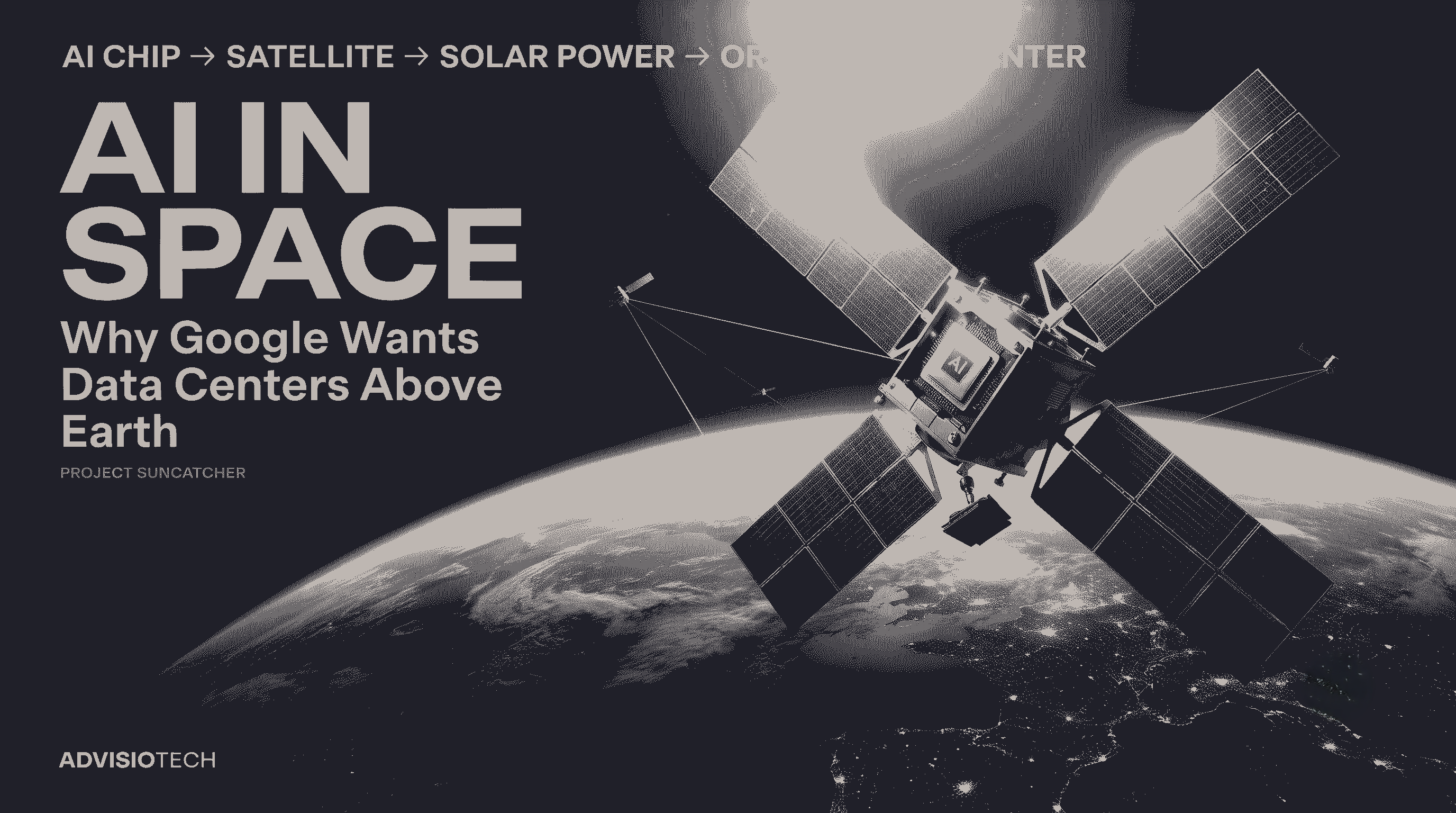
Google Is Putting AI in Space, Here's Why It Wants Data Centers Above Earth
Google is taking one of the strangest ideas in AI infrastructure and turning it into an actual space experiment.
The company is preparing to launch a prototype satellite carrying its Tensor Processing Units, or TPUs, to test whether AI computing hardware can survive and operate in orbit.
The project is called **Project Suncatcher**.
And while Google is not building a giant AI data center in space just yet, it is testing the basic technology needed to find out whether that idea could eventually work.
What Is Project Suncatcher?
Project Suncatcher is Google's long-term research project exploring whether machine-learning infrastructure could eventually be placed in low Earth orbit.
The basic idea is surprisingly simple.
Instead of putting every AI computer on Earth, Google wants to investigate whether some of that computing could happen on satellites powered by the Sun.
Google says satellites in low Earth orbit can receive near-constant sunlight and potentially generate up to eight times more solar power than solar panels on Earth.
The company is exploring whether that energy advantage could eventually make space an attractive place for large-scale AI computing.
But before Google can even think about building a real orbital AI data center, it has to answer a much simpler question:
**Can its AI chips actually survive in space?**
Google Is Starting With One Small Satellite
The first Suncatcher mission is not a massive orbital data center.
It is a prototype satellite designed to collect real-world data about how Google's AI hardware performs in space.
The satellite is scheduled to fly on SpaceX's Transporter-18 rideshare mission, with Planet involved in the spacecraft development.
Google plans to use the mission to study how its TPUs handle radiation, launch vibrations and the thermal environment of space.
This is essentially Google's first real-world experiment before attempting anything much larger.
Why Put AI in Space?
The biggest reason is energy.
AI data centers on Earth require enormous amounts of electricity.
As AI models become larger and companies deploy more AI services, the amount of computing infrastructure required continues to increase.
Space offers one unusual advantage: sunlight is available for much of the time in the right orbit.
Google's long-term concept involves satellites equipped with AI processors and connected to one another through high-bandwidth laser links.
Instead of one enormous data center sitting on the ground, the future system could potentially consist of many smaller satellites working together.
That is still a research concept, not an operational Google service.
The First Problem: Can the Chips Survive the Launch?
Getting AI hardware into space is not as simple as putting a computer inside a satellite.
A rocket launch subjects hardware to intense vibration and acceleration.
Google says the spacecraft can experience forces of up to around 10 times Earth's gravity during launch, while individual components can experience much higher forces.
The company has already performed vibration testing by shaking the satellite hardware along multiple axes to simulate launch conditions.
The first orbital mission will provide the real-world test.
The Second Problem: Radiation
Space is filled with radiation that can interfere with electronic hardware.
High-energy particles can cause errors in computer memory and calculations, including what engineers call bit flips.
Google tested its Trillium TPUs using proton radiation at UC Davis's Crocker Nuclear Laboratory.
The company says its initial tests showed the TPUs could withstand a radiation dose greater than what they would be expected to receive during a five-year space mission.
But laboratory testing can only go so far.
The actual satellite mission will give Google data about how the hardware behaves in orbit.
The Weirdest Problem: Cooling AI in Space
This might be the most interesting engineering problem in the entire project.
AI chips generate a lot of heat.
On Earth, data centers can use fans, air conditioning, liquid cooling and other systems to move that heat away from processors.
Space does not work like that.
There is no normal airflow in a vacuum.
That means Google cannot simply put a fan next to its TPU and expect the heat to disappear.
Instead, the company is testing a system involving heat pipes and radiators that can transfer heat away from the chips and release it as thermal radiation.
Google has already tested its cooling system inside a thermal vacuum chamber designed to reproduce the conditions of space.
The upcoming mission will show how well that system works outside the laboratory.
Google's AI Won't Run Forever on the First Satellite
The first prototype is not designed to operate like a normal Earth-based AI data center.
According to reporting on the mission, the cooling system is expected to allow the TPUs to run in short periods before the hardware needs time to cool down.
That is another reason this mission should be viewed as an engineering experiment rather than a finished orbital data center.
Google first needs to understand what works, what fails and what needs to be redesigned.
What Will Google Actually Run in Space?
Google says its TPUs will be used for AI workloads during the experiment.
The company is testing whether its existing AI hardware can perform computing tasks under real orbital conditions.
The goal is not to send a complete Gemini data center into space next week.
The goal is to learn whether the underlying hardware and infrastructure can work well enough to make a larger system possible.
Google Has Bigger Plans for 2027
The first satellite is only the beginning of the experiment.
Google's longer-term research involves multiple satellites working together.
The company plans to test inter-satellite connectivity using two satellites in 2027.
The idea is to connect computing satellites using high-bandwidth optical, or laser, links.
If that technology works, multiple satellites could potentially operate as a distributed computing system.
That would be a much bigger step toward Google's vision of scalable AI infrastructure in orbit.
This Is Not a Space Data Center Yet
This distinction is important.
Google is not announcing that it has solved the problem of building data centers in space.
Project Suncatcher is still a research moonshot.
The first mission is designed to answer fundamental engineering questions before Google attempts to scale the concept.
There are still major problems involving cooling, radiation, hardware reliability, communication, launch costs, maintenance and the economics of operating computing infrastructure in orbit.
A successful test would not automatically mean that commercial AI data centers will soon move into space.
It would simply give Google more information about whether the idea is technically feasible.
Why Google Thinks Space Could Be Useful for AI
There is a bigger reason companies are thinking about orbital computing now.
AI requires enormous amounts of computing power.
That means companies need more chips, more electricity and more infrastructure.
Traditional data centers have physical limits.
They need land, electricity, cooling systems and large amounts of supporting infrastructure.
Space potentially offers a different environment.
There is abundant sunlight, no shortage of physical space in orbit and the possibility of building modular satellite clusters instead of a single enormous facility.
But those advantages come with completely different engineering problems.
The Biggest Question Is Still Cost
Even if Google proves that TPUs can survive in orbit, there is another question that may be much harder:
**Would it actually be cheaper or more practical than building AI infrastructure on Earth?**
Launching hardware into orbit is expensive.
Replacing or repairing hardware in space is difficult.
Communication between satellites introduces latency and engineering challenges.
And every satellite has to survive an environment that is far less forgiving than a normal data center.
Google will need to solve those problems before Suncatcher could become anything more than an interesting experiment.
Why This Is Interesting for the AI Industry
AI infrastructure is becoming a major engineering problem.
Companies are no longer competing only on models and applications.
They are also competing on chips, electricity, cooling, data centers and ways to build enough computing capacity to support increasingly demanding AI systems.
Project Suncatcher shows how far that infrastructure race could eventually go.
The question is no longer simply:
"How do we build a bigger AI data center?"
It is becoming:
"Where should the next AI data center actually exist?"
What Happens Next?
The immediate milestone is Google's first orbital test.
The company wants to collect real-world information about radiation, vibration, thermal performance and the behavior of its AI hardware in orbit.
The next major step is expected to involve testing multiple satellites and laser-based communication in 2027.
If those experiments work, Google could have evidence that its basic concept is technically possible.
But even then, commercial-scale orbital AI computing would still be years away.
The Bigger Picture
Project Suncatcher sounds like science fiction because, in many ways, it is an experiment in turning a science-fiction idea into engineering reality.
Google is taking AI chips normally used inside terrestrial data centers and putting them into orbit to see what happens.
The company is not promising that AI data centers will move into space tomorrow.
It is simply testing whether the idea is worth pursuing.
And that may be the most interesting part.
The future of AI infrastructure could eventually involve much more than buildings filled with servers.
It could involve networks of satellites, solar power and AI processors operating hundreds of kilometers above Earth.
For now, Google is just trying to find out whether the first chip can survive the trip.
The Bottom Line
Google's Project Suncatcher is an early experiment to determine whether AI computing hardware can operate in space.
The first prototype satellite will test Google's TPUs against radiation, launch forces and the unusual cooling requirements of operating powerful processors in a vacuum.
Google's long-term vision is much bigger: interconnected solar-powered satellites that could potentially handle AI workloads in orbit.
That vision is still far from reality.
**But if Google's experiments work, the future of AI infrastructure might not be limited to Earth.**
FAQ
What is Google's Project Suncatcher?
Project Suncatcher is Google's research project exploring whether scalable machine-learning infrastructure could eventually operate in low Earth orbit using solar-powered satellites equipped with Google's TPUs.
Is Google building an AI data center in space?
Not yet. The current mission is an experimental prototype designed to test whether Google's AI hardware can survive and operate in space.
When will Google's Suncatcher satellite launch?
Google's first prototype mission is planned for the Transporter-18 rideshare mission, currently scheduled for October 1, 2026. Launch schedules can change.
Why does Google want AI in space?
One major reason is access to sunlight. Google says satellites in suitable low Earth orbits can receive near-constant sunlight and potentially generate substantially more solar power than comparable solar panels on Earth.
How will Google cool AI chips in space?
Because conventional airflow-based cooling does not work in a vacuum, Google is testing heat pipes and radiators to move heat away from the TPUs and release it into space.
What are Google's biggest challenges with AI in space?
The major challenges include surviving launch vibrations, radiation, managing heat in a vacuum, communicating between satellites, maintaining hardware and determining whether orbital computing can make economic sense.
Will Gemini run in space?
Google says the TPUs will perform AI workloads during the test. Reporting on the mission says Gemini models are expected to be used during testing, but this should not be confused with a full Gemini data center operating in orbit.
Is Google the only company thinking about AI data centers in space?
No. Space-based computing is being explored by multiple companies and researchers, but Google's Project Suncatcher is one of the most concrete efforts because Google is moving toward an actual in-orbit hardware test.
When could AI data centers actually operate in space?
There is no confirmed commercial timeline. Google's current work is still experimental, with a first prototype mission followed by planned multi-satellite testing in 2027.