Google Just Let Shoppers Buy Flipkart Products Without Leaving Gemini, Here's What That Actually Means If You Sell Online
Google has started testing a Buy button inside Gemini and AI Mode that takes Indian shoppers straight into Flipkart checkout, no website visit required. Everyone's covering what this means for shoppers. Almost nobody's covering what it means for the sellers whose products show up, or don't, in that AI-powered checkout flow.
Google Just Let Shoppers Buy Flipkart Products Without Leaving Gemini, Here's What That Actually Means If You Sell Online
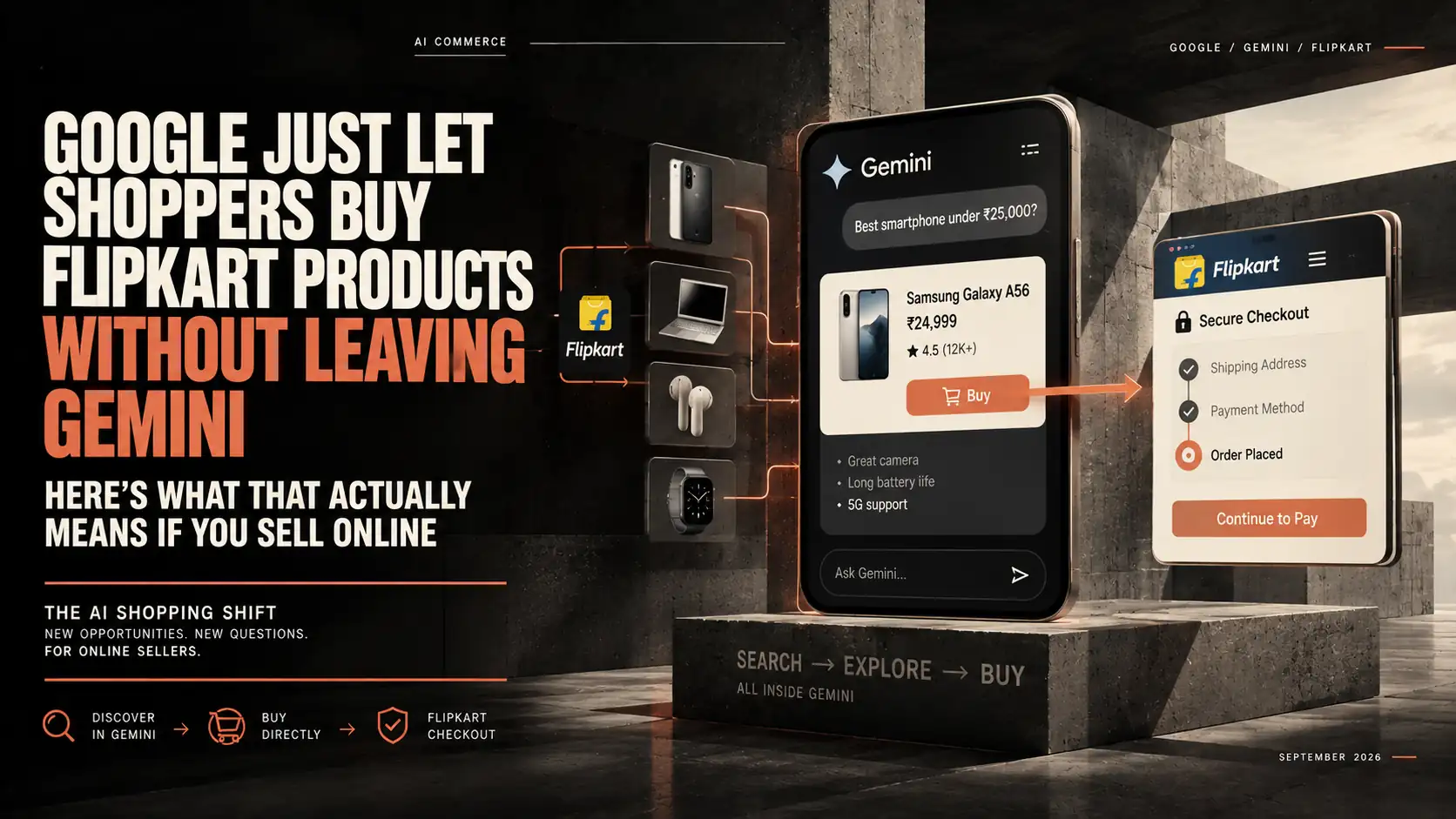
Google has quietly started testing something that's been theoretical for most of this year and just became very real: letting Indian shoppers buy products from Flipkart directly inside Gemini and Google's AI Mode, without ever opening Flipkart's app or website. Tap a "Buy" button on a product Gemini shows you, and you're dropped straight into Flipkart's checkout flow, right there inside the AI conversation.
This has already been widely reported as a shopper-facing story, and it is one. But there's a more important question buried underneath it for anyone who actually sells products online: if AI assistants are becoming a checkout counter, not just a search engine, what determines whether your products even show up there at all?
What Google Actually Launched
According to reporting from TechCrunch, the test is currently limited to a small group of users and a narrow set of product categories, smartphones, electronics, and mobile accessories. Selected shoppers see a "Buy" button appear directly on certain Flipkart product listings inside Gemini and AI Mode. Tapping it takes them into a Flipkart-branded checkout flow without leaving Google's interface entirely.
Google has said it plans to expand this more broadly in October, timed deliberately ahead of India's major festive shopping season, when e-commerce spending spikes sharply around Diwali. A notable detail: in the version reporters were shown, Amazon products also appeared in the same Gemini and AI Mode results, but without the same direct-buy option, only Flipkart listings currently carry it.
This builds on something Google introduced earlier this year called the Universal Commerce Protocol, an open standard designed to let AI agents interact directly with retailers throughout a shopping journey, including completing checkout. Google has described Flipkart as one of its partners in India for building what it calls "agentic" shopping experiences.
Why Amazon Doesn't Have the Same Button (For Now)
The most telling detail in all of this isn't the feature itself, it's who has access to it. Google holds an existing financial relationship with Flipkart, having invested roughly $350 million as part of a Walmart-led funding round in 2024, alongside a deeper technology partnership. That relationship appears to be exactly why Flipkart, not Amazon or any other Indian marketplace, is the one currently wired into this experience.
That's a genuinely important signal for anyone selling online: as AI shopping assistants start making actual purchase decisions on a customer's behalf, which retailer partnerships and technical integrations a platform has quietly built may end up mattering as much as, or more than, how good your product listing actually is.
What This Actually Means If You Sell Products Online
This is the part almost none of the current coverage is addressing, and it's worth sitting with for a moment.
**If your products are listed on Flipkart**, this is genuinely good news, potentially. A shopper using Gemini to research a purchase can now go from "comparing options" to "bought it" without ever leaving the AI conversation, which removes real friction that used to cost sellers conversions. But it also means the AI itself is now making a judgment call about which specific listings are worth surfacing with a direct buy option at all, not every product on Flipkart is described as getting this treatment in the current test.
**If your products are only on Amazon or another platform**, this is worth watching closely rather than ignoring. If Google continues expanding checkout-enabled AI shopping specifically through partnered platforms, sellers who only distribute through non-partnered marketplaces could find themselves at a structural disadvantage in AI-driven shopping, regardless of how good their actual product or reviews are.
**If you run your own independent online store**, this is arguably the most important signal of all. It's a concrete, real-world example of something already discussed in the context of AI search more broadly: AI assistants are increasingly not just recommending where to buy something, they're becoming the actual point of purchase. A product that isn't clearly, accurately described in a way AI systems can confidently understand and surface risks becoming invisible at exactly the moment a customer is ready to buy, not just when they're researching.
The Bigger Pattern This Confirms
This test is a real, concrete data point in a shift that's been building all year: AI platforms moving from simply answering questions to actually completing transactions on a user's behalf. It's the same underlying shift behind Google's broader Universal Commerce Protocol push, and it mirrors similar moves already happening with AI agents and shopping more broadly across the industry. What Google's Flipkart test adds is a live, visible example of exactly how uneven that transition can be, some sellers get the shortcut to checkout, others don't, based on partnerships that have nothing to do with product quality.
What Sellers Should Actually Do Right Now
- **Make sure your product listings, wherever they live, are genuinely clear and complete.** Accurate titles, specific descriptions, and complete category tagging matter more, not less, as AI systems increasingly decide what to surface.
- **Don't assume being on one major platform is enough.** If AI-driven checkout continues expanding through specific partnerships, having a presence across multiple channels, including your own website, reduces the risk of being structurally excluded from an AI-powered shopping flow you have no control over.
- **Watch how this test expands in October.** Since Google has explicitly tied the wider rollout to festive shopping season, any seller relying heavily on Diwali-period sales should track this closely rather than finding out about it after the fact.
The Bottom Line
The shopper-facing story here, tap a button, buy a phone, never leave the chat, is genuinely convenient and easy to understand. The seller-facing story is the one that actually matters for the future of online retail: a major AI platform is now making real, live decisions about which products get a frictionless path to purchase and which don't, based on partnerships happening well above any individual seller's control. That's worth paying attention to now, while this is still a small, limited test, rather than after it's already reshaped how a meaningful share of online shopping happens in India.
FAQ
What is Google's Flipkart checkout test in Gemini?
Google is testing a "Buy" button on select Flipkart product listings shown inside Gemini and Google's AI Mode, which takes shoppers directly into a Flipkart checkout flow without leaving the AI interface. The test is currently limited to select users and product categories like smartphones and electronics.
Why does Flipkart have this feature but not Amazon?
Google holds a financial and technology partnership with Flipkart, including a roughly $350 million investment in 2024. Amazon listings currently appear in the same Gemini and AI Mode results without the direct checkout option.
When will this roll out more broadly?
Google has indicated it plans to expand the feature later in October 2026, timed ahead of India's major festive shopping season.
What is Google's Universal Commerce Protocol?
It's an open standard Google introduced to let AI agents interact directly with retailers throughout the shopping journey, including completing checkout, forming the underlying technology approach behind features like this Flipkart test.
Does this affect sellers who aren't on Flipkart?
Potentially, yes. If AI-driven checkout continues expanding primarily through specific retailer partnerships rather than uniformly across all platforms, sellers outside those partnerships could see reduced visibility in AI-powered shopping experiences, regardless of product quality.
What should online sellers do in response to this trend?
Maintain clear, accurate, and complete product listings across every platform you sell on, avoid relying on a single marketplace, and monitor how AI-driven shopping features expand, particularly around high-volume periods like festive shopping season.