Google Business Profile's Q&A Is Gone, Replaced by an AI Called Ask Maps, Here's Everything You Need to Know to Still Get Found
If the "Ask a Question" button vanished from your Google Business Profile, you're not imagining it, Google quietly shut it down and replaced it with an AI called Ask Maps that now answers customer questions about your business on its own. Here's the complete picture: what changed, how the AI actually decides what to say, and exactly what to do about it.
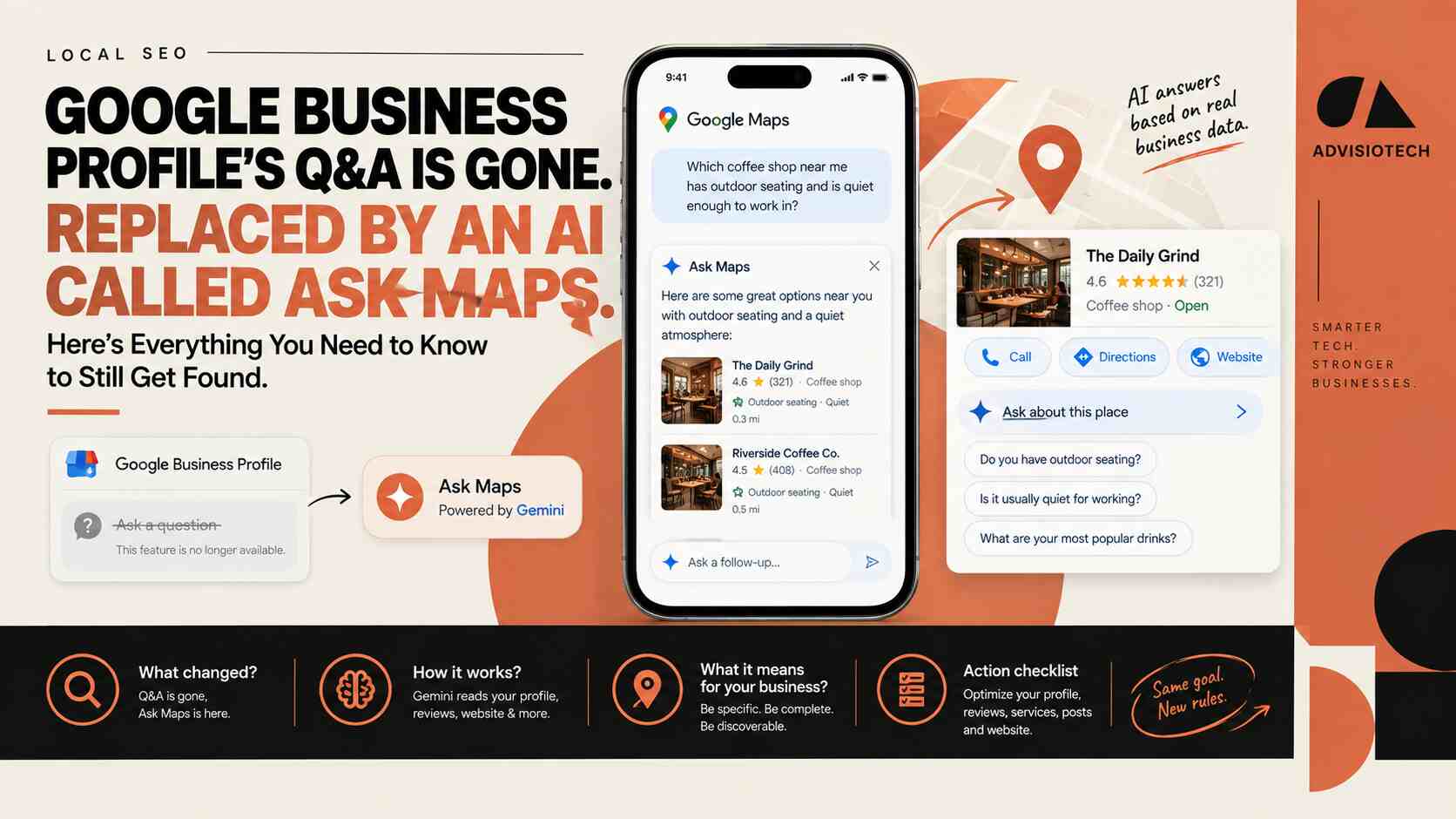
Google Business Profile's Q&A Is Gone, Replaced by an AI Called Ask Maps, Here's Everything You Need to Know to Still Get Found
If you've logged into your Google Business Profile recently looking for the "Ask a Question" button and come up empty, you're not losing your mind, and you're not alone. Business owners have been flooding Google's own support forums with confused, slightly panicked threads asking where it went. Here's the full, complete picture of what actually happened, because most of what's out there only tells part of the story.
First: What Actually Happened to Q&A
Google officially discontinued the Q&A API on November 3, 2025, after announcing the change roughly two months earlier. Since then, the feature has been gradually disappearing from business listings across the platform. If you already had questions and answers on your profile, some of that content may still be visible for now, but it's frozen. You can no longer add new questions, and if your listing is newer, you likely never had access to the feature at all.
For years, this was a genuinely useful, quietly powerful local SEO tool. Business owners could post their own frequently asked questions and answer them directly, seeding their profile with keyword-rich, helpful content that showed up right where customers were already looking. That entire lever is gone now.
What Replaced It: Meet Ask Maps
Google didn't remove Q&A and leave a gap. It replaced it with something considerably bigger. On March 12, 2026, Google launched Ask Maps, a conversational AI feature built directly into Google Maps and powered by Gemini, Google's AI model family.
Instead of typing a short keyword like "coffee near me" and scrolling through a list, users can now ask full, natural-language questions, things like "which coffee shop near me has outdoor seating and is quiet enough to work in" or "is there a place nearby that's open late and takes walk-ins." Ask Maps responds with a direct, synthesized answer, not a list of links, connected to an actual customized map, and it remembers context, so you can ask a natural follow-up question afterward without starting over.
According to Google, Ask Maps draws on information from more than 300 million places and reviews from over 500 million contributors, alongside broader web information, to generate these answers. There's also a related, slightly different feature worth knowing about: inside the Google Maps app itself, tapping on a specific place and invoking Gemini brings up an "Ask about place" option, letting you ask Gemini detailed questions about that one specific business, like menu details or how to get there, pulling directly from that listing's data.
So How Does Ask Maps Actually Decide What to Say About Your Business?
This is the part that matters most if you run a business, and it's also the part most existing coverage only partially explains. Google hasn't published an exact formula for how heavily each factor is weighted, but based on how the system behaves and what's been observed since launch, a consistent picture has emerged of what it actually reads:
- **Your Google Business Profile itself**: hours, categories, attributes, service areas, and how complete and accurate it is overall.
- **Your reviews, in real detail, not just star ratings.** This is one of the most important and most overlooked pieces. A review that simply says "great service, highly recommend" gives the AI almost nothing usable to work with. A review that says something specific, mentioning same-day availability, easy parking, or a particular product by name, becomes something the AI can actually pull from and cite when someone asks a related question.
- **Your Products or Services tab.** This is reportedly one of the most underused parts of a profile right now. When someone asks Ask Maps something like "does anywhere nearby sell X" or "which local shop offers Y," Google appears to pull directly from this section. It's not just for retail either, a law firm can list flat-fee service packages as products, a salon can list its menu with prices, a contractor can list specific service types, all of it becomes usable data the AI can reference.
- **Your photos**, which help verify and support claims made in reviews or your profile description.
- **Your website**, particularly if it has clear, structured, accurate information, especially anywhere your site and your Google Business Profile might otherwise say slightly different things.
The Single Most Important Shift to Understand
Before Ask Maps, your Business Profile was essentially something a customer looked at directly. Now, it's more accurate to think of it as a source Gemini reads from behind the scenes to decide whether to mention you at all, and what to say if it does. If someone asks Ask Maps for a plumber who offers same-day service, the AI is actively scanning for reviews and profile details that specifically mention same-day service, quick response times, or that kind of urgency, not just checking whether your business category says "plumber."
That's a fundamentally different game than traditional local SEO. Ranking well used to mean matching the right keywords and categories. Increasingly, it means having enough specific, real, detailed content about your business floating around for an AI to confidently pull from and quote.
What You Should Actually Do About It
Based on everything currently known about how Ask Maps pulls information, here's a practical checklist:
- **Stop trying to bring back Q&A.** It's gone, and no setting or workaround restores it. Redirect that energy instead.
- **Move your best Q&A-style content to your website as a proper FAQ, with schema markup.** If a customer used to ask something in your GBP Q&A, that same question and answer belongs clearly on your site now, close to the relevant service page, not buried on a generic FAQ page.
- **Fill out your Products or Services tab properly, even if you're not a retail business.** List specific packages, services, or offerings with real names and prices where possible, rather than leaving it empty or generic.
- **Actively guide better reviews, without writing them yourself.** You can't write a customer's review for them, but you can prompt for detail. A simple ask like "let us know what specifically stood out about your visit" tends to produce far more useful, specific reviews than a generic request for a rating.
- **Use Google Posts consistently.** With Q&A gone, Posts are now the most direct remaining way to put structured, specific, question-answering content directly on your profile, addressing a common customer question, sharing a "did you know" detail, or correcting a common misconception.
- **Make sure your website and your Google Business Profile say the same things, in the same way.** Mismatched details between the two, different hours, different service descriptions, create exactly the kind of confusion that leads an AI system to either skip you or generate something inaccurate.
- **Check your NAP consistency everywhere.** Your business name, address, and phone number should match exactly across your website, your profile, and any directory listing you appear in.
Why This Matters Even Beyond Google Maps
This isn't an isolated Google Maps story. It's a local, concrete example of a much bigger shift already reshaping search more broadly: AI systems increasingly answering questions directly instead of showing a list of options for someone to click through and evaluate themselves. Google's AI Overviews, ChatGPT, and Gemini are all doing versions of this same thing across the web, deciding on your behalf which businesses and sources are worth mentioning. Ask Maps is simply that same shift arriving inside the single most important local discovery tool most small businesses have.
The businesses that treat this as a genuine opportunity, building out complete, specific, detail-rich profiles now, are likely to end up with a real head start over competitors who are still managing their listing the same way they did two years ago, back when a keyword-stuffed category and a handful of five-star ratings were enough to get found.
The Bottom Line
Q&A didn't just quietly disappear, it was deliberately replaced with something considerably more powerful, and considerably less forgiving of an incomplete or vague profile. The businesses that show up in Ask Maps' answers going forward won't necessarily be the ones with the most reviews or the flashiest photos, they'll be the ones that gave Google's AI the clearest, most specific picture of what they actually do and who they actually serve. That's genuinely good news for a small business willing to put in the detail, because it's no longer just about who spent the most on ads or who's been around the longest.
FAQ
Why did the Ask a Question button disappear from my Google Business Profile?
Google officially discontinued the Q&A API on November 3, 2025, after announcing the change roughly two months earlier, and the feature has been gradually removed from listings since. It's not a bug or an error specific to your account.
What is Ask Maps?
Ask Maps is a conversational AI feature built into Google Maps, powered by Gemini, that launched March 12, 2026. It lets users ask full, natural-language questions and receive a direct, AI-generated answer connected to a customized map, rather than browsing a keyword-based list of results.
Can I still answer customer questions on my Google Business Profile?
Not through the traditional public Q&A format, that feature is gone. The most effective remaining ways to address common customer questions are a clear FAQ section on your website with proper schema markup, and consistent use of Google Posts.
How does Ask Maps decide which businesses to mention?
Google hasn't published exact weighting, but observed behavior points to a combination of profile completeness, specific and detailed reviews, the Products or Services tab, photos, and consistency between your website and your Google Business Profile.
Does this mean online reviews matter more now?
Yes, and specifically the detail within reviews matters more than the star rating alone. Generic reviews give the AI little to work with, while specific reviews mentioning particular services, timing, or experiences give it real content to reference when answering a related question.
Is Ask Maps available everywhere?
As of its initial rollout, Ask Maps launched in the US on Android and iOS, with availability expanding over time. It's worth checking current availability in your specific region, since AI feature rollouts typically expand gradually rather than launching globally all at once.