Google AI Overviews Just Changed Again, More External Links Could Change How SEO Works
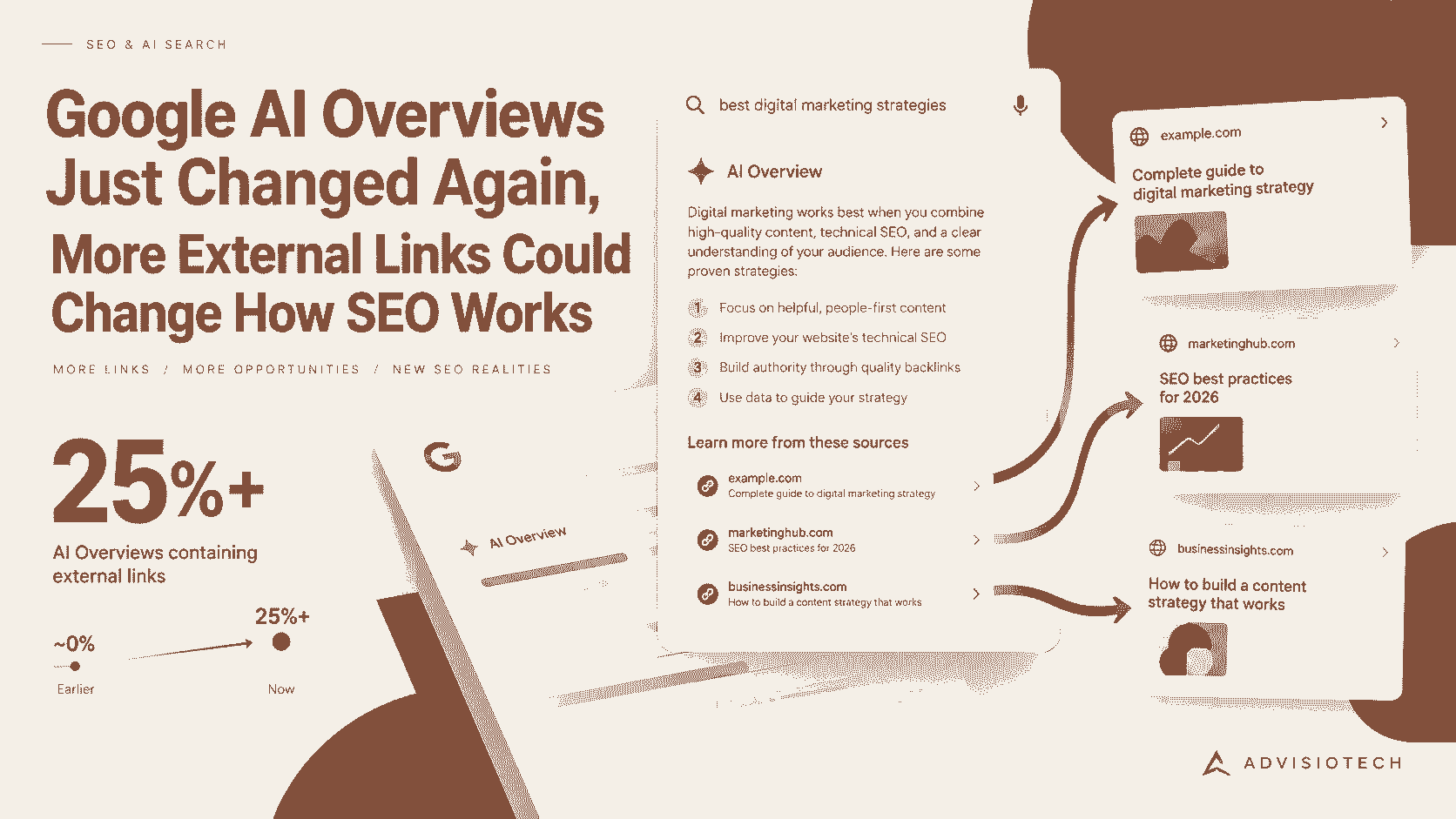
Google AI Overviews are reportedly showing far more external links than they did before, with new data showing the share of AI Overviews containing external links rising from almost zero to more than 25%. Here's what changed, why it matters for website traffic, and what businesses should do now to stay visible in Google's AI search.
Google AI Overviews Just Changed Again, More External Links Could Change How SEO Works
Google Search is changing again, and this time the change could be very important for anyone who depends on organic traffic.
New data shared on September 23, 2026, shows that Google AI Overviews are now displaying external links far more frequently than before. The data, shared by Peec AI and reported by Search Engine Roundtable, shows the share of AI Overviews containing external links moving from close to 0% to more than 25%.
That does not mean one out of every four Google searches now sends traffic to websites through an AI Overview. The measurement is specifically about the share of AI Overviews containing external links, and the underlying data comes from Peec AI rather than Google itself.
But the change is still worth paying attention to.
Because for businesses, publishers, and SEO professionals, the question is no longer simply whether Google shows an AI-generated answer.
The bigger question is: **Will Google still give people a reason to click through to the websites behind that answer?**
What Actually Changed?
Google has been steadily expanding AI Overviews as part of its move toward AI-powered search.
Instead of simply showing a list of blue links, Google can now generate an answer at the top of the results page and provide links to supporting websites.
In May 2026, Google also announced new ways for AI Mode and AI Overviews to help people explore websites, including direct links, article suggestions, and previews of content from across the web.
The latest development suggests that external links are becoming a more visible part of the AI Overview experience.
According to data shared by Peec AI, AI Overviews containing external links went from almost 0% to above 25% in its tracked data.
That is a substantial change in the search interface.
But it is important not to confuse this with a Google announcement saying that 25% of all AI Overviews now contain links. The figure comes from third-party tracking and should be treated as observed data rather than an official Google-wide statistic.
Why External Links Matter So Much
For years, SEO has essentially been built around one basic idea:
**Google sends users to websites.**
AI search changes that relationship.
If Google answers a question completely inside the search results page, a user may have less reason to visit the website that originally published the information.
That creates the biggest concern surrounding AI search:
Your content can be used without necessarily generating the same amount of traffic.
But external links create another possibility.
If an AI Overview answers a question and then gives users a clear path to explore the source, the website can still become part of the user's journey.
That makes being cited inside an AI answer potentially valuable even when the traditional ten-blue-links model becomes less important.
An AI Overview Link Is Not Always the Same as a Traditional Search Result
This is where things become more complicated.
A traditional Google result generally has a familiar structure: title, URL, description, and a click that takes the user directly to the website.
AI search can behave differently.
Google has been experimenting with different ways of presenting sources, links, follow-up questions, and AI Mode interactions.
On September 22, 2026, Search Engine Roundtable reported another test in which some links displayed inside AI Overviews were taking users into AI Mode rather than directly to the referenced webpage.
That means businesses should not assume that every visible link inside an AI-generated answer automatically equals a traditional website visit.
The destination and purpose of the link matter.
Google Is Creating a New Search Journey
Think about the old search journey:
User searches → Google shows results → User clicks website → Website gets visitor.
The AI search journey can look more like this:
User asks question → Google generates answer → Google cites information → User asks follow-up → Google generates another answer → User eventually chooses whether to visit a website.
The website may still be part of the journey, but it is no longer necessarily the first destination.
This is one of the biggest changes SEO professionals need to understand.
Does More AI Overview Linking Mean More Traffic?
Not necessarily.
More links create more opportunities for users to visit websites, but the existence of a link does not guarantee a click.
A user may read the AI-generated answer and leave.
A user may ask another question.
A user may click a competitor.
A user may enter AI Mode instead of visiting the source.
And a user may click the cited website only when they want additional detail.
So businesses should avoid assuming that an increase in AI Overview links automatically translates into an equivalent increase in organic traffic.
The real question is whether those links are generating meaningful visits and conversions.
But There Is Another Important Opportunity
There is a positive side to this change.
If Google is increasingly linking to external sources inside AI-generated answers, then being one of those sources becomes more important.
That creates another form of search visibility.
A company may not necessarily need to be the traditional number-one organic result to become part of the user's AI search journey.
It may instead need to become one of the sources Google considers useful enough to include in an AI-generated response.
That is where SEO and GEO start overlapping.
What Does This Mean for GEO?
Generative Engine Optimization, or GEO, is often described as optimizing a brand for AI-generated answers.
Google's AI search development makes the idea more concrete.
If an AI system is generating an answer and selecting supporting sources, businesses need to make their websites easy to understand, useful, trustworthy, and relevant to specific questions.
That means GEO should not simply be about getting your company name mentioned.
It should also be about getting the right pages discovered and understood as useful sources.
For example, a digital marketing agency should not rely entirely on a homepage saying:
"We provide digital marketing services."
A stronger information structure would include detailed pages explaining SEO, AEO, GEO, website development, graphic design, content marketing, paid advertising, and the specific problems each service solves.
That gives search systems more useful information to work with.
The Homepage Alone Is Not Enough
One of the biggest mistakes businesses make with AI search is treating their homepage as the entire digital identity of the company.
AI systems may need answers to very specific questions.
For example:
- **What does the company actually do?**
- **Who are its services designed for?**
- **What does each service include?**
- **How does the company approach the problem?**
- **What questions do customers normally ask?**
- **What evidence supports the company's claims?**
- **Which page provides the most relevant information?**
A well-organized website gives Google and other AI systems more opportunities to connect individual pages with specific questions.
This Makes Topical Authority Even More Important
Suppose a company publishes one article about SEO.
Now imagine another company has 30 genuinely useful resources covering technical SEO, local SEO, ecommerce SEO, keyword research, content strategy, AI search, AEO, GEO, Search Console, website architecture, and SEO measurement.
The second website has created a much larger information footprint around the subject.
That does not guarantee AI citations or rankings.
But it gives search systems substantially more context about what the business knows and what topics its website covers.
This is why businesses should think beyond individual keywords.
**Build a topic, not just a page.**
What Businesses Should Do Now
If your website depends on Google traffic, this is a good time to review how your content is structured.
- **Create useful service pages:** Clearly explain every important service your company provides.
- **Answer real customer questions:** Build content around problems people actually search for.
- **Use specific language:** Explain exactly what you do instead of filling pages with generic marketing language.
- **Strengthen internal links:** Connect related articles, services, guides, and resources.
- **Publish original information:** Add examples, research, observations, case studies, and first-hand expertise where possible.
- **Keep important pages updated:** Outdated information is less useful to both users and search systems.
- **Improve page clarity:** Make it obvious what each page is about and what question it answers.
- **Build authority outside your website:** Relevant mentions and references from other reputable websites can help establish your broader digital presence.
- **Track AI visibility:** Monitor whether your important pages are appearing as sources in AI search experiences.
- **Track traffic separately:** A citation or AI impression is not the same thing as a website visit.
Don't Chase AI Citations With Tricks
As AI search becomes more important, businesses will inevitably start looking for shortcuts.
There will be claims about secret prompts, special markup, hidden files, magic keywords, and guaranteed methods for getting cited.
Businesses should be skeptical of those promises.
Google's own guidance around AI search emphasizes the importance of normal Search fundamentals. There is no publicly documented magic tag that guarantees a website will appear in AI Overviews.
The better approach is much less exciting but considerably more sustainable:
Create genuinely useful information, make it accessible to search engines, organize it clearly, and establish your website as a credible source in its subject area.
AI Search Does Not Make SEO Obsolete
There is a temptation to say that GEO has replaced SEO.
That is not what is happening.
Google's AI search experiences still rely heavily on information from the web and Google's search ecosystem.
A website still needs to be crawlable.
Its pages still need to be understandable.
Its information still needs to be useful.
Its technical foundation still matters.
Its authority still matters.
Its content still matters.
What is changing is the way users may encounter that information.
Instead of seeing your page first, they may see an AI-generated explanation that uses your page as one of its sources.
The New SEO Question
For years, businesses asked:
"How do I rank number one on Google?"
Now another question needs to be added:
"How does my website become one of the sources Google uses when it answers this question?"
Those are related questions, but they are not identical.
A page can be useful to an AI-generated answer even when the user does not experience the search result in the traditional way.
And as AI search interfaces continue changing, businesses will need to monitor both traditional rankings and AI visibility.
What You Should Watch Next
The most interesting part of this development is that Google is clearly still experimenting with the relationship between AI answers and the open web.
External links are increasing in some tracked AI Overview data.
At the same time, Google is testing links that can send users into AI Mode rather than directly to websites.
These developments point in two directions at once.
Google is giving websites more opportunities to appear inside AI answers, while also creating more ways for users to remain inside Google's AI environment.
That tension is going to be extremely important for SEO.
The Bottom Line
Google AI Overviews are no longer something businesses can treat as a temporary experiment.
The latest third-party data showing a sharp increase in external links suggests that websites may have more opportunities to become visible inside AI-generated answers.
But a link inside an AI Overview should not automatically be treated as a traditional organic ranking or a guaranteed website visit.
The real opportunity is broader.
**Businesses need to become useful sources of information, not just pages that rank for keywords.**
That means strong SEO fundamentals, clear website architecture, genuinely useful content, topical authority, original expertise, and ongoing monitoring of how your brand appears across AI search.
The search result is changing.
The businesses that understand where their information appears in that new journey will be better positioned to measure and adapt to what comes next.
FAQ
What are Google AI Overviews?
Google AI Overviews are AI-generated answers that can appear within Google Search and summarize information related to a user's query while providing supporting links and other ways to explore the topic.
Are Google AI Overviews showing more external links?
New third-party data shared by Peec AI and reported by Search Engine Roundtable indicates that the share of tracked AI Overviews containing external links has increased from close to 0% to more than 25%. This is observed third-party data, not a Google-wide official statistic.
Do AI Overview links send traffic to websites?
They can, but a link does not guarantee a click. Users can read the AI-generated answer, ask a follow-up question, enter AI Mode, or choose another result instead.
What does this change mean for SEO?
It creates another visibility opportunity for websites. Businesses now need to think not only about traditional rankings but also about whether their content is being used and cited within AI-generated search experiences.
What is GEO?
GEO stands for Generative Engine Optimization. It generally refers to improving a brand's visibility and representation in AI-generated answers and AI-powered search experiences.
Does SEO still matter for Google AI Overviews?
Yes. Traditional SEO fundamentals remain important because AI search experiences still depend heavily on information that Google can discover, understand, and retrieve from the web.
How can I improve my chances of appearing in Google AI Overviews?
Focus on technically accessible pages, clear and useful content, strong internal linking, topical depth, accurate information, original expertise, and content that directly answers relevant user questions.
Does appearing in an AI Overview guarantee more traffic?
No. Visibility in an AI-generated answer and a website visit are separate metrics. Businesses should measure AI visibility, citations, clicks, engagement, and conversions separately.
Is GEO replacing SEO?
No. GEO and SEO overlap, but they address different aspects of search visibility. Strong SEO fundamentals remain important while businesses also adapt their content for AI-powered search experiences.