Google Search Is Changing Again, And Websites That Ignore AI Mode Could Lose Traffic
Google's AI Mode has surpassed 1 billion monthly active users, while Google says its AI search experiences are sending billions of clicks to websites every week. But independent research has also found that AI Mode can reduce visits to external websites. Here's what the shift means for SEO, AEO, GEO and businesses that depend on Google traffic.
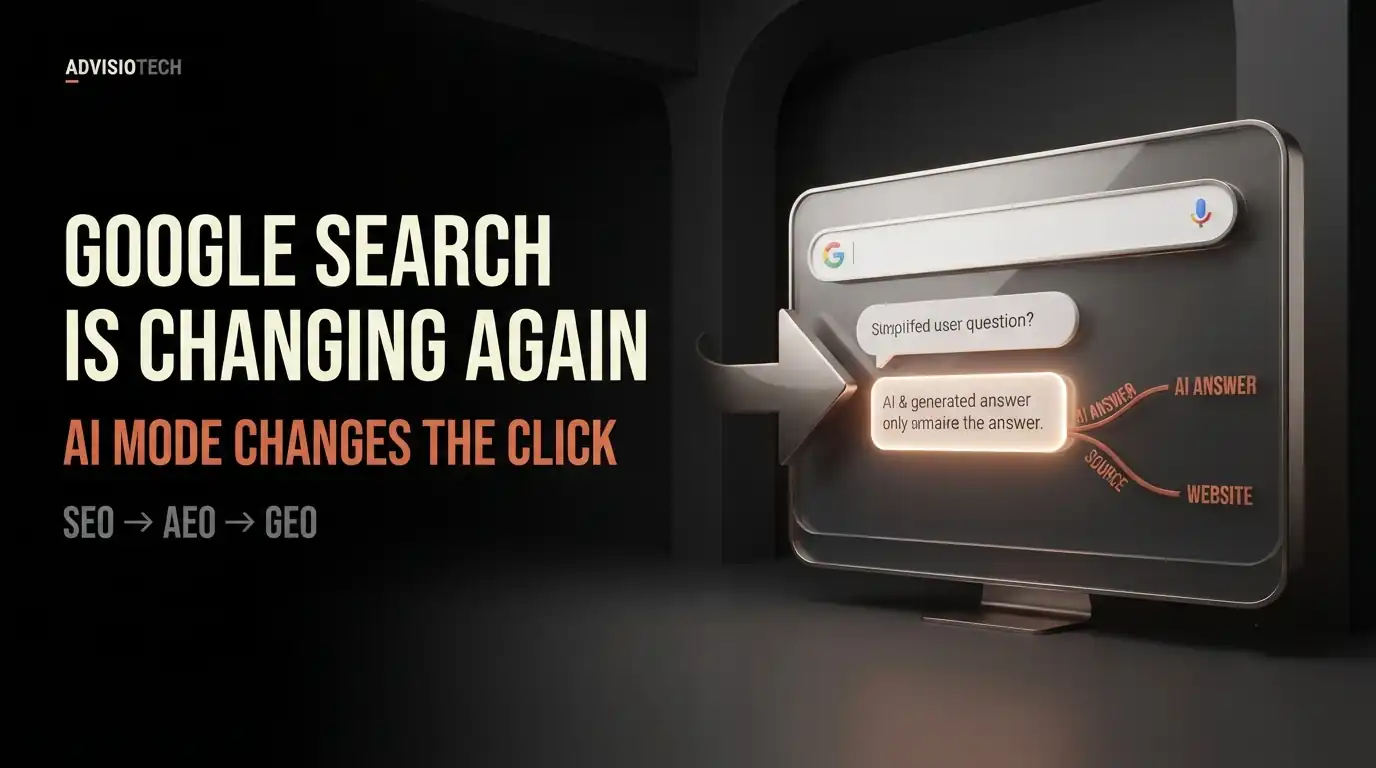
Google Search Is Changing Again, And Websites That Ignore AI Mode Could Lose Traffic
For more than two decades, Google Search followed a relatively simple model. Someone searched for something, Google showed a list of websites, and businesses competed to appear near the top.
That model is changing quickly.
Google's AI Mode has now surpassed 1 billion monthly active users globally, according to Google, while the company says AI powered Search is sending billions of clicks to websites every week. At the same time, independent research published in September 2026 found that forcing users into AI Mode reduced the share of searches that resulted in an external website visit.
That creates a strange new reality for website owners. Google can potentially send more total traffic to the web while individual websites receive fewer clicks from some types of searches.
The important question is therefore no longer simply whether your website ranks on Google. It is whether your business can still be discovered when Google answers the question before the user visits a website.
What Is Google AI Mode?
AI Mode is Google's conversational Search experience. Instead of entering a short keyword and scanning a traditional results page, users can ask longer and more complicated questions and continue the conversation with follow up questions.
Google says AI Mode can use a technique called query fan out, where a complicated question is broken into multiple related searches. The system can then explore different parts of the web before generating an answer.
That changes what a search can look like.
A user might not search for "best digital marketing agency" anymore. They could ask Google which digital marketing services a growing business actually needs, how much those services normally cost, what should be included and which type of agency would be appropriate.
One conversational question can therefore contain several traditional search intents.
AI Mode Is Already Too Big to Ignore
Google says AI Mode has surpassed 1 billion monthly active users globally. Google has also reported that AI Overviews have more than 2.5 billion monthly active users.
Those numbers matter because AI Search is no longer a small experiment that businesses can safely ignore.
Google has also said that its AI Search experiences are generating billions of clicks to websites each week. The company argues that AI Search can create new opportunities because people are asking more complex questions and exploring topics in greater depth.
But there is another side to the story.
The Traffic Problem Businesses Cannot Ignore
A September 2026 randomized field experiment involving roughly 1,100 Google users found that forcing participants to use AI Mode reduced the share of searches that resulted in an external website visit by 18.8 percentage points compared with normal Google Search.
That number should not be interpreted as a prediction that every website will suddenly lose 18.8 percent of its traffic. The study examined a specific search experience and population, and traffic effects can vary significantly by query and industry.
But it demonstrates something important.
Google can now satisfy part of a user's information need without requiring that person to immediately click a website.
For simple informational searches, that could mean fewer reasons to leave Google.
For more complicated searches, however, AI Search can also introduce users to sources they might not have discovered through traditional Search.
So Is Google AI Search Good or Bad for Website Traffic?
There is no single answer.
Google says AI Search is generating billions of weekly website clicks, while independent research has found lower external click behavior in some AI Mode scenarios. These findings measure different things and should not be treated as contradictory proof that one side is correct.
The more useful conclusion is that the traffic journey is changing.
A user who previously performed three searches and clicked three websites might now ask one detailed question, receive an AI answer, ask a follow up question and then click only one or two sources.
That means the number of searches, impressions, citations and clicks may no longer move together in the way SEO professionals are accustomed to seeing.
The New SEO Question Is Not Just Where Do I Rank?
Traditional SEO often revolves around one basic question: where does my page appear for a particular search?
AI Search creates several additional questions.
Does Google understand what my company actually does?
Can Google's systems identify the subjects my website has genuine expertise in?
Can an AI system extract a clear answer from my content?
Does my content contain original information worth referencing?
Can Google connect my company with the products, services and topics discussed on my website?
Does the page answer the follow up questions a user is likely to ask?
And perhaps most importantly, does the content give someone a reason to visit the original website after seeing an AI answer?
This is where traditional SEO starts overlapping with AEO and GEO.
What AEO Means in the AI Search Era
AEO stands for Answer Engine Optimization. The basic idea is to make information clear and structured enough that answer engines can understand it and use it when responding to questions.
That does not mean creating hundreds of pages designed around slightly different versions of the same keyword.
It means answering genuine customer questions directly.
A service page should clearly explain what the service is, who it is for, what is included, how the process works and what questions customers normally have.
An educational article should define the subject early, explain the important concepts and answer obvious follow up questions without forcing the reader to dig through unnecessary paragraphs.
The goal is simple: make the information useful to humans first and easy for search systems to understand as a result.
What GEO Means for Your Website
GEO stands for Generative Engine Optimization. It focuses on improving the likelihood that a brand, website or piece of content is accurately represented in generative AI experiences.
This requires more than inserting keywords into articles.
AI systems need enough context to understand who you are, what your company does, what topics you know about and why your information is useful.
That makes entity clarity increasingly important.
Your company name, services, products, authors, expertise and relationships between those entities should be clear and consistent across your website and other relevant sources.
The goal should not be to manipulate an AI system into mentioning your company. The goal is to make your business genuinely understandable and useful.
Google Is Giving Website Owners More AI Search Controls
Google has been adding tools and guidance to help website owners understand how their content appears within its evolving AI Search experiences. The company has also introduced additional controls and Search Console insights for website owners as AI Search develops.
This matters because traditional SEO reporting was built around familiar metrics such as queries, impressions, rankings and clicks.
AI Search adds another layer to the equation.
A website can potentially contribute information to an AI generated answer without receiving a traditional blue link click for every interaction.
That means businesses need to think about visibility and discovery alongside traffic.
What Businesses Should Change Right Now
The first change is to stop creating content exclusively around isolated keywords.
Instead, build content around the questions customers actually ask before they buy.
If you provide website development, for example, one page targeting "website development" is unlikely to answer every question a potential customer has. They may also want to know how much a business website costs, which pages are required, whether SEO should be included, how long development takes, whether the website can generate leads and what happens after launch.
Those questions form a topic ecosystem.
The second change is to make important answers easy to identify.
Use descriptive headings, clear definitions, concise explanations and direct answers. This helps readers and gives search systems clearer information to interpret.
The third change is to publish information that competitors cannot simply reproduce by rewriting another article.
Original research, firsthand experience, unique examples, experiments, proprietary data, case studies and genuinely useful analysis give a website something more valuable than another generic summary of information already everywhere online.
The fourth change is to strengthen your business entity.
Your website should clearly explain who your company is, what it offers and what makes its expertise relevant. Important business information should not be scattered across pages with inconsistent descriptions.
The fifth change is to create reasons for people to leave the AI answer and visit your website.
Interactive tools, calculators, original research, detailed service information, product specifications, case studies and useful resources can give users a reason to continue beyond a summary.
What About Keywords?
Keywords are not disappearing.
Google's AI Search systems remain connected to the broader Search ecosystem, so traditional technical SEO, crawlability, useful content and website structure still matter.
What is changing is the relationship between keywords and intent.
A single conversational question can contain multiple traditional search intents.
That means a genuinely comprehensive page can potentially answer many related questions without creating a separate page for every keyword variation.
The goal should be topical relevance rather than keyword stuffing.
The Biggest Mistake Businesses Can Make
The biggest mistake would be assuming that AI Search means businesses should publish as much AI generated content as possible.
More pages do not automatically mean more authority.
Google continues to emphasize useful, original and high quality content, including content that provides information or perspectives that users cannot easily find elsewhere.
That points toward a better strategy.
Create fewer pieces of content that contain more original information.
Answer real questions.
Demonstrate genuine expertise.
Keep important business information consistent.
Make pages technically accessible to search engines.
And give readers a reason to visit the original source instead of stopping at the AI answer.
What Happens When Google Answers Everything?
This may become one of the biggest questions in modern SEO.
If Google can answer a simple question directly, the user may have no reason to visit the source for a basic definition.
That means purely informational content could face more pressure than content where the user needs something Google cannot fully provide inside the answer.
Original research is one example.
Detailed product information is another.
Interactive tools, proprietary data, case studies, demonstrations and strong service pages can also create reasons to continue to a website.
The future of SEO may therefore involve optimizing not only for visibility, but also for the moment when an AI answer makes the user curious enough to click.
The New Search Funnel
The old search funnel was relatively simple: search, results page, click, website, conversion.
The AI Search funnel is becoming more complicated.
A user may ask a broad question, receive an AI answer, ask a follow up question, see several sources, compare those sources and only then visit a website.
A business can therefore be visible at several stages without receiving a click from the first query.
A company might be mentioned in an AI answer, appear as a source, be discovered through a follow up question and eventually receive a website visit when the user is ready to take action.
Visibility is becoming more than a single ranking position.
What This Means for AdvisioTech
For digital agencies and businesses, this shift creates a new opportunity.
Companies can build websites around the way people are increasingly asking questions rather than treating every search as an isolated keyword.
That means combining traditional technical SEO with useful content, clear business information, strong entity signals, direct answers, original information and content that can be understood across conventional Search and generative experiences.
AEO and GEO should not replace SEO.
They extend it.
The Bottom Line
Google Search is not disappearing. It is becoming more conversational and increasingly capable of answering questions before a user visits a website.
Google says AI Mode has surpassed 1 billion monthly active users and that its AI Search experiences are sending billions of clicks to websites every week. Independent research, meanwhile, has found that AI Mode can reduce external website visits in controlled search scenarios.
The safest conclusion is not that websites are doomed or that AI Search will automatically increase traffic.
The real change is that the path between a search and a website visit is becoming more complicated.
Businesses that optimize only for traditional rankings may miss part of that new discovery journey.
The websites that clearly explain what they know, publish original information, establish strong authority and make themselves useful to both people and AI systems will have more opportunities to appear throughout the new Search experience.
FAQ
What is Google AI Mode?
Google AI Mode is a conversational Search experience that allows users to ask complex questions, receive AI generated responses and continue with follow up questions while exploring information from the web.
Does Google AI Mode reduce website traffic?
It can reduce external website visits for some searches. A September 2026 randomized experiment involving roughly 1,100 users found an 18.8 percentage point reduction in searches leading to an external website when participants were directed into AI Mode. The result should not be treated as a universal traffic forecast for every website.
How many people use Google AI Mode?
Google says AI Mode has surpassed 1 billion monthly active users globally.
What is AEO?
AEO stands for Answer Engine Optimization. It focuses on making information clear and structured so answer engines can understand and use it when responding to questions.
What is GEO?
GEO stands for Generative Engine Optimization. It focuses on improving a brand's visibility and accurate representation in generative AI search and answer experiences.
Should businesses stop doing traditional SEO?
No. AI Mode remains connected to Google's broader Search systems. Traditional technical SEO, crawlability, useful content and strong website architecture remain important. AEO and GEO should be treated as additional considerations rather than replacements for SEO.
How can a website appear in AI Search?
There is no guaranteed formula for appearing in an AI generated answer. Businesses can strengthen their foundations by creating useful original content, clearly explaining their expertise and entities, answering relevant questions directly, maintaining strong technical SEO and making important information easy for search systems and users to understand.
Will AI Search kill Google traffic?
There is not enough evidence to support that conclusion. Google reports billions of weekly website clicks from its AI Search experiences, while independent research has found lower external click behavior in controlled AI Mode usage. The impact can vary by query, website and search experience.