DeepSeek Is Helping Huawei Build an Alternative to NVIDIA's CUDA, Here's Why It Matters
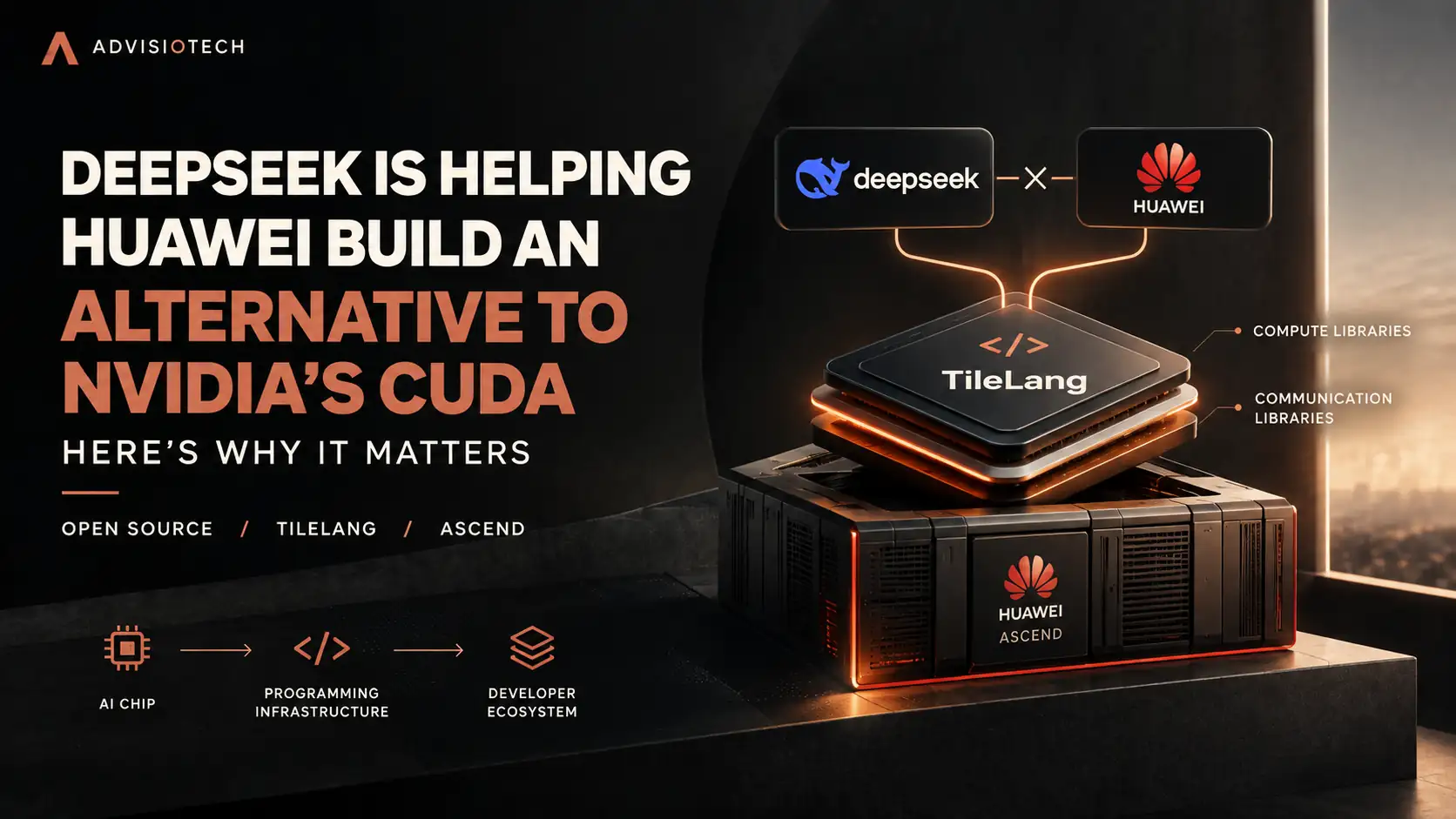
DeepSeek has partnered with Huawei to open-source programming infrastructure for Huawei's Ascend AI chips, including TileLang and related compute and communication libraries. The move is about more than AI chips: it targets the software ecosystem that makes accelerators useful in the first place. Here's what DeepSeek and Huawei are building, how TileLang fits in, and why NVIDIA's CUDA advantage is so difficult to challenge.
DeepSeek Is Helping Huawei Build an Alternative to NVIDIA's CUDA, Here's Why It Matters
The race to challenge NVIDIA in artificial intelligence is no longer only about building another powerful AI chip. It is also about building the software developers need to actually use that chip.
On September 30, 2026, Chinese AI company DeepSeek said it had partnered with Huawei to develop programming infrastructure optimized for Huawei's Ascend AI processors. DeepSeek said it was open-sourcing infrastructure for Ascend, including TileLang along with related computation and communication libraries.
That matters because NVIDIA's position in AI computing is built around more than its hardware. CUDA and the software ecosystem surrounding NVIDIA GPUs have become a major part of how developers build and optimize AI workloads. DeepSeek and Huawei are now trying to strengthen an alternative software path around Huawei's own accelerators.
What DeepSeek and Huawei Actually Announced
DeepSeek said Huawei provided full support during the development of the new programming infrastructure and that the two companies jointly advanced a supernode solution based on 128 Huawei Ascend 950 chips.
The companies worked on both computation and communication across the system. That detail is important because large AI workloads do not depend only on how quickly an individual accelerator performs calculations. The chips also have to exchange data efficiently when many processors work together.
DeepSeek is also open-sourcing several pieces of the software infrastructure supporting the Ascend platform. Reuters reported that the release includes a high-level programming language called TileLang as well as compute and communication libraries.
DeepSeek described the goal as building an independent GPU software ecosystem and said TileLang was designed to provide a simpler programming model while still reaching the performance potential of the underlying hardware.
Why CUDA Matters So Much
When people talk about NVIDIA's dominance in AI chips, it is easy to focus entirely on the GPUs themselves. The hardware is obviously important, but the software surrounding that hardware is one of NVIDIA's biggest advantages.
CUDA gives developers a mature programming environment for NVIDIA GPUs. Over many years, developers and companies have built libraries, frameworks, tools and optimized workloads around it.
That creates an ecosystem effect. A company considering a different accelerator is not simply asking whether the new chip is fast enough. It also has to ask whether its existing software can run efficiently, whether developers know how to program the hardware, whether important libraries are available and whether performance can be tuned for production workloads.
This is one reason competing with NVIDIA is difficult even when alternative AI accelerators exist.
Where TileLang Fits In
TileLang is an open-source programming language and compiler-oriented project designed to help developers write high-performance computational kernels for different accelerator architectures.
The broader TileLang project already supports multiple hardware targets, including NVIDIA CUDA, AMD ROCm and Apple Metal. Its ecosystem also contains dedicated work for Huawei Ascend hardware.
The Ascend-specific implementation uses a Python-style programming model and is built around compiler infrastructure including TVM and an Ascend-specific intermediate representation. The project documentation describes support for operations such as matrix multiplication, vector operations and attention mechanisms.
That means TileLang is not simply a replacement name for CUDA. The two are different pieces of technology with different architectures and ecosystems. A more accurate way to describe the current development is that DeepSeek and Huawei are expanding a higher-level programming and optimization layer that can make Ascend hardware easier to target.
Why Software Can Be as Important as the Chip
Imagine buying a powerful computer but discovering that the software you depend on does not support its processor properly. The hardware might look impressive on paper, but its practical value can be much lower.
AI accelerators face a similar problem.
A modern AI chip needs software that can translate high-level workloads into efficient operations on the hardware. Developers need optimized kernels. Frameworks need to communicate with the accelerator. Memory movement and communication between processors need to be handled efficiently.
For large AI models, small inefficiencies can become expensive when multiplied across thousands of operations and large clusters.
This is why DeepSeek's involvement is notable. DeepSeek is not only an AI model developer. It has also spent significant effort optimizing the underlying computational workloads required to run its models.
The 128-Chip Supernode Is an Important Detail
DeepSeek and Huawei said they jointly advanced a supernode solution based on 128 Ascend 950 chips.
The significance is not simply the number 128. Large AI systems depend on coordinating many accelerators as a single computing environment, which makes communication between processors increasingly important.
If computation is fast but data cannot move efficiently between processors, the overall system can lose performance. That makes communication libraries and system-level optimization an important part of the AI infrastructure stack.
Reuters reported that DeepSeek and Huawei optimized both computation and communication for the jointly developed system.
That does not establish that the system is faster than NVIDIA's latest infrastructure in real-world workloads. No such conclusion should be drawn from the announcement alone. What it does show is that Huawei and DeepSeek are working on the software and system layers required to scale Ascend hardware for demanding AI workloads.
This Is Not Yet a CUDA Replacement
The phrase "NVIDIA CUDA alternative" is useful for explaining the strategic direction, but it can also be misleading if taken too literally.
CUDA is a mature ecosystem developed over many years, with extensive adoption across AI research, cloud computing and enterprise software. Reproducing that entire ecosystem is much harder than releasing a new programming language or compiler.
DeepSeek's announcement is therefore better understood as another step toward reducing dependence on NVIDIA's software stack rather than proof that CUDA has been replaced.
The real test will be adoption.
Developers need reliable tools, documentation, libraries, debugging capabilities and stable performance. AI frameworks also need to support the hardware properly. Companies deploying models at scale need confidence that workloads will continue to perform well as systems become larger and more complicated.
Why DeepSeek Is Important to This Strategy
DeepSeek has a particularly interesting position in the Chinese AI ecosystem because its models have created demand for highly optimized inference and training infrastructure.
The company has also published and open-sourced parts of the software techniques used around its models. Its involvement therefore gives Huawei access to a developer and optimization partner that is focused specifically on demanding AI workloads.
That does not mean every DeepSeek workload can immediately move from NVIDIA hardware to Huawei hardware. Software compatibility, performance, hardware availability and production maturity all remain separate questions.
But DeepSeek's willingness to optimize its software for Ascend gives Huawei something more valuable than a theoretical hardware alternative: a real AI workload around which the software stack can be developed and tested.
Why Huawei Needs the Software Layer
Huawei has been developing its Ascend AI accelerator family as part of a broader effort to build domestic computing infrastructure.
Hardware alone cannot create an independent AI ecosystem. Developers need tools that make the hardware practical, while cloud providers and AI companies need software that can scale across large clusters.
The collaboration with DeepSeek addresses part of that problem by working on the programming layer and on communication between accelerators.
This is particularly important because access to advanced AI hardware has become a strategic issue for Chinese technology companies. Building a domestic alternative requires progress across the entire stack rather than simply producing another processor.
What This Means for NVIDIA
The immediate impact on NVIDIA should not be overstated.
DeepSeek and Huawei have not demonstrated that their new software ecosystem has displaced CUDA globally, nor does the announcement establish that Ascend hardware currently matches NVIDIA's overall software ecosystem or production scale.
The more meaningful development is that a major AI model developer is actively helping improve an alternative accelerator ecosystem.
If developers can increasingly move workloads between different accelerator platforms using higher-level tools and portable software layers, hardware vendors could face less dependence on a single programming ecosystem.
That would be strategically important because software lock-in has historically been one of the strongest advantages of established computing platforms.
The Bigger Battle Is for Developer Attention
The AI chip market is often presented as a competition between silicon designs. In reality, developers sit at the center of the ecosystem.
A hardware platform becomes more valuable when developers can easily write software for it, frameworks support it, optimized libraries are available and production systems can be maintained without excessive engineering effort.
This creates a difficult cycle for new competitors. Without developers, software ecosystems remain small. Without software, customers have fewer reasons to adopt the hardware. Without customers, developers have fewer reasons to invest in the platform.
Breaking that cycle is one of the hardest parts of challenging an established computing ecosystem.
DeepSeek's open-source approach could help lower that barrier by making more of the software infrastructure available to developers working with Ascend.
What Developers Should Watch
The most important developments from here will not necessarily be new headlines about chip specifications. Developers should watch whether the Ascend software ecosystem becomes easier to use, whether major AI frameworks support it reliably, whether important workloads can be optimized efficiently and whether more companies begin contributing to the stack.
The broader TileLang project is already designed around multiple accelerator targets. Its current ecosystem includes NVIDIA, AMD, Apple and Huawei-related backends, among others.
That portability could become increasingly valuable as AI infrastructure becomes more heterogeneous.
Instead of every AI workload being designed around one vendor's hardware and programming environment, developers could increasingly use higher-level abstractions while still tuning critical kernels for specific accelerators.
What This Does Not Prove
DeepSeek and Huawei's announcement does not prove that Huawei's Ascend processors outperform NVIDIA's latest GPUs.
It does not prove that TileLang is a complete replacement for CUDA.
It does not mean Chinese AI companies have eliminated their dependence on foreign semiconductor technology.
And it does not mean NVIDIA's software ecosystem is suddenly disappearing.
The confirmed development is narrower but still significant: DeepSeek and Huawei are jointly developing and open-sourcing software infrastructure intended to make Huawei's Ascend platform more practical for demanding AI workloads.
The Bottom Line
DeepSeek's partnership with Huawei shows that the battle for AI computing is moving deeper into the software stack.
Huawei is building Ascend processors, but processors alone are not enough. Developers need programming tools, compilers, libraries and communication software that allow large AI workloads to run efficiently.
By open-sourcing Ascend-focused infrastructure including TileLang and related compute and communication libraries, DeepSeek is helping strengthen that missing layer.
It is too early to call this a replacement for NVIDIA CUDA. But it is another sign that the global AI industry is becoming more interested in software portability and alternative accelerator ecosystems.
For NVIDIA, the challenge is therefore not simply whether another company can manufacture a competitive AI chip. The bigger question is whether competitors can build enough of the surrounding software ecosystem to make developers willing to use it.
FAQ
What did DeepSeek announce about Huawei?
DeepSeek said on September 30, 2026 that it had partnered with Huawei to develop programming infrastructure optimized for Huawei's Ascend AI chips and was open-sourcing infrastructure including TileLang and related compute and communication libraries.
What is TileLang?
TileLang is an open-source programming language and compiler-oriented project designed to help developers create high-performance computational kernels for AI accelerators. The project supports multiple hardware ecosystems, including NVIDIA, AMD, Apple and Huawei Ascend.
Is TileLang a replacement for NVIDIA CUDA?
Not in the sense of replacing the entire CUDA ecosystem. TileLang is a different technology. DeepSeek describes its Ascend work as part of building an independent AI accelerator software ecosystem, while CUDA remains NVIDIA's established programming platform and ecosystem.
What is Huawei Ascend?
Ascend is Huawei's family of AI processors and related computing infrastructure designed for AI workloads. The current DeepSeek partnership focuses on making software and system-level infrastructure work more effectively with Ascend hardware.
What is a supernode in AI computing?
In this context, a supernode is a large computing system that combines multiple AI accelerators and coordinates their computation and communication. DeepSeek and Huawei said they jointly advanced a system based on 128 Ascend 950 chips.
Does this mean Huawei can replace NVIDIA?
The announcement does not establish that. Building competitive AI infrastructure requires hardware, software, networking, developer tools, frameworks, production availability and a broad ecosystem. DeepSeek's contribution strengthens one part of that ecosystem, but it is not evidence that NVIDIA has been displaced.
Why does AI software matter so much for chips?
AI accelerators need software that can translate workloads into efficient operations on the hardware. Libraries, compilers, kernels and communication systems can have a major effect on how effectively an accelerator performs in real workloads. That software ecosystem is therefore a major part of the practical value of an AI chip.