ChatGPT vs Gemini vs Claude: What Should You Actually Use in 2026?
ChatGPT, Gemini, and Claude have all become powerful enough to handle writing, research, coding, analysis, and everyday work. But they are built around different strengths. Here is a practical 2026 comparison of what each AI is actually good at, where each one makes sense, and how to choose the right tool for the job.
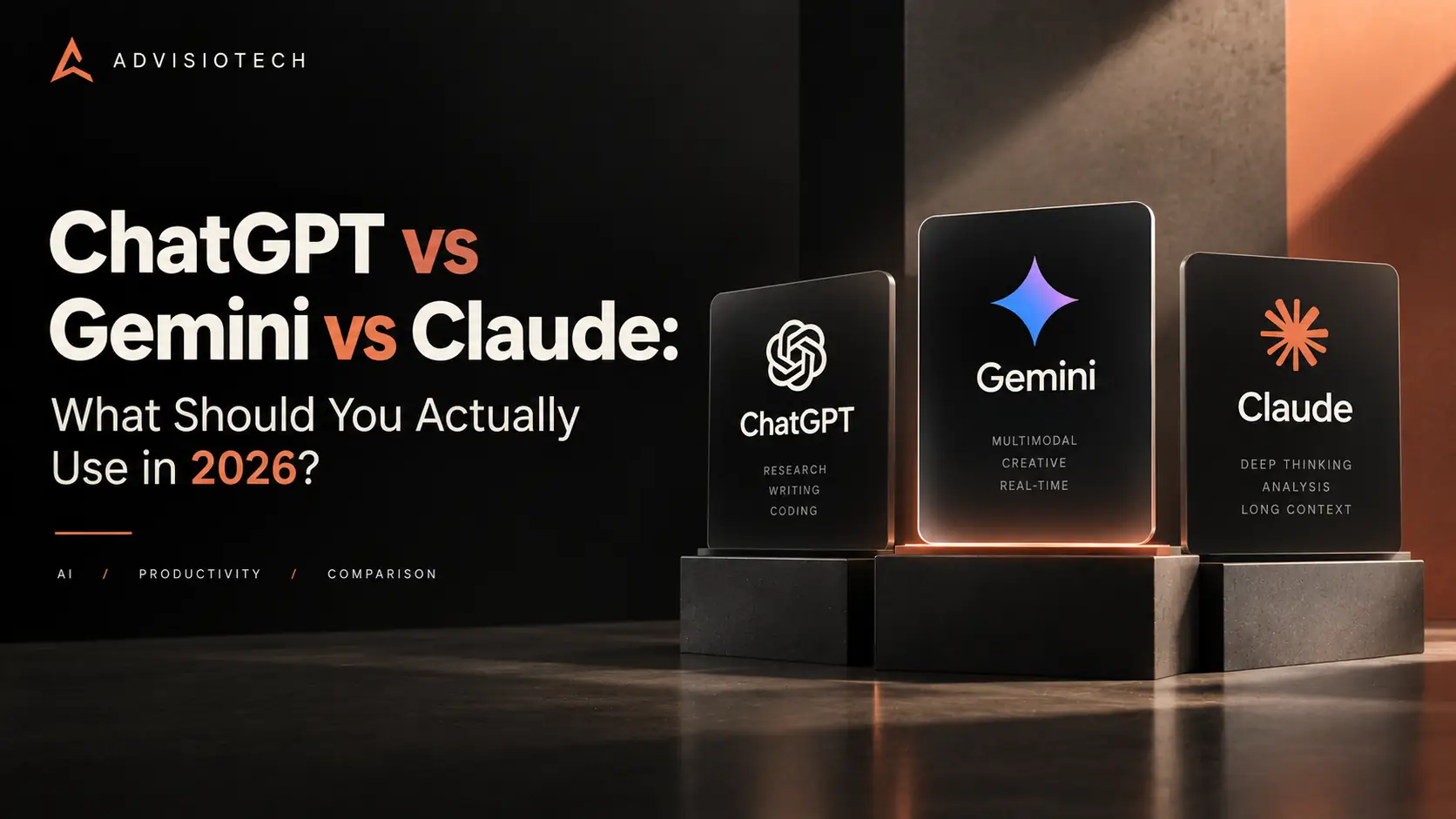
ChatGPT vs Gemini vs Claude: What Should You Actually Use in 2026?
Choosing an AI assistant in 2026 is no longer as simple as asking which chatbot is the smartest. ChatGPT, Gemini, and Claude can all write, research, analyze information, work with files, code, and handle increasingly complex tasks. The real difference is how each platform approaches the work around the model.
OpenAI now has GPT 6 Astra, Google has Gemini 3.8 Flash, and Anthropic has Claude Opus 5.5 and Fable 5.1. That makes older comparisons surprisingly easy to outdate. A comparison that was accurate a few months ago can already be describing a very different AI landscape.
So instead of trying to declare one universal winner, it makes more sense to look at what each platform is designed to do particularly well and then match that to the type of work you actually need.
The Short Answer
ChatGPT is a strong choice when you want a broad AI workspace that can combine reasoning, research, writing, coding, files, images, and increasingly autonomous computer based work.
Gemini makes particular sense if you already live inside Google's ecosystem or want an AI that is closely connected to Google Search, Google's productivity tools, multimodal inputs, and agentic workflows.
Claude is particularly interesting for people who care about long form knowledge work, coding, careful analysis, and long running tasks where consistency matters.
That does not mean one platform is objectively better for everyone. Your best choice depends on what you actually do with AI.
ChatGPT in 2026
OpenAI's current frontier model is GPT 6 Astra. OpenAI describes Astra as its most capable model for complex end to end work, including computer use, browsing, software engineering, cybersecurity, science, and professional work.
One of the biggest differences with ChatGPT is that the product is becoming more than a traditional chatbot. ChatGPT can work with files, connected services, documents, spreadsheets, presentations, websites, images, and longer multi step tasks depending on the account and features available.
This makes ChatGPT particularly useful when the task does not fit neatly into one prompt. You can start with a question, provide files, ask for research, change the requirements, and continue working toward a finished result.
GPT 6 Astra is also designed for computer use. OpenAI says it can perform tasks such as filling online forms, updating records, researching information, creating websites, testing interfaces, and working through complex professional workflows.
For a person who wants one general purpose AI workspace rather than several separate tools, this broad approach is one of ChatGPT's biggest advantages.
Where ChatGPT Makes Sense
ChatGPT is a particularly practical option for general productivity because it covers a wide range of tasks in one environment.
It can be useful for writing and rewriting, research, brainstorming, coding, document analysis, spreadsheet work, image creation, data analysis, website work, and multi step projects.
It is also becoming increasingly useful for people who want an AI system to actually perform parts of a workflow instead of simply explaining how to do them.
If your work changes constantly and you want one assistant that can move between different types of tasks, ChatGPT is designed around that kind of flexibility.
Gemini in 2026
Google's Gemini ecosystem has taken a different route. Gemini is deeply connected to Google's broader search and productivity ecosystem, while Google's latest Gemini models are increasingly focused on reasoning, coding, multimodal understanding, and agentic workflows.
Google introduced Gemini 3.8 Flash in September 2026 and described it as its best reasoning and coding model at the time of release. Google says the model is designed for software engineering, agentic tasks, and complex multi step reasoning.
Gemini is also closely connected to Google Search. Google's AI Mode now supports longer questions, multimodal searches, and increasingly agentic experiences. Google says AI Mode has surpassed one billion monthly active users globally.
That ecosystem matters. If you already use Google Search, Gmail, Google Workspace, Google Sheets, or other Google services heavily, Gemini can fit naturally into the way you already work.
Google is also pushing Gemini beyond text. Gemini 3.8 Live with Live Avatar adds real time visual presence to conversational AI, showing how Google's strategy increasingly combines text, images, audio, video, and tool use.
Where Gemini Makes Sense
Gemini can be particularly useful for people who spend a large part of their day inside Google's ecosystem.
It is worth considering for research, multimodal tasks, Google connected workflows, coding, long documents, and situations where Search integration is important.
It can also make sense if your work frequently involves images, screenshots, files, or other forms of information that do not fit into a simple text prompt.
The important point is that Gemini is not simply Google's answer to ChatGPT. Google is increasingly treating Gemini as an intelligence layer across Search, productivity tools, and other products.
Claude in 2026
Anthropic's Claude family has developed a particularly strong reputation around coding, knowledge work, and long running tasks.
In September 2026, Anthropic introduced Claude Fable 5.1 and Claude Mythos 5.1. Fable 5.1 is generally available, while Mythos 5.1 is available through trusted access programs for areas such as cybersecurity and life sciences.
Anthropic also released Claude Opus 5.5 on September 22, 2026. Anthropic describes Opus 5.5 as a major improvement over Opus 5, with a focus on agentic coding, computer use, and knowledge work.
Claude is especially interesting when the task involves substantial amounts of text, code, research, or a project that needs to continue for a long time without losing the broader objective.
Anthropic's product direction also places significant emphasis on coding agents and professional workflows, rather than treating Claude only as a conversational assistant.
Where Claude Makes Sense
Claude can be a strong fit for developers, researchers, writers, analysts, and teams working with large amounts of complex information.
It is particularly worth considering when coding quality, long running tasks, careful reasoning, and consistency are more important than having the largest collection of consumer features in one application.
Claude's ecosystem also includes tools such as Claude Code, which makes the platform especially relevant to developers who want an AI assistant that can work directly with software projects.
ChatGPT vs Gemini vs Claude for Writing
All three can produce strong writing, but the experience can feel different depending on the task.
ChatGPT is useful when writing is part of a larger workflow. You can research a topic, analyze source material, create an outline, write the article, revise it, and turn the same information into other formats.
Gemini becomes particularly interesting when the writing task depends heavily on Google's ecosystem or multimodal research.
Claude is often a good option for long documents, detailed editing, structured reasoning, and situations where you want to spend a long time refining a piece of work.
The practical lesson is that writing quality alone is no longer a useful way to choose between these platforms. Workflow matters just as much.
ChatGPT vs Gemini vs Claude for Coding
Coding is one of the areas where the differences between frontier models have become increasingly difficult to summarize with a simple winner.
OpenAI says GPT 6 Astra is its strongest software engineering model to date and has built it around complex coding and computer use workflows.
Google says Gemini 3.8 Flash was designed for long horizon coding and autonomous agent workflows, including complex engineering tasks.
Anthropic's latest models are also heavily focused on agentic coding. Anthropic reports that Opus 5.5 performs strongly on several coding and computer use evaluations.
For developers, the best choice may therefore depend less on a single benchmark and more on the tools surrounding the model, the coding environment, the repository size, the amount of context required, and how much autonomy you want the AI to have.
ChatGPT vs Gemini vs Claude for Research
Research is another area where there is no universal answer.
ChatGPT is useful when research needs to turn into a finished deliverable such as a report, presentation, spreadsheet, document, or website.
Gemini has a natural advantage for users who want research closely connected to Google's Search ecosystem and multimodal information.
Claude is well suited to deep knowledge work where large amounts of material need to be analyzed and turned into a coherent answer.
For serious research, however, none of these systems should be treated as automatically correct. Important claims should still be checked against primary sources and original documents.
Which One Is Best for Business?
For businesses, the question changes again.
The important factors are not just model intelligence. Companies also need to consider data handling, permissions, integrations, administrative controls, cost, security, compliance, and how easily employees can incorporate the AI into existing workflows.
ChatGPT can make sense for businesses that want a broad AI workspace with multiple types of work in one place.
Gemini can make sense for organizations deeply invested in Google Workspace and Google's wider ecosystem.
Claude can make sense for teams focused heavily on coding, research, knowledge work, and long running professional tasks.
The right decision should therefore start with the company's existing tools and workflows rather than with a benchmark leaderboard.
What About Accuracy?
One of the biggest mistakes people make when comparing AI assistants is assuming that the model that sounds the most confident must also be the most accurate.
ChatGPT, Gemini, and Claude can all produce incorrect information. Even advanced models can misunderstand a question, make an unsupported inference, misread a document, or provide an answer that sounds convincing but needs verification.
For important work, the safest approach is to treat AI as a research and reasoning assistant rather than an unquestionable source of truth.
That becomes especially important for legal, financial, medical, security, and business decisions where an incorrect answer can have real consequences.
Should You Pay for More Than One AI?
For some people, paying for multiple AI platforms can make sense.
A developer might prefer one model for coding and another for research. A business might standardize on one platform while using another for specialized work. A writer might use different systems for research, editing, and brainstorming.
But most people do not need three subscriptions simply because three major AI companies exist.
Start with the tasks you perform most often. Choose the platform that fits those tasks and only add another one when you can identify a specific workflow where it provides meaningful value.
The AI Landscape Is Changing Too Quickly for Permanent Winners
The most important thing to understand about this comparison is that it has an expiration date.
OpenAI, Google, and Anthropic are releasing new models and features quickly. A model that leads a benchmark today may be replaced by another release a few weeks or months later.
That means users should pay attention to the overall product ecosystem rather than becoming permanently attached to one model because it won a benchmark at one point in time.
The better question is not "Which AI is the smartest?" It is "Which AI works best for the things I actually need to get done?"
So, What Should You Actually Use in 2026?
If you want a broad general purpose AI workspace that can move between research, writing, coding, files, images, and increasingly autonomous workflows, ChatGPT is worth considering.
If you rely heavily on Google Search and Google productivity tools and want multimodal and agentic capabilities closely connected to that ecosystem, Gemini is worth considering.
If your priorities are coding, long form knowledge work, research, and sustained professional tasks, Claude is worth considering.
You do not need to choose based on hype. Define the work you want AI to do, test the platforms on that work, and compare the actual results.
FAQ
Is ChatGPT better than Gemini in 2026?
There is no single answer for every task. ChatGPT and Gemini have different product ecosystems and capabilities, so the better fit depends on what you want to do.
Is Claude better than ChatGPT for coding?
Both platforms offer advanced coding capabilities. Claude is particularly focused on coding and agentic software work, while ChatGPT combines coding with a broader set of research, productivity, file, and computer use capabilities.
Which AI is best for students?
ChatGPT, Gemini, and Claude can all help students with research, explanations, writing, studying, and organization. The best fit depends on the student's preferred workflow and the features available in their region and plan.
Which AI is best for business?
The answer depends on the company's existing ecosystem, security requirements, integrations, administrative controls, cost, and the types of work employees need to perform.
Can I use ChatGPT, Gemini, and Claude together?
Yes. Some users use multiple AI platforms for different tasks. The practical question is whether the additional subscription or workflow complexity provides enough value to justify using more than one.
Which AI is best for research?
All three can support research. The most useful choice depends on the type of research, the available tools, the amount of source material, and how the final output needs to be produced. Important claims should always be checked against reliable primary sources.
Will ChatGPT, Gemini, and Claude keep changing?
Yes. All three companies continue to release new models and product features, so comparisons can become outdated quickly. Always check the current model and feature availability before making a long term decision.
The Bottom Line
ChatGPT, Gemini, and Claude are no longer just competing to answer questions. They are becoming platforms for getting real work done.
ChatGPT is building a broad AI workspace around reasoning, research, files, coding, images, and computer use. Gemini is connecting advanced AI with Google's Search and productivity ecosystem. Claude is pushing deeply into coding, knowledge work, and long running professional tasks.
There is no need to choose based on which company has the loudest marketing or which model wins one benchmark.
The best way to choose an AI in 2026 is much simpler: take the work you actually need to do, test each platform on that work, and keep the one that consistently helps you do it better.