ChatGPT Referral Traffic Just More Than Doubled in 2026, What Does That Mean for Your Website?
ChatGPT referral traffic to websites increased 101% from January to August 2026, according to new BrightEdge data. But the bigger story is not the number itself. AI assistants are becoming another way people discover businesses, products and websites, which means ranking on Google may no longer be the whole visibility game. Here is what ChatGPT traffic means for your website and what you can actually do about it.
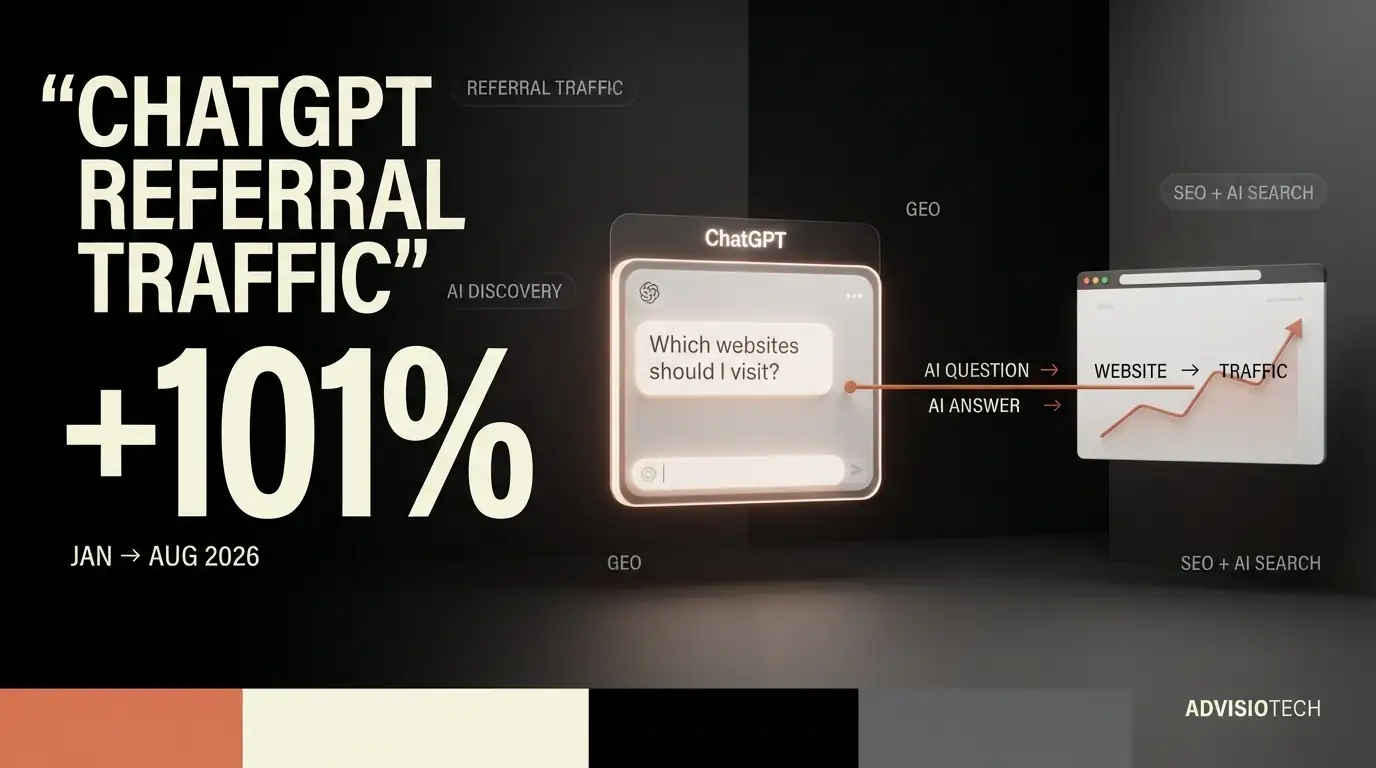
ChatGPT Is Sending More People to Websites Than It Was at the Start of 2026
Something interesting is happening to website traffic. People are increasingly asking AI assistants for answers, recommendations and research, and some of those conversations are ending with a click to a real website.
New data from BrightEdge shows that referral traffic from ChatGPT increased 101% between January and August 2026. In August alone, ChatGPT referral traffic increased 36% from the previous month. BrightEdge also reported that ChatGPT represented 95.1% of AI generated referral traffic in its dataset during August. :contentReference[oaicite:0]{index=0}
That does not mean 95.1% of all internet traffic comes from ChatGPT. It means that within the AI referral traffic measured by BrightEdge, ChatGPT accounted for that share. The distinction matters because AI referral traffic is still much smaller than traditional search traffic across the web.
But the direction is difficult for website owners to ignore. AI is becoming another discovery layer between a person and a business website.
What Is ChatGPT Referral Traffic?
ChatGPT referral traffic is website traffic that arrives after someone discovers or receives a website recommendation through ChatGPT and then clicks through to that site.
Imagine someone asks ChatGPT, "What are the best tools for creating a professional business website?" ChatGPT may provide an answer and, depending on the product experience and available web sources, include links to relevant websites. If the person clicks one of those links and reaches the website, that visit can appear as AI referred traffic in analytics.
This is different from someone searching Google for "best website design agency" and clicking a traditional search result.
The user is still visiting a website, but the discovery process happened somewhere else.
The Numbers Are Interesting, But There Is an Important Catch
BrightEdge's latest research is based on its own dataset, so its percentages should not be treated as a universal measurement of the entire internet.
Its data shows ChatGPT referral traffic rising 101% between January and August 2026, while total AI referral traffic increased roughly 73% in less than a year. BrightEdge reported that Gemini represented 2.4% of AI referral traffic in August, followed by Perplexity at 1.1% and Claude at 0.8% within its measurement. :contentReference[oaicite:1]{index=1}
Other datasets produce different numbers. For example, DataDome reported that ChatGPT represented 83.4% of AI referred visits to the customer sites it measured between January and June 2026. Another study from SE Ranking reported that AI platforms accounted for 0.32% of all website traffic in its dataset during 2026. :contentReference[oaicite:2]{index=2}
The exact percentage therefore depends heavily on what sites are being measured, what period is being studied and how the traffic is classified.
The broader signal is more useful than any single percentage: AI assistants are already capable of sending measurable traffic to websites, and that traffic is growing in several independent datasets.
Why This Matters If You Already Rank on Google
For years, the basic discovery model was relatively straightforward. Someone searched for something, Google displayed results, and the user chose a website.
AI changes the first part of that journey.
Instead of searching for ten websites and comparing them, someone can ask an AI assistant to research the subject, compare options, explain differences and recommend what to consider.
That means your website can potentially influence a decision before the user ever performs a traditional Google search.
There is another important difference. A Google ranking can put your page in front of someone who is actively searching. An AI answer can introduce your business while the person is still figuring out what they need.
That makes AI visibility relevant to businesses that sell services, software, products, information and expertise.
Being Mentioned by AI Is Not the Same as Getting AI Traffic
This is where many discussions about GEO become confusing.
A website can appear as a source or citation in an AI generated answer without receiving a click. Another website might receive the click even though several sources were considered during the answer generation process.
There are therefore at least two different goals.
The first is visibility: getting your brand, website or content surfaced when an AI system answers a relevant question.
The second is referral traffic: turning that visibility into an actual visit to your website.
A good AI visibility strategy should care about both.
So How Does a Website Get Mentioned in ChatGPT?
There is no simple public formula that says a website will be recommended if it uses a particular number of keywords or follows a fixed checklist.
AI products can use different systems, search features, retrieval methods and sources depending on the product and query. The exact process can also change over time.
That is why trying to reverse engineer one permanent "ChatGPT ranking factor" is unlikely to be a useful long term strategy.
A more practical approach is to make your website extremely clear about who you are, what you do, which questions you answer and why your information is trustworthy.
This Is Where GEO Comes In
Generative Engine Optimization, often shortened to GEO, is the practice of improving how a brand and its content can be discovered and understood across AI powered search and answer systems.
Traditional SEO focuses heavily on helping search engines understand and rank web pages.
GEO expands the problem. You also want your content to be understandable when an AI system is trying to answer a question, compare businesses, explain a concept or recommend resources.
That does not mean replacing SEO with GEO.
For most businesses, the two strategies overlap heavily because technically accessible websites, useful content, clear information architecture, strong topical coverage and credible information can help across multiple discovery systems.
What Should You Actually Do to Increase AI Visibility?
Start with the information that an AI system or potential customer would need to understand your business.
Your website should clearly explain what your company does, who it serves, what problems it solves and which services or products it provides. Avoid making important business information dependent on vague marketing language.
Create genuinely useful pages around questions your potential customers ask. Instead of producing dozens of shallow pages targeting slightly different keywords, build strong resources that answer real problems completely.
Make important facts easy to identify. Clear headings, descriptive page titles, concise explanations, FAQs and well structured service pages make information easier for both humans and machines to interpret.
Build topical authority naturally. If your business offers digital marketing, for example, publishing one generic article about SEO is less useful than building a coherent collection covering technical SEO, content strategy, local search, AI search visibility, analytics, conversion optimization and related customer questions.
Keep your business information consistent. Your company name, services, descriptions, contact information and other important facts should not contradict each other across your website and other reputable online sources.
And most importantly, do not write content purely for AI systems. The person reading the page is still the customer.
Your Website Needs to Answer Questions, Not Just Sell
This may be one of the biggest changes in search behavior.
A traditional service page might say, "We provide professional digital marketing solutions designed to accelerate business growth."
That sounds like marketing, but it does not answer many actual questions.
A stronger content ecosystem would also answer questions such as what digital marketing includes, how much different services can cost, how long SEO normally takes, how businesses can measure results, what GEO means, how AI search differs from Google Search and what a company should do before hiring an agency.
Those pages give potential customers useful information before they are ready to buy.
They also create more opportunities for your business to become relevant to specific questions people ask across search and AI platforms.
Do Not Ignore Traditional SEO
The rise of AI referral traffic does not mean Google Search is disappearing.
BrightEdge itself described traditional search as the primary driver of website traffic while noting that AI referrals are adding another discovery channel. :contentReference[oaicite:3]{index=3}
The smarter approach is to treat AI discovery as an additional layer rather than throwing away everything that already works in SEO.
Technical SEO still matters. Search intent still matters. Page experience still matters. Original content still matters. Internal linking still matters. Authority and reputation still matter.
The difference is that your content now has to work in a world where a user might encounter an answer before they encounter a search results page.
Google Is Also Giving Websites More Data About AI And Visual Discovery
This shift is not limited to ChatGPT.
Google announced new web multimodal Search reporting in Search Console on September 24, 2026. The reporting covers searches involving Google Lens, Circle to Search on Android, image uploads to Google Search and Chrome's "Search this image" feature. Google says the new multimodal search type can be viewed inside Search Console performance reports and the data can be exported. :contentReference[oaicite:4]{index=4}
Google also introduced dedicated reporting for visibility in generative AI features such as AI Overviews and AI Mode. Those reports can show impressions, pages, countries, devices and performance over time. :contentReference[oaicite:5]{index=5}
The message for website owners is straightforward: search is no longer just ten blue links and a text box.
People are searching with images, asking AI systems questions and discovering information through increasingly different interfaces.
How to Measure Whether AI Is Actually Sending You Visitors
The first step is to look at your analytics rather than assuming AI visibility automatically means traffic.
Check referral and acquisition reports for traffic associated with AI platforms. Depending on the analytics platform and how the visit is recorded, you may see traffic associated with domains or referral sources connected to AI services.
Do not judge the strategy only by total sessions. Look at which pages receive AI referred visits, how engaged those visitors are, whether they explore other pages and whether they eventually complete meaningful actions such as submitting a form, requesting a quote or making a purchase.
You should also monitor AI visibility separately from referral traffic when possible. Being mentioned in an AI answer and receiving a click are different outcomes.
What Kind of Pages Can Benefit Most?
There is no single page type guaranteed to receive AI traffic.
However, pages that answer specific questions can be particularly useful because they match the way people naturally interact with AI assistants.
Detailed guides, comparisons, original research, definitions, troubleshooting pages, service explanations, product documentation and expert explanations can all play a role.
For a digital marketing agency, for example, a page explaining "What is GEO?" could attract a very different audience from a page explaining "How much does SEO cost?" or "How do I make my business appear in AI search?"
Each page addresses a different information need.
That is much more useful than publishing dozens of articles that all say essentially the same thing.
What Not to Do
Do not create hundreds of AI generated pages simply because you think more pages automatically mean more visibility.
Do not stuff phrases such as "ChatGPT SEO" and "GEO optimization" into every paragraph.
Do not invent statistics to make an article look authoritative.
Do not copy articles from other websites and rewrite the wording slightly.
And do not assume that mentioning your brand repeatedly will make an AI system recommend you.
AI visibility is still an evolving area. There is no reliable shortcut that guarantees a brand will be cited or recommended.
The Bigger Change Is Not ChatGPT Itself
The important story is not simply that ChatGPT referral traffic increased 101% in one company's dataset.
The bigger change is that the path from question to website is becoming less predictable.
Someone can discover a company through Google Search, Google AI features, ChatGPT, Gemini, Perplexity, social media, YouTube, an image search or an AI agent.
For businesses, that means visibility is becoming more distributed.
Your website is no longer competing only for a position on a search results page. It is also competing to become a useful source that different discovery systems can understand, trust and surface.
What This Means for AdvisioTech
For businesses investing in digital marketing, the opportunity is not simply to rank for more keywords.
The bigger opportunity is to build a digital presence that explains the business clearly across traditional search and AI driven discovery.
That means combining technical SEO, useful content, strong service pages, structured information, brand consistency, analytics and GEO focused content strategy.
At AdvisioTech, our approach is built around helping businesses grow online through digital marketing and design, while adapting to the way people increasingly discover information.
FAQ
What is ChatGPT referral traffic?
ChatGPT referral traffic is traffic that reaches a website after a user discovers or receives a link to that website through ChatGPT or a related ChatGPT experience.
Did ChatGPT referral traffic really increase 101% in 2026?
BrightEdge reported that referral traffic from ChatGPT increased 101% between January and August 2026. This is BrightEdge's own dataset and should not be interpreted as a universal measurement of all websites on the internet. :contentReference[oaicite:6]{index=6}
Does 95.1% mean ChatGPT controls 95.1% of all website traffic?
No. BrightEdge reported that ChatGPT accounted for 95.1% of AI generated referral traffic in its August 2026 dataset. That is a share within the AI referral category measured by BrightEdge, not 95.1% of total internet traffic. :contentReference[oaicite:7]{index=7}
What is GEO in digital marketing?
GEO stands for Generative Engine Optimization. It refers to strategies intended to improve how a brand and its content can be discovered, understood and surfaced by AI powered search and answer systems.
Does GEO replace SEO?
No. GEO and SEO overlap, but they are not identical. Traditional SEO remains important for search visibility, while GEO focuses more specifically on visibility within generative AI experiences.
How can I get my website mentioned by ChatGPT?
There is no guaranteed method or publicly documented formula that ensures ChatGPT will mention a particular website. A practical strategy is to create original, useful, clearly structured content, establish consistent information about your business and build a website that answers real customer questions.
Should I stop focusing on Google SEO because of AI search?
No. Traditional search remains a major source of website traffic. AI discovery should be treated as an additional channel rather than a complete replacement for SEO. :contentReference[oaicite:8]{index=8}
How do I know if ChatGPT is sending traffic to my website?
Check your analytics platform's acquisition and referral reports for traffic associated with ChatGPT and other AI platforms. Then compare the landing pages, engagement and conversions of those visitors with other traffic sources.
The Bottom Line
ChatGPT is becoming a measurable source of website referrals, and the latest BrightEdge data shows its referral traffic more than doubled between January and August 2026. Other datasets also show AI assistants sending substantial and growing amounts of traffic to websites, although the exact numbers vary by dataset and methodology. :contentReference[oaicite:9]{index=9}
The lesson for businesses is not to chase a mysterious AI ranking formula.
Build a website that is technically accessible, clearly explains what you do, answers real questions and publishes genuinely useful information. Then measure where your visitors actually come from.
Google is still important. AI search is becoming important too. The businesses that understand both discovery systems will have more ways to be found when customers start asking questions.