Welcome to the Age of AI Tamagotchis, The New Wearable Gadgets Designed to Listen to Everything You Say
In the span of one week, three different companies launched wearable AI devices built to listen to your life and talk back, a keychain, a pendant, and a badge that acts like a digital friend. Nobody's calling this a category yet, but it already has a name floating around: AI Tamagotchis. Here's what's actually going on, and why the last time companies tried this, it flopped hard.
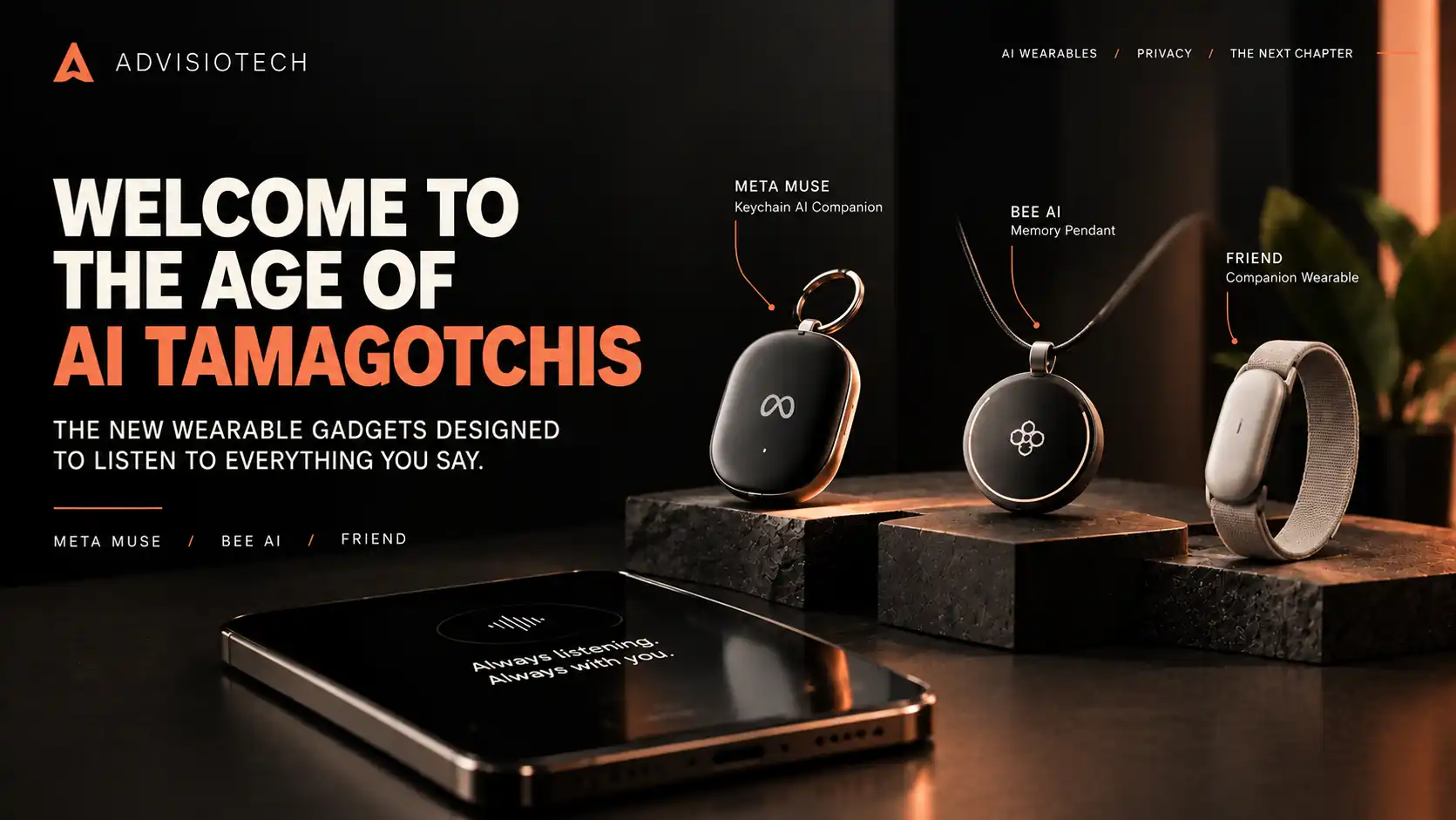
Welcome to the Age of AI Tamagotchis, The New Wearable Gadgets Designed to Listen to Everything You Say
Something genuinely strange happened in tech over the past couple of weeks, and almost nobody's connected the dots on it yet. Within days of each other, multiple companies launched small, wearable AI devices built around one core idea: a gadget that listens to your life, all day, and acts as a kind of ever-present digital companion. One tech newsletter, only half-joking, has started calling them "AI Tamagotchis," after the palm-sized digital pets that were everywhere in the late 1990s. The comparison is sharper than it sounds.
What Actually Launched, All at Once
**Meta's Muse Charm**, unveiled by Mark Zuckerberg at Meta Connect on September 17, is a small, keychain-sized device that runs Meta's Muse personal AI agent, the same AI that's already seen rapid growth as a standalone app. Meta has described it as something you can ask about a product on a store shelf, a flier on a wall, or a school supply list, and it will take action on your behalf. It's priced modestly and positioned as a lightweight companion to Meta's broader push into AI wearables, which also includes camera glasses, camera-free audio glasses, and a new mixed-reality headset.
**Bee AI**, a startup most people have never heard of, raised $7 million in seed funding around the same time for a wearable pendant built to record conversations throughout your day, essentially creating a running memory of your life that its AI can later reference and act on.
**Friend**, launched by a different company entirely, is a pendant explicitly marketed around companionship rather than productivity, designed to listen to its surroundings and respond in a way meant to mimic a real friend, complete with a deliberately gen-Z-coded launch campaign.
Three different companies, three different devices, one shared premise: a small, wearable object that's always listening, and always ready to talk back.
Why This Feels Familiar, and Why That's a Warning Sign
If this setup sounds like something that's already been tried and quietly failed, that's because it has. In early 2024, two heavily hyped AI wearables, the Humane AI Pin and the Rabbit R1, launched with enormous fanfare and collapsed almost as quickly. Reviewers found both devices frustrating and often broken in everyday use, and it later became clear the underlying AI simply wasn't capable enough yet to reliably deliver on what the marketing promised. Both products became widely cited cautionary tales about shipping an AI gadget before the AI itself was actually ready.
The genuine question hanging over this new wave is whether that same gap has actually closed. There's a real argument that it has, today's AI agents are considerably more capable of completing multi-step, real-world tasks, chasing down a refund, booking something, comparing prices, than what powered the Humane Pin or Rabbit R1 just two years ago. Whether that improvement is enough to avoid a repeat of 2024's very public flop is something only real-world use over the coming months will actually answer.
The Part That's Genuinely Unsettling
Here's what's easy to gloss over in the excitement of a product launch: every one of these devices is fundamentally built to listen. Not occasionally, when you activate it, but continuously, by design, since that's what makes it useful as an ever-present assistant. That's a meaningfully different privacy proposition than a phone sitting in your pocket that you actively pick up and unlock.
It also arrives at an interesting moment, given that Meta's own camera-equipped smart glasses have faced real, sustained backlash this year over people secretly recording others without consent, serious enough that Meta introduced a camera-free version specifically to address it. A keychain or pendant that's always listening raises a closely related question that hasn't gotten nearly as much attention: what about audio, not video? If a stranger sitting near you is wearing a device recording ambient conversation, that's arguably just as significant a consent question as a hidden camera, and it's one none of these launches have addressed head-on.
Why Companies Are Betting on This Anyway
According to Dan Ives, a technology analyst who's covered several of these announcements, the reasoning from the industry side is straightforward: trillions of dollars are being invested into AI infrastructure right now, and companies need genuinely compelling consumer products to justify and monetize that spending, not just cloud services and chatbots. A wearable, always-on companion is, in a sense, the most direct, personal way to put that investment into someone's daily life.
There's also a less discussed angle worth naming honestly: a growing body of commentary has connected this new wave of AI companion devices to what's often called the loneliness epidemic, the well-documented rise in social isolation, particularly among younger people. A device explicitly designed and marketed to feel like a friend, always listening, always responsive, is a direct, if slightly uncomfortable, product answer to that trend, whatever you make of it as a solution.
Should You Actually Get One?
If you're curious, there's genuinely nothing wrong with trying one, particularly something like the Muse Charm, which is low-cost enough to be a low-stakes experiment rather than a major purchase. But it's worth going in with clear eyes about what you're actually adopting: a device built around continuous listening, from a product category with a very recent, very public history of overpromising and underdelivering.
A few practical things worth checking before buying any device in this category: how and where your conversation data is actually stored, whether you can review or delete what it's recorded, whether it works offline or requires a constant connection to function at all, and realistically, how it performs on the specific tasks you'd actually want it for, rather than the polished tasks shown in a launch demo.
The Bottom Line
"AI Tamagotchi" is a funny name, but it's pointing at something real: an entire new product category is being born in real time, several companies at once, all betting that people are ready to wear a device that listens to their life continuously in exchange for genuine, useful help. The last time this exact bet was made, it failed publicly and quickly. Whether this round is different will come down to something no launch keynote can answer: how these things actually perform once they're out in the world, worn by ordinary people, doing ordinary things, rather than a company's own demo.
FAQ
What is an "AI Tamagotchi"?
It's an informal, only half-joking term being used to describe a new wave of small, wearable AI companion devices, like Meta's Muse Charm, Bee AI's pendant, and the Friend pendant, that continuously listen and respond throughout a person's day, compared to the palm-sized digital pets popular in the late 1990s.
What is Meta's Muse Charm?
It's a small, keychain-sized wearable device unveiled at Meta Connect on September 17, 2026, that runs Meta's Muse personal AI agent, allowing users to ask questions and get help with everyday tasks by speaking to it.
Have AI wearables like this been tried before?
Yes, and they largely failed. The Humane AI Pin and Rabbit R1 both launched with major hype in early 2024 and quickly became cautionary tales after reviewers found the underlying AI wasn't capable enough to reliably deliver on its promises.
Are these devices always recording?
Most devices in this category, including pendants like Bee AI and Friend, are designed to listen continuously as part of their core functionality, which raises genuine privacy and consent questions, particularly for people nearby who aren't using the device themselves.
Why are multiple companies launching similar devices at the same time?
Analysts point to massive ongoing AI infrastructure investment needing consumer products that can justify and monetize it, alongside a genuine belief that today's AI agents are finally capable enough to deliver on promises that failed with earlier devices like the Humane Pin.
Is it safe to use an AI wearable that listens continuously?
That depends on the specific device and company. It's worth checking how conversation data is stored, whether you can review or delete recordings, and understanding that anyone near you may also be recorded without their own knowledge or consent.