92% of Indian Shoppers Are Already Using AI to Shop, Here's What Businesses Need to Do Before AI Becomes the New Google
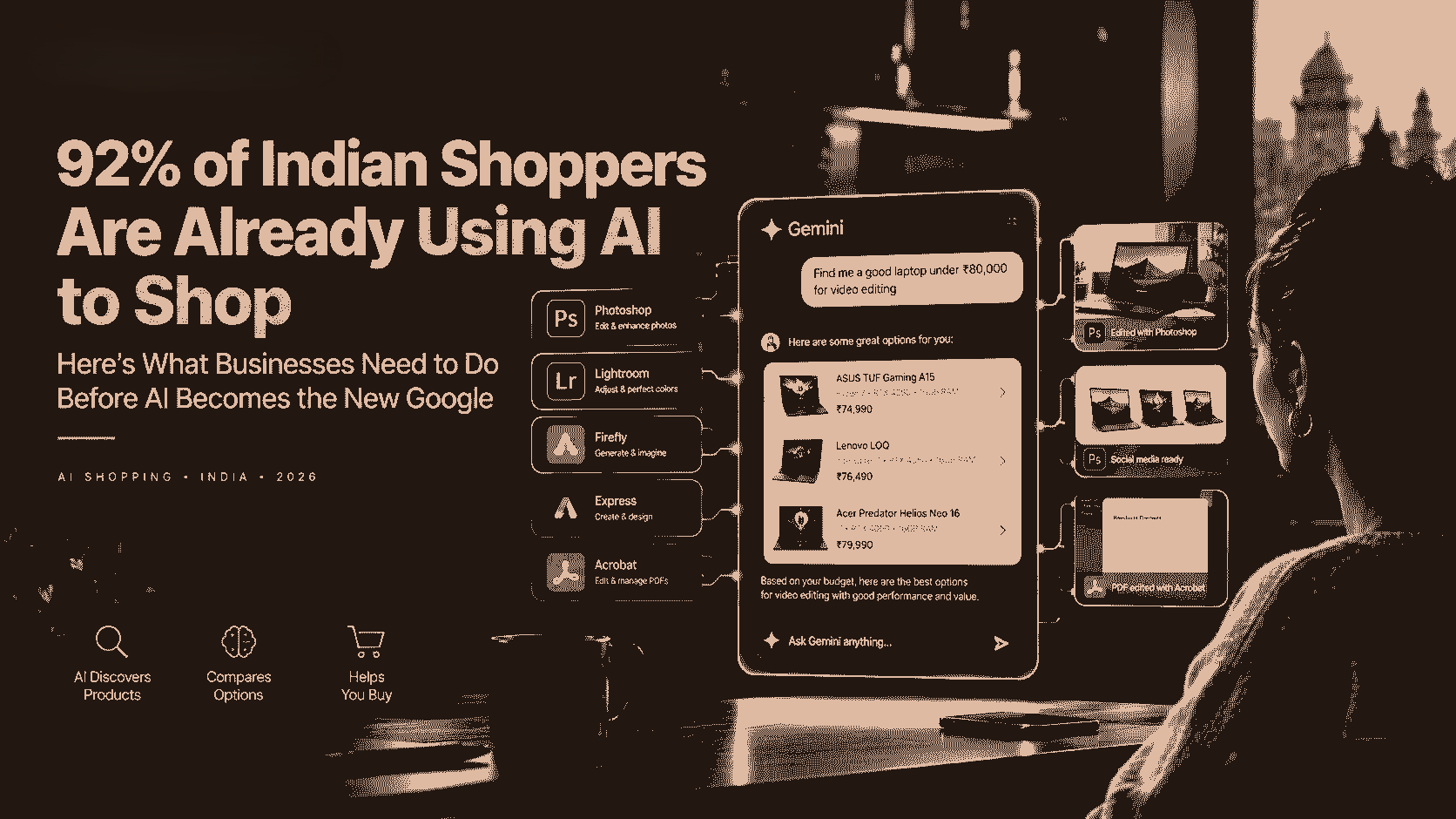
AI is no longer just helping people write emails or answer questions. A new NIQ study found that 92% of surveyed urban Indian shoppers had already used AI while shopping in the previous month, while 96% said they were open to AI-powered shopping tools. As ChatGPT, Gemini and other AI systems move deeper into product discovery and purchasing, businesses may have to optimize for a new kind of customer journey where an AI decides what people see before they ever visit a website.
AI Shopping Has Quietly Become a Big Deal in India
For years, businesses were taught that the path to an online customer was simple: get found on Google, rank well, attract a click, and convince the visitor to buy. That model is starting to change.
A September 2026 report from NIQ found that 92% of surveyed urban Indian shoppers had used at least one AI tool while shopping during the previous month. The study covered India's top eight metros and 16 product categories, so the number should not be treated as a measurement of every Indian consumer. But the finding points to a major shift in how people are discovering and evaluating products. :contentReference[oaicite:0]{index=0}
NIQ also reported that 96% of the surveyed shoppers were open to using AI-powered shopping tools, while 87% said they were comfortable receiving AI-powered product recommendations. :contentReference[oaicite:1]{index=1}
That matters because AI is moving further up the shopping funnel. Instead of someone searching for ten products, opening ten websites and comparing them manually, an AI assistant can increasingly help with the research, comparison and recommendation process.
What Does AI Shopping Actually Mean?
AI shopping is bigger than simply asking ChatGPT which shoes to buy.
Today's AI shopping experience can involve discovering products, comparing options, summarizing reviews, finding deals, evaluating different brands and, increasingly, helping complete the purchase.
NIQ describes this broader shift as agentic commerce, where AI systems increasingly participate in product discovery, evaluation and purchasing decisions. :contentReference[oaicite:2]{index=2}
Google is also building infrastructure for this type of commerce. Its Universal Commerce Protocol is designed to allow AI agents and commerce systems to communicate across parts of the shopping journey, including product information, carts and purchasing experiences. :contentReference[oaicite:3]{index=3}
This means the future customer may not always begin with a traditional Google search.
They might begin with a question such as: "Find me a good laptop under ₹80,000 for video editing."
The AI could then research products, compare specifications, consider reviews and present a small number of recommendations.
The customer may never visit ten different websites.
Why This Changes the Game for Businesses
Traditional SEO is largely built around getting a webpage to appear in search results and earning a click.
AI-mediated shopping introduces another question: does the AI understand your business or product well enough to recommend it in the first place?
That is a different visibility problem.
A business can have a beautiful website and still provide weak information for an AI system if its products, services, pricing, specifications, policies and customer-facing information are incomplete, inconsistent or difficult to interpret.
NIQ and Similarweb are already working on ways to measure this emerging environment, including what they call agentic shelf visibility and product content readiness. Their planned measurement solution is intended to help brands understand whether products appear in AI-driven discovery and whether product information is complete enough for AI systems to understand and recommend accurately. :contentReference[oaicite:4]{index=4}
AI Could Become a New Discovery Layer
Google has already started building AI into the shopping journey rather than keeping AI separate from search.
Google says its Universal Commerce Protocol is being integrated into shopping experiences including AI Mode in Search and the Gemini app. Its January 2026 announcement also described Business Agent, merchant-focused conversational experiences and new Merchant Center capabilities designed for conversational commerce. :contentReference[oaicite:5]{index=5}
For businesses, this creates a new question alongside traditional rankings: when someone asks an AI assistant for recommendations in your category, is your business represented accurately and given enough context to be considered?
That is where concepts such as Generative Engine Optimization, or GEO, and Answer Engine Optimization, or AEO, become increasingly relevant.
What Businesses Should Start Doing Now
The answer is not to stuff websites with AI-generated articles or repeat the same keywords hundreds of times. AI systems need useful information, not keyword spam.
- **Build clear product and service pages**: Explain exactly what you sell, who it is for, important features, pricing where appropriate, limitations and frequently asked questions.
- **Keep business information consistent**: Your website, business profiles, product feeds and other important online references should not contradict one another.
- **Answer the questions customers actually ask**: Build useful FAQ and comparison content around real customer problems instead of publishing articles only because a keyword has search volume.
- **Strengthen topical authority**: A single sales page rarely gives an AI system enough context. Supporting guides, explanations, case studies and expert content can create a clearer picture of what your business knows.
- **Make product information structured and complete**: Google is introducing richer conversational attributes and AI Performance Insights for merchants as part of its broader AI-commerce infrastructure. :contentReference[oaicite:6]{index=6}
- **Don't ignore traditional SEO**: AI discovery does not mean Google Search has disappeared. Search visibility, useful content, technical SEO, brand mentions and strong websites still matter.
- **Monitor how AI represents your brand**: Search for your business and products across different AI systems and look for missing, outdated or incorrect information.
The Biggest Change May Be Who Makes the Shortlist
The most important change is not necessarily that AI can press the Buy button.
It is that AI can increasingly influence which products make it into the customer's consideration set.
Imagine two businesses selling similar products. A customer asks an AI assistant for three recommendations. If the AI understands one business clearly but has incomplete information about the other, the second business could potentially be invisible during the recommendation stage even though its website ranks well for traditional searches.
This is why AI visibility is becoming a business problem, not just a technology problem.
But AI Shopping Has a Serious Trust Problem
The growth of AI shopping does not mean consumers should blindly hand over purchasing decisions to an agent.
On September 22, 2026, Reuters reported that a group of major banks including NatWest, Bank of America, ING, Capital One, ASB Bank and Commonwealth Bank of Australia warned that AI shopping agents could create risks involving scams, fraud and data privacy. The banks said the technology was developing faster than existing industry standards and consumer protections. :contentReference[oaicite:7]{index=7}
The concerns include situations where an AI agent could buy the wrong product, spend more than expected, expose sensitive payment information or direct consumers toward payment methods with weaker protections. :contentReference[oaicite:8]{index=8}
The banks proposed safeguards including clearer disclosure when an AI agent is involved in a transaction and greater transparency around how AI agents make decisions. :contentReference[oaicite:9]{index=9}
So the future of AI shopping will not depend only on how intelligent the AI becomes. It will also depend on whether consumers trust the systems enough to let them act on their behalf.
AI Shopping Is Already Moving Beyond Experiments
The change is not limited to research papers and futuristic demonstrations.
NIQ's research shows significant current AI-shopping usage among its surveyed urban Indian consumers. Google is building commerce infrastructure specifically for AI-mediated shopping, while banks and retailers are already discussing the risks and commercial consequences of agents participating in transactions. :contentReference[oaicite:10]{index=10}
Reuters also reported that UK retailer John Lewis said searches originating from AI agents had risen from 0.3% to 2.5% over a year. That figure is specific to John Lewis and should not be interpreted as a universal measurement of AI shopping traffic. :contentReference[oaicite:11]{index=11}
But the direction is difficult for businesses to ignore: AI is increasingly becoming another layer through which customers discover products.
What This Means for Digital Marketing
Digital marketing used to revolve around a relatively predictable sequence: search query, search result, website visit and conversion.
The emerging AI shopping journey can look very different: customer question, AI interpretation, product shortlist, recommendation, website visit or agent-assisted purchase.
That creates a new optimization problem.
Businesses now need to think not only about whether a customer can find their website, but whether AI systems can understand what the business offers, recognize its relevance and accurately describe it when customers ask for recommendations.
This does not replace SEO. It expands the visibility problem.
For agencies and businesses, the opportunity is to combine technical SEO, high-quality content, structured product information, strong brand signals and AEO/GEO strategies rather than treating AI visibility as a completely separate marketing universe.
The Bottom Line
AI shopping is moving from an interesting experiment toward a real part of the customer journey.
NIQ's September 2026 research found that 92% of surveyed urban Indian shoppers had already used AI while shopping, and Google is actively building infrastructure that allows AI systems to participate more deeply in commerce. :contentReference[oaicite:12]{index=12}
For businesses, the lesson is straightforward: don't wait until AI becomes a major shopping gateway before thinking about how your brand appears inside it.
Your next customer may not ask Google which website to visit.
They may ask an AI which business or product they should choose.
And when that happens, being visible may depend on whether the AI can understand your business in the first place.
FAQ
Are Indian consumers really using AI to shop?
A September 2026 NIQ study found that 92% of surveyed urban Indian shoppers had used at least one AI tool while shopping during the previous month. The study covered India's top eight metros and 16 categories, so the figure should not be treated as representative of every Indian consumer. :contentReference[oaicite:13]{index=13}
What is agentic commerce?
Agentic commerce refers to shopping experiences in which AI agents do more than provide information. They can increasingly help with product discovery, evaluation, recommendations and, in some systems, purchasing-related tasks. :contentReference[oaicite:14]{index=14}
Is AI replacing Google Search?
Not based on the evidence discussed here. AI is becoming another discovery layer alongside traditional search. Google itself is integrating AI shopping experiences into Search and Gemini rather than describing AI commerce as a replacement for all traditional search. :contentReference[oaicite:15]{index=15}
What is GEO?
GEO, or Generative Engine Optimization, generally refers to optimizing a brand's online presence so generative AI systems can better discover, understand and potentially reference the business or its content.
What is AEO?
AEO, or Answer Engine Optimization, focuses on making information clear and useful for systems that provide direct answers to user questions, including AI-powered search and answer experiences.
Should businesses create lots of AI-generated content for AI search?
No. Publishing large amounts of low-value content simply to target AI search can create more noise than authority. Businesses should focus on accurate, useful and genuinely relevant information that clearly explains their products, services and expertise.
Are AI shopping agents safe?
There are real unresolved risks. Major banks have warned about scams, fraud, privacy breaches, incorrect purchases and payment-security issues, while also calling for stronger transparency and safeguards. :contentReference[oaicite:16]{index=16}
What should a business do about AI search and AI shopping?
Start with the fundamentals: maintain accurate website and product information, build useful expert content, strengthen technical SEO, keep important business information consistent across the web, make product information structured and complete, and monitor how AI systems describe and recommend your brand.