What Is GEO and AEO? Why Your Competitor Shows Up in ChatGPT and You Don't
SEO used to be the whole game. Now a growing share of your customers never see a ranked list at all, they just ask ChatGPT or Google's AI Overview and get an answer instantly, sometimes recommending your competitor by name instead of you. GEO and AEO are the disciplines built to fix that. Here's everything they actually mean, and the exact questions business owners are asking about them right now.
What Is GEO and AEO? Why Your Competitor Shows Up in ChatGPT and You Don't
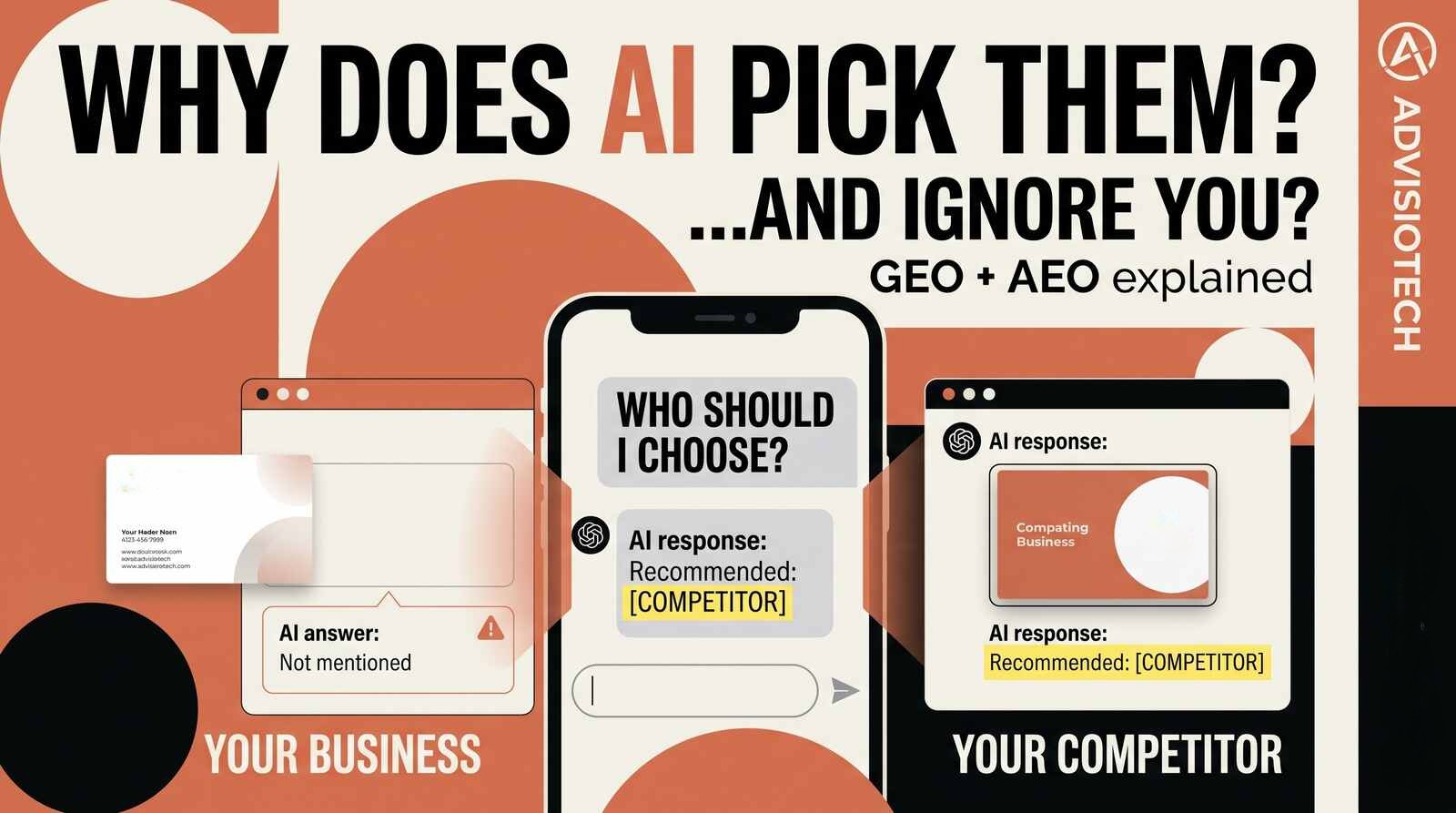
Here's an experiment worth trying right now: open ChatGPT or Gemini and ask it a question a customer might ask about your industry, something like "who's a good [your service] near me" or "what should I look for in a [your product] company." See if your business gets mentioned. Now ask yourself: if it didn't, but your competitor's did, do you actually know why?
That gap, between businesses that show up when AI recommends someone and businesses that quietly don't, is exactly what two newer marketing disciplines, GEO and AEO, exist to address. Both terms get thrown around constantly right now, often used loosely or interchangeably, which is part of why so many business owners are confused about what they actually mean and whether either one applies to them. This is the plain-English breakdown of both, built around the actual questions people are typing into search bars trying to understand this.
SEO vs AEO vs GEO: The Difference That Actually Matters
Before anything else, it helps to separate three terms that get blended together constantly.
**SEO (Search Engine Optimization)** is the discipline you already know. It's about ranking your website in a traditional list of search results on Google, so a person sees your link among several others and chooses to click it. The goal is a click, and being ranked third or fifth still earns you real traffic.
**AEO (Answer Engine Optimization)** is about being chosen as the direct answer itself, not just one of several links. When a search shows a featured snippet, a People Also Ask box, a voice assistant's spoken response, or Google's AI Overview, one source, sometimes a small handful, gets pulled up and presented as the answer, rather than just listed as an option. AEO is the work of structuring your content so it's the one that gets selected for that spot. Unlike SEO, there's no ranking involved, either your content gets pulled into the answer, or it doesn't.
**GEO (Generative Engine Optimization)** is the broadest of the three. It's about getting your content selected, cited, and referenced by generative AI systems, ChatGPT, Perplexity, Gemini, Claude, Copilot, when they synthesize a longer, conversational answer from multiple sources, often in tools that have no traditional results page or featured snippet at all. GEO covers the entire AI-driven ecosystem, not just Google's specific answer features.
A simple way to hold all three in your head: SEO gets you found. AEO gets you selected. GEO gets you quoted. They build on top of each other rather than replacing one another, and in practice, most agencies now treat improving all three as one connected strategy rather than separate jobs, because the underlying content quality work overlaps heavily.
The Real Questions Business Owners Are Asking About This (Answered Directly)
Search data shows a very specific, very underserved set of questions business owners are actively asking about AI visibility right now, questions most existing guides don't answer clearly. Here they are, answered directly.
Can AI actually bring customers to a small business?
Yes, and often higher-quality customers than traditional search traffic. People who ask an AI assistant a detailed question and then click through to a business tend to already be further along in deciding what they want, some research suggests AI-referred visitors convert at noticeably higher rates than average organic traffic. The catch is that this only works if your business gets mentioned in the first place, which is the entire problem GEO and AEO exist to solve.
Why does ChatGPT recommend my competitor but not my company?
Usually not because your competitor has better SEO. AI systems weigh a different mix of signals: how consistently a business is described across the web, whether other trustworthy sites and third parties mention it, how clearly its content answers specific questions, and how recently that information was updated. A competitor with fewer Google rankings but stronger, more consistent presence across review sites, forums, and press mentions can easily out-cite you in AI answers.
How do I know if my business is visible in ChatGPT?
The simplest method is manual testing: open ChatGPT, Gemini, and Perplexity in a fresh, logged-out or incognito session, so personalization doesn't skew results, and ask the kinds of questions a real customer would ask about your category. Note whether your business is mentioned, and how it's described. For a more systematic view, specialized GEO tracking tools now exist that run this kind of test at scale and monitor it over time.
How do you measure GEO ROI?
Three things to track: referral traffic from AI platforms in your website analytics, most tools now show traffic sources like chatgpt.com or perplexity.ai directly; your "Share of Model," meaning the percentage of relevant test questions where your brand actually gets mentioned across AI tools; and the conversion rate of that AI-referred traffic specifically, compared against your regular organic traffic, to see whether those visitors are converting at a different rate.
Why does AI mention some businesses and ignore others?
It comes down to a handful of consistent factors: clear, directly-answered content near the top of a page, verifiable claims backed by sources or data, a consistent brand identity across the web, and some degree of third-party validation, meaning other sites and sources also talk about the business in similar terms. Businesses that are vague, inconsistent, or only exist on their own website with no outside corroboration tend to get skipped.
Why is ChatGPT citing a website with worse SEO than mine?
Because AI citation and Google ranking are genuinely different scoring systems, not the same thing measured two ways. SEO rewards backlinks, keyword targeting, and technical performance. AI systems care much more about whether a piece of content directly and clearly answers a specific question, whether it can be confidently attributed to a real source, and how it's corroborated elsewhere. A page can be a weak Google performer and still be an excellent AI citation, if it's simply the clearest, most directly useful answer to that particular question.
If I'm #1 on Google, why doesn't ChatGPT mention me?
Because the overlap between top-ranking Google pages and AI-cited sources has reportedly dropped to below 20% in recent research, down from around 70% not long ago. AI systems don't simply pull from the top of Google's results, they run their own retrieval and evaluation process, often breaking your question into smaller related sub-questions and searching each separately. Ranking first for the exact phrase someone typed doesn't guarantee you're the best match for the fragments the AI is actually searching behind the scenes.
Why am I getting AI referrals but no conversions?
A few common causes: the landing page a visitor arrives on doesn't match what the AI told them to expect, the page fails to quickly build the same trust the AI's answer already implied, or the traffic is coming from earlier-stage, research-focused questions rather than buying-intent ones. It's worth checking what specific questions are driving that AI referral traffic and whether your landing experience actually delivers on what was promised in the AI's answer.
Does GEO work for a small business with almost no backlinks?
Often better than SEO does, actually. Since AI citation leans more heavily on content clarity, direct answers, and consistent entity signals than on raw backlink volume, a small business with limited link-building resources but clear, well-structured, genuinely useful content can compete for AI citations in a way that's much harder in traditional SEO rankings, where backlink authority still carries enormous weight.
Can a website be technically perfect but still invisible to AI?
Yes, and this happens more often than people expect. A site can have flawless technical SEO and still be invisible to AI systems if its robots.txt file unintentionally blocks AI crawlers, if the content doesn't clearly and directly answer specific questions, or if there's no outside corroboration of the business anywhere else online. Technical health is necessary, but it's not sufficient on its own.
Does AI-written content hurt your chances of being cited by ChatGPT?
Not because of who or what wrote it, AI systems generally aren't detecting and penalizing AI-generated text specifically. What actually hurts citation chances is generic, unoriginal content that simply repeats what's already available elsewhere, which happens to be a common trait of low-effort AI content, but is just as damaging when a human writes it. Originality, specific data, and a genuine point of view are what earn citations, regardless of how the words were produced.
How does ChatGPT know what my company actually does?
Largely by cross-referencing how your business is described across multiple places on the web, your website's own "About" content, your Google Business Profile, your LinkedIn page, directory listings, and any press or third-party mentions. When these all describe your business consistently, AI systems build a clearer, more confident picture of what you do. When they conflict or are vague, it becomes harder for the AI to summarize or recommend you with confidence.
Do Google reviews affect what ChatGPT recommends?
There's growing evidence they play a role, even if indirectly. AI systems often draw on review-aggregator content and broader trust signals when forming an impression of a business, and reviews contribute to exactly the kind of third-party validation AI systems weigh when deciding whether a business is worth mentioning confidently.
Why does ChatGPT trust Reddit more than my company's website?
Because forums like Reddit are full of first-person, unpolished, seemingly unbiased opinions, which AI systems tend to treat as more genuine and trustworthy than content published directly by a business talking about itself. It's a real structural bias worth knowing about: a business's own marketing copy is inherently self-interested in the AI's evaluation, while a stranger's forum post recommending that same business carries more perceived credibility, even if it's less detailed or accurate.
Can AI recommend my business even if I don't rank #1 on Google?
Yes, and this is one of the more encouraging parts of how GEO works. Unlike SEO, there's no single "position one" to fight over in AI answers. A page that has never cracked Google's top ten can still earn an AI citation, especially for the smaller, related sub-questions an AI system searches behind the scenes, if it directly and clearly answers one of those fragments well.
How can I test what ChatGPT says about my business?
Ask it directly, in a fresh session without prior conversation history influencing the answer, using the kinds of questions real customers would ask, not just your business name. Try variations: "best [category] in [your city]," "who should I use for [specific service]," "is [your business] good." Repeat this periodically, since AI answers can shift as models update and as your own content and citations change.
What should I do if ChatGPT gives customers wrong information about my company?
Start by publishing a clear, well-structured, and clearly dated correction on your own website, since that becomes a source future AI retrieval can pick up. It's also worth checking whether the AI platform in question offers any feedback or reporting mechanism for factual errors. Beyond that, the same GEO fundamentals apply: the more consistently accurate information about your business exists across multiple trusted sources, the less room there is for an AI system to synthesize an inaccurate answer in the first place.
What Actually Moves the Needle Across Both GEO and AEO
Based on current research and practitioner findings, these tactics consistently help across both disciplines:
- **Answer questions immediately.** Open each section with a direct two-to-three sentence answer before adding supporting detail.
- **Back every claim with something concrete.** Princeton's original GEO research found that citing sources, including statistics, and adding direct quotations improved AI visibility by roughly 30% to 40% compared to unoptimized content.
- **Keep your identity consistent everywhere.** The same brand name, author names, and service descriptions across your website, Google Business Profile, LinkedIn, and directory listings.
- **Structure for extraction.** One idea per paragraph, headers phrased as real questions, and FAQ or HowTo schema markup where it fits.
- **Check that AI crawlers can actually reach you.** Many sites unintentionally block AI bots through robots.txt or hosting-level defaults without realizing it.
- **Say something original.** Content that only repeats what's already widely available gives an AI no real reason to cite you over anyone else.
- **Stay current.** Outdated pricing, stats, or examples are one of the fastest ways to lose a citation to a competitor with fresher content.
The Bottom Line
For twenty years, showing up on Google was basically the whole game. That game hasn't disappeared, but it's no longer the only one being played. A growing share of the questions your future customers are asking now get answered entirely inside ChatGPT, Gemini, or an AI Overview, sometimes recommending your competitor by name, sometimes not mentioning either of you at all. GEO and AEO aren't rebrands of SEO with trendier names, they're a genuine response to that shift, and the businesses paying attention now are quietly building a head start over the ones who'll only notice once their traffic has already dropped.
FAQ
What's the difference between AEO and GEO in one sentence?
AEO is about being pulled into a direct answer feature like a featured snippet or AI Overview, while GEO is the broader discipline of being cited and referenced across the full range of generative AI tools, even ones with no traditional search results page at all.
Do I need to choose between SEO, AEO, and GEO?
No. They build on the same foundation of clear, well-structured, trustworthy content, and most agencies now treat improving all three as one connected strategy rather than separate, competing efforts.
Is it too late to start working on GEO and AEO?
No. AI-generated answers reportedly appear for around 15% to 20% of searches today and that share is still climbing, which means most businesses, including most of your competitors, haven't seriously addressed this yet either.