UPI Is About to Start Charging Fees, And Ashneer Grover Isn't Happy About It: The Full UPI MDR Controversy Explained
From October 15, 2026, UPI will start charging merchants a small fee on bigger transactions, and it's sparked a full-blown public fight, with Ashneer Grover calling it a tax grab and PhonePe's CEO firing back. Here's exactly what's changing, who's angry about it, and what it actually means for your wallet and your business.
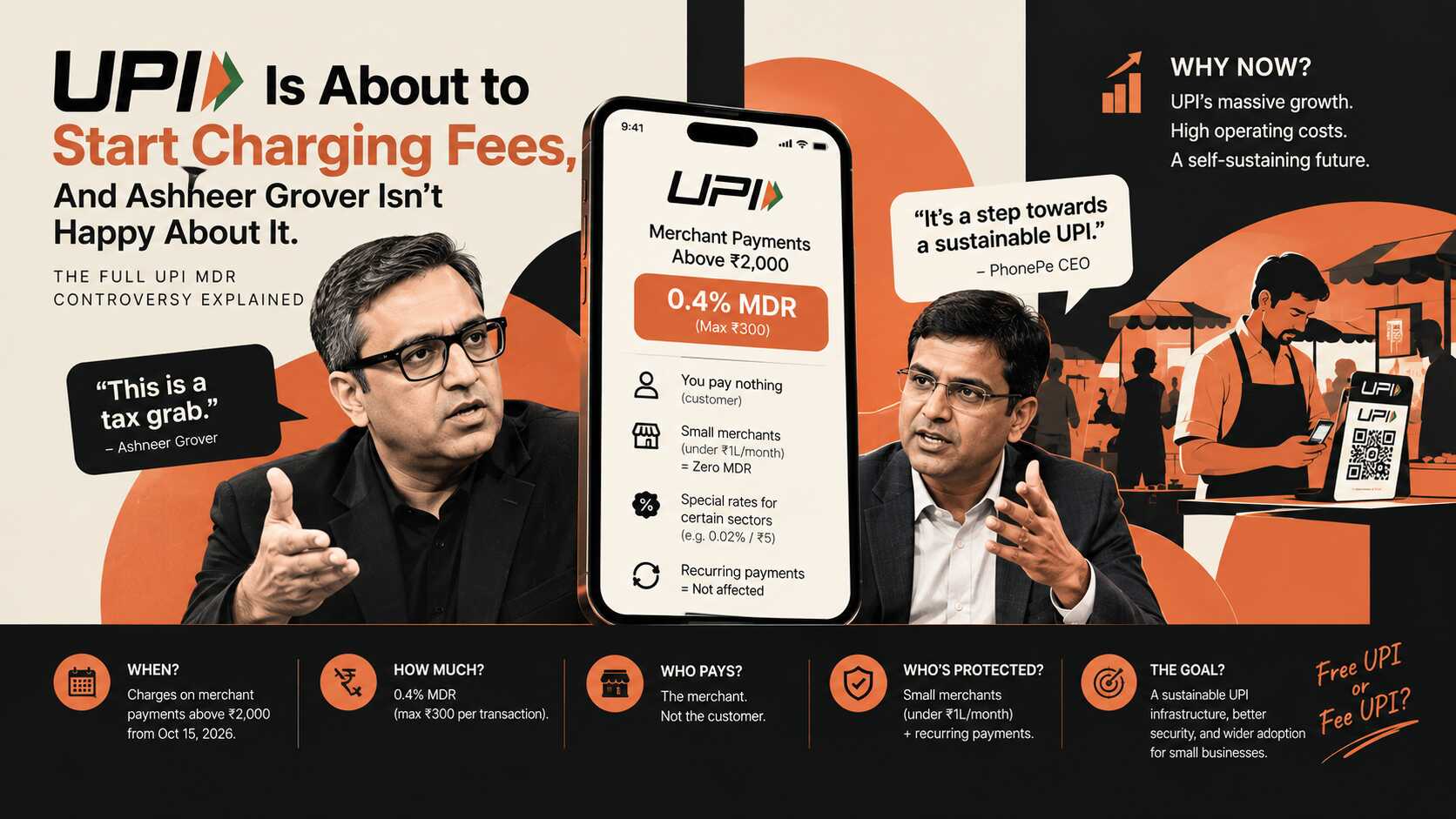
UPI Is About to Start Charging Fees, And Ashneer Grover Isn't Happy About It: The Full UPI MDR Controversy Explained
For six years, UPI has meant one thing to every Indian who's used it: it's free. Send money to a friend, pay the vegetable vendor, split a dinner bill, all of it, zero charges, every time. That's now changing, at least partially, and it has triggered one of the loudest fintech arguments India has seen in years, with entrepreneur Ashneer Grover on one side, PhonePe's CEO on the other, and half the startup world weighing in between them.
If your feed has been full of "UPI charges," "MDR," and Ashneer Grover's name over the last few days, here's what's actually going on, broken down without the jargon.
What's Actually Changing (The Simple Version)
On September 14, 2026, the government issued an official notification confirming that everyday UPI use stays free. Sending money to a friend or family member remains free no matter how large the amount. Paying a shopkeeper, a street vendor, or a small business up to ₹2,000 also remains completely free, for both the customer and the merchant.
The change is specifically about merchant payments above ₹2,000. Starting October 15, 2026, the National Payments Corporation of India, the body that runs UPI, will apply a small fee called a Merchant Discount Rate, or MDR, on select business transactions above that threshold. The standard rate is 0.4%, and it's capped at ₹300 per transaction, so even a ₹1 lakh payment won't cost the merchant more than ₹300 in fees.
A few important details that have gotten lost in the noise:
- **You, the customer, don't pay this fee.** It's charged to the merchant receiving the payment, and banks have been directed not to let merchants pass it on to customers.
- **Small merchants are largely protected.** Businesses receiving under ₹1 lakh a month through UPI stay at zero MDR even on transactions above ₹2,000.
- **Some sectors get special, lower rates.** Capital market transactions, like moving money to a stockbroker, are charged a much smaller 0.02%. Categories like railways, telecom, insurance, and fuel get a flat ₹5 fee instead of the percentage-based rate.
- **Recurring payments are unaffected.** UPI Autopay and mandates, things like subscriptions and EMI-style payments, stay outside the MDR framework entirely.
For comparison, credit cards typically charge merchants between 1.5% and 2.5% in fees, and debit cards charge up to 0.9%. Even with the new charge, UPI stays dramatically cheaper for merchants than card payments.
Why Is This Happening Now?
UPI has grown into something genuinely massive. NPCI processed over 2,451 crore transactions worth roughly ₹29.9 lakh crore in August 2026 alone. Running that kind of infrastructure, including fraud prevention, servers, and customer support, costs real money, and until now, that cost has largely been absorbed by banks and the government rather than charged to anyone using the system.
The government's own figures reportedly put UPI's operating cost at around ₹20,700 crore against a much smaller ₹2,000 crore budget allocated to support it, a gap officials say isn't sustainable long-term. The stated goal of the new MDR is to build a more self-funding model for UPI's infrastructure and security, while keeping the vast majority of everyday transactions completely untouched. Five percent of whatever MDR is collected is also earmarked for a fund specifically meant to expand UPI adoption among small merchants.
Enter Ashneer Grover
This is where things got loud. Ashneer Grover, the outspoken former BharatPe co-founder and familiar face from Shark Tank India, went after the new charges hard on social media and in television interviews. His core argument: UPI doesn't actually need this money. He pointed to the RBI's massive surplus transfer to the government, the combined profits of India's listed banks, and NPCI's own reported cash reserves and pre-tax profit as evidence that introducing a charge now isn't about sustainability, it's simply a new way to collect revenue dressed up as a fee. He's been blunt about it, essentially arguing that once UPI starts charging anything at all, its entire appeal as India's free, frictionless payment system starts to unravel.
PhonePe's CEO wasn't having it. He publicly dismissed Grover's criticism, pointing out that the overwhelming majority, by his account around 95 to 96%, of merchant UPI transactions fall under ₹2,000 and therefore won't be affected by the new charge at all. His argument is straightforward: this isn't a tax on ordinary Indians or small shopkeepers, it's a modest fee on a narrow slice of higher-value transactions, and it's still far cheaper than the alternative payment methods those merchants would otherwise be stuck with.
Adding another layer to the drama, BharatPe, the company Grover co-founded and was later removed from, published a statement distancing itself entirely from his comments, clarifying that he's had no association with the company since 2024 and that his views were expressed purely in a personal capacity, not on the company's behalf.
It's Not Just Grover vs PhonePe
The wider fintech world has split into a genuinely interesting debate, and not everyone falls neatly into a for-or-against camp.
Zerodha's Nithin Kamath took a more nuanced position. He said he isn't fundamentally against an MDR and even called it more or less inevitable given how dominant UPI has become. But he flagged a specific problem for stockbroking: regulations require brokers to periodically return unused client funds, and those funds often come right back to the broker via UPI without any actual trade happening. If a broker gets charged MDR every time that money moves back and forth due to a regulatory requirement, not a completed transaction, that cost adds up with no matching revenue. He suggested a much smaller cap, closer to ₹5 or ₹10, would make more sense for that specific use case than the standard ₹300 cap.
Meanwhile, executives at MobiKwik and PhonePe have broadly welcomed the move, arguing that fintech companies and banks have effectively been absorbing UPI's operating costs out of their own pockets for years, and that a sustainable funding model actually strengthens the system's long-term future rather than threatening it. Some small business owners have taken a middle path too, writing directly to the Prime Minister's office to ask that any fee structure account for how thin retail margins actually are, rather than judging affordability purely by transaction size.
What This Means For You
If you're an ordinary consumer sending money to friends and family, or paying for groceries and small everyday purchases, nothing changes. Your UPI experience stays exactly as free as it's always been.
If you run a business and regularly receive UPI payments above ₹2,000, for example a larger retail purchase, a service invoice, or a big-ticket order, you'll start seeing a small deduction on those specific transactions from October 15 onward, unless you qualify for the small-merchant exemption. It's worth checking where your business falls under the new framework before the change takes effect, so there are no surprises on your settlement amounts next month.
The Bigger Question Nobody's Fully Answered Yet
Strip away the personalities and the social media back-and-forth, and this controversy is really about one unresolved question: can something be free forever if the infrastructure behind it keeps growing? Grover's camp says the money already exists elsewhere in the system and this is an unnecessary money grab. The industry's other camp says a completely unfunded, always-free model was never going to scale indefinitely, and a small, well-capped fee on high-value merchant transactions is a reasonable trade-off to keep the whole system healthy.
Whichever side turns out to be right, October 15 will be the real test. That's when we'll find out whether a 0.4% fee on a narrow slice of transactions quietly settles into the background the way most fee changes eventually do, or whether it becomes the first crack in what has been India's most beloved "it just works, and it's free" digital success story.
FAQ
Will I be charged for using UPI now?
No, not if you're a regular consumer. Person-to-person payments remain completely free at any amount, and merchant payments up to ₹2,000 also remain free. The new charge only applies to specific merchant transactions above ₹2,000, and it's charged to the merchant, not the customer.
What is UPI MDR?
MDR stands for Merchant Discount Rate, a small fee charged to merchants for accepting a digital payment. Starting October 15, 2026, a 0.4% MDR, capped at ₹300, applies to select UPI merchant transactions above ₹2,000.
Why is Ashneer Grover against UPI charges?
Grover has argued that NPCI's financial reserves and the broader profitability of India's banking sector show there's no real need to introduce charges, calling the move a form of tax collection rather than a genuine sustainability measure.
Is BharatPe involved in this controversy?
BharatPe issued a statement distancing itself from Grover's remarks, clarifying that he has had no role at the company since 2024 and that his comments reflect his personal views only.
Are small merchants affected by the new UPI charges?
Small merchants receiving under ₹1 lakh a month through UPI remain exempt from MDR even on transactions above ₹2,000, under the framework's small-merchant protections.
When do the new UPI charges start?
The new MDR framework takes effect on October 15, 2026, giving banks, payment apps, and merchants time to adjust their systems beforehand.