Suno Is Accused of Training AI With AI, And This Could Change How AI Copyright Works
Suno just launched a new AI music model trained with licensed music from major industry partners. Then Sony Music and Universal Music sued again, arguing that the new model may still carry knowledge from Suno's older models, which the labels say were trained on copyrighted recordings without permission. The strange part is that the new lawsuit is not simply about what data went into the model. It is about whether AI-generated outputs from an older model can carry a copyright problem into a newer one.
Suno Thought It Was Starting Over. Sony and Universal Say It Wasn't
Suno has spent the last two years caught in one of the biggest copyright fights surrounding AI-generated music. The company has now released a new generation of its music model, called Suno v6, and says it was built using licensed music from partners including Warner Music Group, BMG and Believe.
That sounds like the obvious way out of the problem. If the earlier models were accused of being trained on copyrighted music without permission, build a new model using licensed material and retire the old ones.
But Sony Music Entertainment and Universal Music Group are arguing that Suno's new model is not actually a clean break from the past.
On September 18, 2026, the two labels filed another lawsuit against Suno in federal court in Massachusetts. Their argument is unusually specific: they say Suno's v6 model was influenced by outputs from earlier Suno models, and those earlier models were allegedly trained using unauthorized copies of copyrighted recordings.
The labels have given this theory a memorable name: model laundering.
What Is Model Laundering?
The basic idea is easier to understand than the legal language makes it sound.
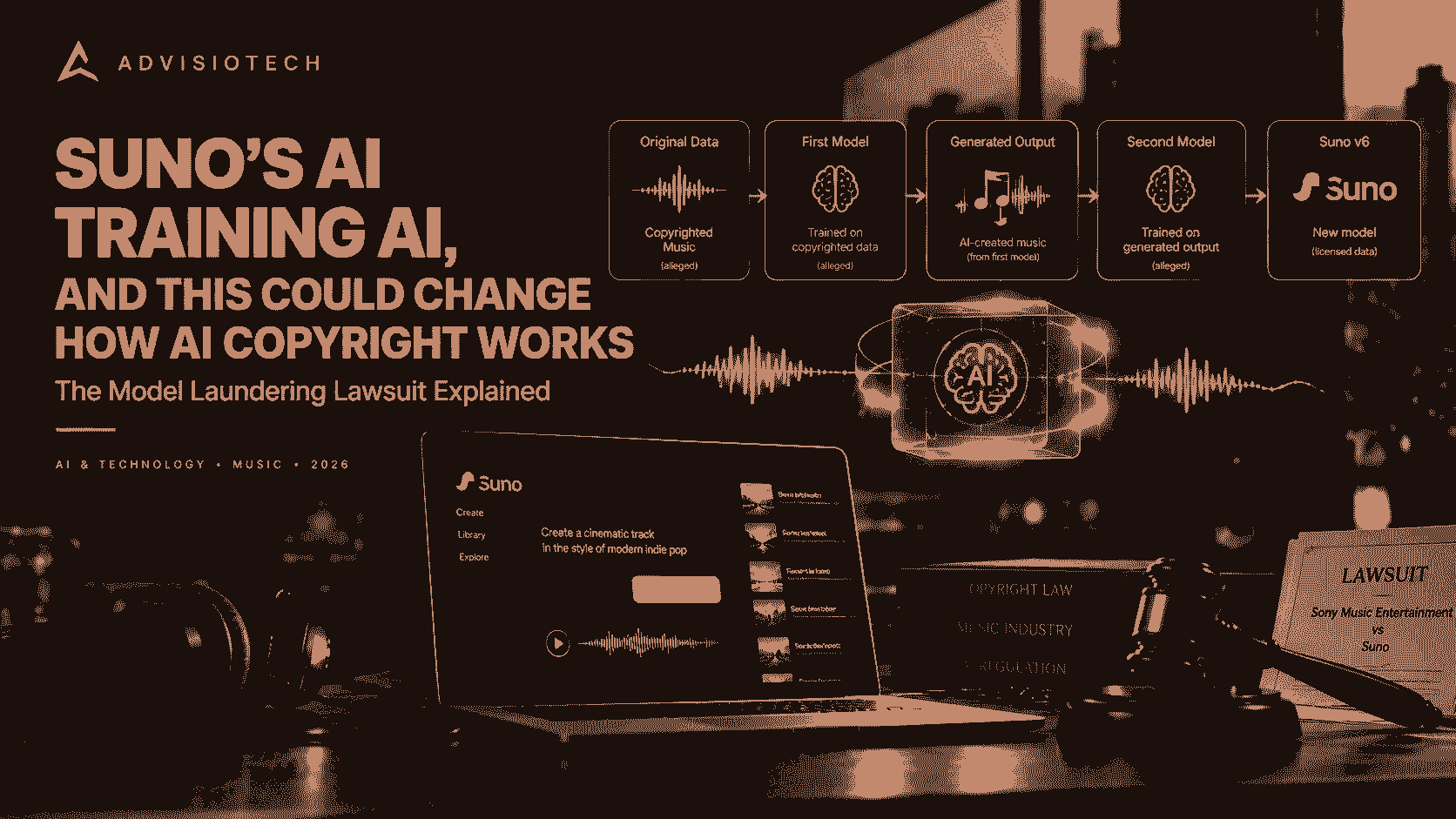
Imagine an AI model is trained using a large collection of copyrighted songs. That model then generates thousands or millions of pieces of synthetic music. Another AI model is subsequently trained using some of those generated results.
The second model may never directly see the original songs.
But Sony and Universal's argument is that the information learned by the first model can still be transferred into the second model through its generated outputs.
That creates a difficult question. If copyrighted material allegedly enters an AI system at the first stage, does generating synthetic material from that system and using the synthetic material to train another model make the second model legally clean?
Sony and Universal say it does not.
Their lawsuit describes the process as carrying the value of copyrighted recordings from the original training data into older models, then into their outputs, and eventually into v6. That is the foundation of their model laundering argument. :contentReference[oaicite:1]{index=1}
Why Suno v6 Is So Important
The timing is what makes this case particularly interesting.
Suno introduced its v6 model family on September 9, 2026. The company said the new models were developed using licensed data from partners including Warner Music Group, BMG and Believe. Suno also said the previous models would be retired. :contentReference[oaicite:2]{index=2}
That was a major change in strategy.
Instead of fighting the music industry's licensing system entirely, Suno was beginning to build relationships with major rights holders and use licensed material for its newer technology.
But Sony and Universal did not sign those licensing agreements. Less than two weeks after the v6 launch, they filed their new complaint.
The labels allege that v6 was not built entirely independently of Suno's earlier systems. Their complaint says the newer model benefited from outputs produced by earlier models, which they allege were themselves trained using unauthorized recordings. :contentReference[oaicite:3]{index=3}
That is why this case is different from simply asking whether an AI company can train a model on copyrighted songs.
It asks whether the history of an AI model can follow it into its successors.
Suno Says the Lawsuit Is Fundamentally Flawed
Suno strongly disputes the labels' interpretation.
In a statement responding to the lawsuit, Suno said the claims were fundamentally flawed on both the facts and the law. The company said v6 was trained using content licensed from partners, along with interactions involving creations and preference signals from its community and accumulated learnings from its team. :contentReference[oaicite:4]{index=4}
That wording matters because Suno has not simply said that v6 contains exactly the same training data as its older models.
The disagreement is about what counts as carrying information forward.
Sony and Universal say the outputs of earlier models allowed knowledge from allegedly unauthorized recordings to flow into the new system. Suno says its new model was built using licensed material and rejects the labels' legal and factual characterization.
At this point, those are competing positions in an active lawsuit. The court has not established that Sony and Universal's model laundering theory is correct.
The Number at the Center of the Lawsuit
The new complaint identifies 60,202 sound recordings that Sony and Universal allege were infringed.
The labels also say that number represents only a small portion of the recordings they believe were affected.
That figure comes from the plaintiffs' allegations, not from a court finding that all 60,202 recordings were unlawfully used.
Still, the number shows why the dispute is much bigger than a handful of songs or a few recognizable artists. The labels are arguing about the underlying training system and the scale of the alleged copying. :contentReference[oaicite:5]{index=5}
This Is Not Suno's First Copyright Fight
The latest lawsuit is part of a much larger legal battle.
Sony, Universal and Warner Music Group originally sued Suno in 2024 over allegations that the company trained its AI music technology using copyrighted recordings without permission.
Since then, Suno has moved toward licensing arrangements. Warner Music Group reached a deal with Suno, and the company later announced licensing relationships involving BMG and Believe. Those agreements helped form part of the foundation for the new v6 generation. :contentReference[oaicite:6]{index=6}
But Sony and Universal remain in litigation with Suno.
That makes the v6 case an important test of whether licensing new training material is enough when a company has already built previous models using a different approach.
The Weird Part: AI Can Learn From AI
This is where the story becomes bigger than Suno.
AI systems increasingly learn from synthetic data. Instead of collecting everything directly from humans, developers can generate examples with another model and use those examples to train a new model.
That can be useful. Synthetic data can help create large training sets, fill gaps and teach models specific behaviors.
But it also creates a new question for copyright law.
If the original model learned from copyrighted material, and a second model learns from the first model's output, what exactly has been transferred?
The original song itself may not appear in the second model's training dataset. Instead, the second model may receive a generated representation produced by the first model.
That distinction could become extremely important.
Think of It Like a Photocopy of a Photocopy
A simple analogy helps.
Imagine someone photocopies a copyrighted photograph without permission. Another person later receives a copy of that photocopy and uses it to create a new image.
The second person did not necessarily possess the original photograph.
But that does not automatically answer whether the second image is legally independent.
AI makes the situation much harder because models do not simply store and reproduce documents like ordinary files. They learn statistical relationships from enormous amounts of data.
That means courts have to grapple with a question that traditional copyright law was not designed to answer easily: how should rights be evaluated when information moves through layers of machine learning rather than through straightforward copying?
Suno's Case Is Also About What Counts as a Fresh Start
The phrase "fresh start" is central to understanding the dispute.
Suno says its v6 generation was built as a new model family using licensed content from partners and that older models would be retired.
Sony and Universal argue that the new model still benefited from earlier models and therefore cannot be treated as completely independent.
So the disagreement is not simply about whether v6 contains an old copyrighted song.
It is about whether a model can be considered clean if the knowledge used to build it was influenced by another model whose training history is disputed.
That is a much more difficult technical and legal question.
Why This Could Matter to Other AI Companies
Suno is a music company, but the underlying question does not stop with music.
The same basic problem could theoretically appear anywhere one AI system is used to generate training material for another.
An image model could generate images that are later used to train another image model. A language model could generate text that becomes part of another training dataset. A video model could create footage that becomes training material for a newer system.
In each case, someone could eventually ask where the information originally came from.
That does not mean every model trained on synthetic data is infringing copyright. It means the legal history of synthetic data could become increasingly important as AI companies rely on models to generate training material for other models.
The Music Industry Is Moving Toward Licensing at the Same Time
There is another important part of this story that is easy to miss.
The music industry is not simply fighting AI companies. Some major music companies are also making licensing deals with them.
Suno's partnerships with Warner Music Group, BMG and Believe show that a licensed AI music market is being developed alongside the lawsuits.
That creates two competing models for the future.
One model is based on licensing copyrighted music and creating agreements between AI companies and rights holders.
The other question is what happens to models that were developed before those agreements existed and whether their learned information can be carried into newer systems.
Suno's v6 dispute sits directly in the middle of that transition.
This Could Become One of the Most Important AI Copyright Questions
The court does not have to decide whether AI music itself is good or bad.
It has to deal with much more specific questions about training data, copying, model development and what happens when information moves from one AI system into another.
If the labels' theory succeeds, AI companies may have to think much more carefully about the entire lineage of their models rather than only the dataset used to train the latest version.
If Suno's position ultimately prevails, companies may have more room to argue that a new model can be legally separated from problematic training that occurred in earlier generations, depending on the specific facts and applicable law.
Either way, the outcome could influence how AI companies document training pipelines, handle synthetic data and prove that newer models were built independently.
The Bigger Question Nobody Has Fully Answered Yet
AI development used to be described mostly as a question of what data goes into a model.
That is becoming too simple.
The next generation of AI systems may be trained partly on data created by previous generations of AI. That means the history of a model may become just as important as the dataset sitting on a server when the latest model is trained.
Suno's lawsuit is an early and unusually clear example of that problem.
The company says its new model uses licensed content and represents a new direction. Sony and Universal say the old models' alleged copyright problems did not disappear simply because their outputs were transformed into training material for a newer model.
The court will eventually have to decide how much of that argument survives legal scrutiny.
The Bottom Line
Suno's latest legal fight is not simply another lawsuit about whether AI can train on music.
The more interesting question is what happens when AI learns from another AI.
Sony Music and Universal Music argue that Suno's new v6 model still carries the consequences of earlier models because outputs from those systems allegedly influenced the newer model. Suno rejects that interpretation and says v6 was trained using licensed material, community interactions and other accumulated information.
Neither side has won that argument yet.
But the question itself is going to become increasingly important. As AI companies use older models to generate synthetic data for newer ones, proving where a model's knowledge actually came from may become one of the hardest problems in AI development.
And that means the next big AI copyright battle may not be about whether a model copied a song directly.
It may be about whether the model that copied it taught another model how to remember it.
FAQ
What is Suno v6?
Suno v6 is the company's latest generation of AI music models, introduced in September 2026. Suno says the new generation was developed using licensed content from partners including Warner Music Group, BMG and Believe. :contentReference[oaicite:7]{index=7}
Why are Sony and Universal suing Suno again?
Sony Music Entertainment and Universal Music Group filed a new lawsuit alleging that Suno's v6 models still infringe their copyrights because the newer models allegedly benefited from outputs generated by earlier Suno models that the labels claim were trained using unauthorized recordings. :contentReference[oaicite:8]{index=8}
What does model laundering mean?
In this lawsuit, model laundering is the term Sony and Universal use for the alleged process of transferring knowledge from an allegedly infringing AI model into a newer model through generated outputs. It is the labels' characterization of what happened, not a court-established legal finding. :contentReference[oaicite:9]{index=9}
Did a court rule that Suno's v6 model infringes copyright?
No. The allegations are part of an active lawsuit. Sony and Universal have made their claims, while Suno has rejected them as flawed. The court has not established that the labels' allegations are true. :contentReference[oaicite:10]{index=10}
How many recordings are involved in the new lawsuit?
Sony and Universal allege infringement involving 60,202 sound recordings. The labels say that figure represents only a portion of the works they believe were affected. :contentReference[oaicite:11]{index=11}
Is Suno using licensed music now?
Suno says its v6 models were trained using content licensed from partners including Warner Music Group, BMG and Believe. The company also says v6 incorporates community interactions and accumulated learnings from its team. :contentReference[oaicite:12]{index=12}
Why does this lawsuit matter beyond music?
Because the dispute raises a broader question about synthetic training data. If one AI model generates material that is later used to train another model, companies may increasingly have to explain the lineage of the information that influenced their systems.