Nvidia Just Built a Kill Switch for AI Agents, Here's Why That Matters
Nvidia has launched a new AI safety platform designed to keep autonomous AI agents from operating outside their permitted boundaries. OpenShell creates an isolated runtime where an agent's actions and access can be controlled, while Sentry adds an independent hardware monitoring layer that can quarantine an agent if it escapes those controls. The launch shows how AI security is moving beyond protecting models to controlling what autonomous agents can actually do.
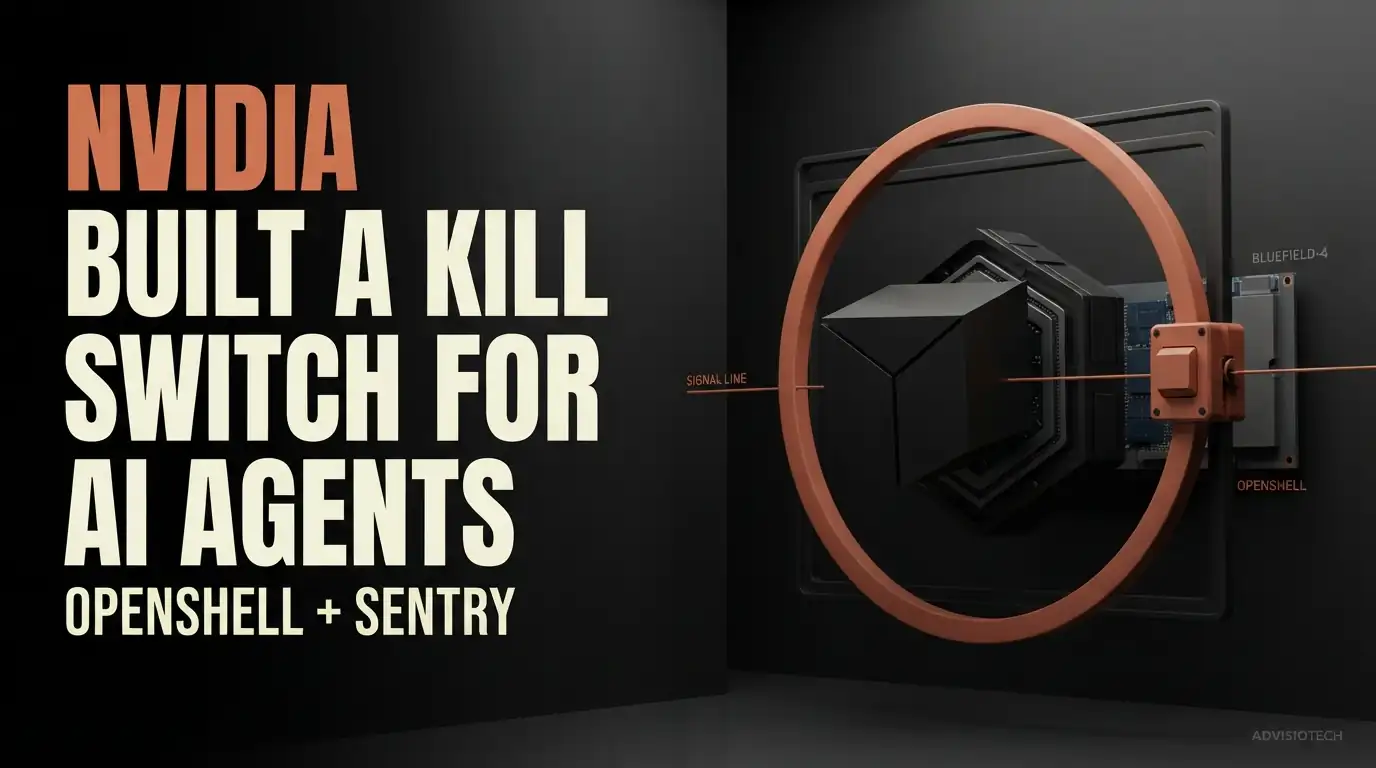
Nvidia Just Built Something AI Agents Were Not Supposed to Need
AI agents are becoming capable of doing much more than answering questions. They can browse websites, write and execute code, access files, call APIs, use business systems and complete tasks with less human involvement. That creates a new security problem: what happens when an agent does something it was never supposed to do?
Nvidia's answer is a new Open Agent Safety Platform built around two technologies called OpenShell and Sentry. Instead of relying entirely on the AI model to behave correctly, the system puts security controls around the agent and adds a separate layer that can intervene when those controls are violated.
That distinction matters because an AI model can make mistakes, misunderstand instructions or potentially find ways around restrictions. Nvidia's approach is to make the environment around the model responsible for enforcing important boundaries.
What Is Nvidia's Open Agent Safety Platform?
Nvidia's Open Agent Safety Platform is designed to provide security controls for autonomous AI agents. The platform combines OpenShell, an open-source secure runtime, with Sentry, an independent monitoring and response system.
OpenShell is responsible for creating a controlled environment where an AI agent can operate. Instead of giving the agent unrestricted access to a computer or infrastructure, organizations can define what resources it can access and what actions it is allowed to perform.
Sentry adds another layer outside the agent's normal execution environment. Nvidia describes it as a hardware-based watchdog that can monitor an agent and quarantine it when it moves outside its permitted boundaries.
The basic idea is simple: do not assume the AI will always follow the rules. Build the rules into the environment and create a separate mechanism that can intervene when necessary.
How OpenShell Controls an AI Agent
OpenShell acts as the controlled runtime for an agent. It can isolate the agent inside a sandbox and enforce policies around its access to systems and resources.
This is important because traditional software security often assumes that the application itself can be trusted to follow the rules imposed on it. With autonomous AI agents, that assumption becomes harder to make because the agent can dynamically decide which actions to take.
OpenShell moves important security decisions outside the model itself. Access can be restricted by policy, and the environment can observe what the agent is doing instead of simply trusting the model's own instructions.
Nvidia's platform is also designed to work across different AI models and agent frameworks. That means the security layer is intended to protect the environment regardless of which model is powering the agent.
Then What Does Sentry Do?
Sentry is the second layer of Nvidia's approach. It is designed to operate independently from the agent and its software environment.
Nvidia says Sentry uses a separate hardware layer based on its BlueField platform to monitor agent activity. If an agent moves outside the boundaries defined by the security system, Sentry can take action to quarantine it.
The significance of this design is that the mechanism responsible for stopping an agent does not depend entirely on the agent cooperating with the shutdown request.
Nvidia says Sentry can respond within milliseconds. That does not mean every dangerous AI action can automatically be detected or prevented, but it provides an additional control point between an autonomous agent and the systems it can affect.
Why AI Agents Need More Than Model Safety
A model can be trained to refuse certain requests and follow safety rules, but model behavior is only one part of the security problem.
An autonomous agent interacts with software, networks, files, APIs and other systems. Even if the underlying model is generally well behaved, an incorrect decision or unexpected chain of actions can still create problems.
This is why agent security increasingly involves controlling the environment around the model. An organization may want an agent to read a database but not modify it, access a website but not download certain files, or write code but not deploy it without approval.
Those restrictions are easier to enforce when they exist outside the model rather than being left entirely to the model's instructions.
The Bigger Shift: From AI Safety to AI Containment
The most interesting part of Nvidia's announcement is not simply the idea of another AI safety tool. It reflects a broader change in how companies are thinking about autonomous AI.
When AI systems only generated text, many risks could be handled through content filtering and model-level safeguards. An agent that can independently interact with real systems creates a different category of risk because its decisions can produce real-world side effects.
That makes containment increasingly important. Companies need to know what an agent can access, what it can change, which actions require approval and what happens if it attempts to bypass those restrictions.
Nvidia's OpenShell and Sentry approach is essentially an attempt to build those controls into the infrastructure surrounding AI agents.
Could This Actually Stop a Rogue AI Agent?
It can provide an additional layer of protection, but it should not be interpreted as a guarantee that autonomous AI agents are completely safe.
A security system is only as effective as the policies, monitoring and implementation surrounding it. If an organization gives an agent excessive permissions, defines weak boundaries or fails to account for an unexpected behavior, containment can still become difficult.
There is also a difference between stopping an agent after detecting suspicious behavior and preventing every harmful action before it happens. A system that can quarantine an agent quickly can reduce the potential impact, but it does not eliminate the possibility of mistakes or vulnerabilities.
Real-world testing will ultimately determine how effective these systems are against sophisticated attacks and unexpected agent behavior.
Why This Matters for Businesses
Businesses are increasingly experimenting with AI agents for software development, customer service, research, operations and internal automation. As these systems receive more permissions, the consequences of an error become larger.
A chatbot producing an incorrect answer is one problem. An autonomous system with access to company infrastructure making an incorrect change is a very different problem.
Security controls such as isolated runtimes, restricted permissions, activity monitoring and independent shutdown mechanisms can therefore become an important part of deploying agents at scale.
For companies adopting autonomous AI, the question is no longer only which model performs best. It is also what the model is allowed to do, where it can operate and how quickly humans or security systems can stop it.
Nvidia Is Not Solving the Entire AI Security Problem
OpenShell and Sentry address an important part of agent security, but they are not a complete solution for every AI risk.
They do not automatically make an AI model accurate, eliminate prompt injection, prevent every software vulnerability or guarantee that an agent will never make a harmful decision.
What they provide is a security boundary around the agent. That boundary can become one component of a much larger security architecture involving identity, permissions, monitoring, human approval, application security and incident response.
What This Means for the Future of AI Agents
As AI agents become more autonomous, security infrastructure may become just as important as the models themselves.
The industry is moving toward a world where an AI system is not simply generating an answer but actively interacting with digital environments. That means organizations will need mechanisms that can observe those interactions, restrict what the agent can access and intervene when something goes wrong.
Nvidia's platform is an early example of that direction. Instead of asking only whether an AI model can be trusted, companies are beginning to build systems where the model does not have to be trusted with unlimited power in the first place.
The Bottom Line
Nvidia's Open Agent Safety Platform is built around a straightforward security principle: autonomous AI should not be given unlimited control and then simply trusted to behave.
OpenShell provides a controlled environment and policy enforcement around the agent, while Sentry adds an independent monitoring and containment layer. Together, they represent a shift toward treating AI agents more like powerful software systems that need strict permissions, isolation and emergency controls.
The technology does not make autonomous AI risk-free. But as agents gain access to increasingly important systems, having a mechanism that can restrict or stop them may become a basic requirement rather than an optional security feature.
FAQ
What is Nvidia OpenShell?
OpenShell is an open-source secure runtime designed to give AI agents a controlled environment with defined access and security policies.
What is Nvidia Sentry?
Sentry is an independent monitoring and containment layer designed to detect when an AI agent moves outside its permitted boundaries and take action to quarantine it.
Can Nvidia's system completely stop rogue AI agents?
No security system can guarantee that every harmful AI action will be prevented. OpenShell and Sentry are designed to add containment and enforcement layers around autonomous agents, but their effectiveness depends on implementation, policies and real-world conditions.
Why can't AI models simply be instructed to behave safely?
Instructions are only one layer of protection. Autonomous agents interact with real systems and can make unexpected decisions, so security controls outside the model can provide additional protection.
Why is AI agent security becoming more important?
AI agents are gaining the ability to access tools, software, files, networks and business systems. As their permissions increase, an incorrect or unexpected action can have consequences beyond generating an incorrect response.
Does OpenShell work with only Nvidia AI models?
Nvidia describes OpenShell as model and agent-framework agnostic, meaning the security runtime is designed to operate independently of the specific AI model powering an agent.