McDonald's Is Using AI to Help Set the Price of Your Big Mac, Here's How It Works
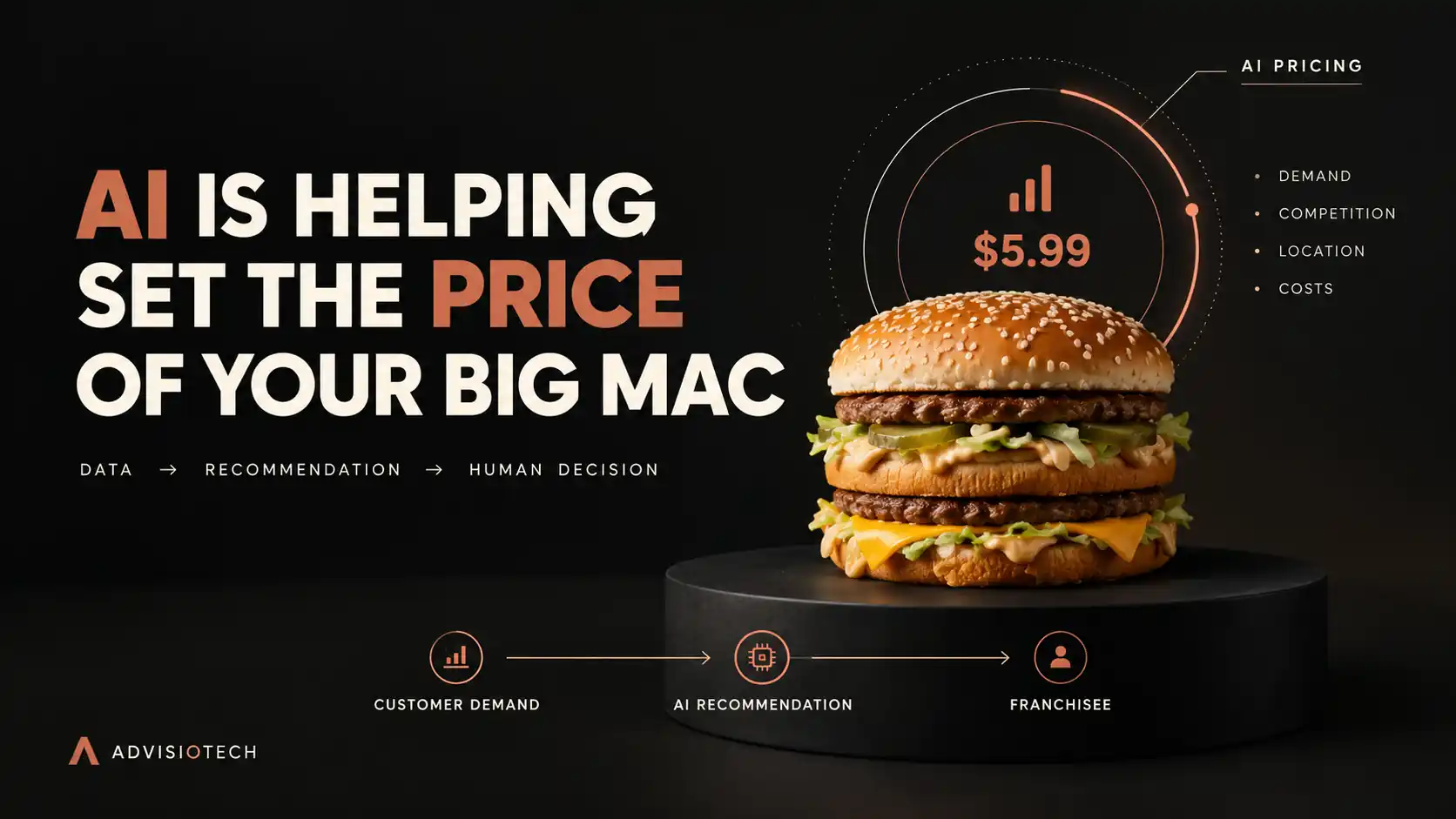
McDonald's is increasingly using AI to guide menu pricing across the U.S. and some international markets. The system estimates what customers at individual restaurants may be willing to pay and recommends prices, while franchisees retain the final decision. Here's what the technology actually does, what it doesn't mean, and why AI-powered pricing is becoming a bigger business issue.
McDonald's Is Using AI to Help Set the Price of Your Big Mac, Here's How It Works
Artificial intelligence is moving into a part of business that most customers rarely think about: deciding how much things should cost.
McDonald's is increasingly using AI to help guide menu prices across the United States and some international markets. According to Reuters, the system can estimate how much customers at an individual restaurant may be willing to pay for particular menu items and use that information to recommend prices.
That does not mean an AI system is independently changing the price of your Big Mac every time you walk into a restaurant. McDonald's franchisees still make the final pricing decision. But the shift is significant because it shows how companies are using machine learning and large amounts of business data to make pricing recommendations that once depended much more heavily on human judgment.
What McDonald's AI Pricing System Actually Does
The basic idea is relatively straightforward. Instead of treating every restaurant as though it has exactly the same customers, costs and demand, an AI system can analyze information from individual locations and help estimate what pricing level could work in each market.
Reuters reported that McDonald's system considers factors including what customers at a particular restaurant appear willing to pay. The system then provides pricing guidance to franchisees.
The important word here is guidance. McDonald's does not describe the system as an autonomous machine that independently sets every customer's price. Franchisees retain the final authority over menu pricing.
That distinction is important because headlines about AI pricing can easily make the technology sound more personalized or automated than the evidence currently shows.
Why Would McDonald's Want AI to Help With Pricing?
McDonald's operates a huge network of restaurants with different customers, competitive environments and operating conditions. A price that works well at one restaurant may not produce the same result at another location.
McDonald's has also been investing heavily in technology as part of its broader NEXT strategy. The company says its technology infrastructure is designed to combine data across its restaurant system and help identify opportunities, test changes and deploy successful approaches more efficiently.
Its NEXT strategy also includes expanding the use of GenAI-enabled ArchIQ, which McDonald's describes as an operating system designed to improve restaurant productivity and simplify operations.
Pricing is therefore part of a much larger effort to use data and software to make decisions across a massive restaurant network.
Does McDonald's Charge Every Customer a Different Price?
Not based on the evidence currently available.
The Reuters reporting describes AI-generated pricing recommendations at the restaurant level. It does not establish that McDonald's is individually calculating a different Big Mac price for every person based on their identity or personal willingness to pay at the moment of purchase.
That distinction matters because personalized pricing and location-level pricing are not the same thing.
A restaurant can receive a recommendation based on the characteristics of its market without the company individually profiling every customer and presenting each person with a different menu price.
Reuters also reported that price differences can exist between McDonald's restaurants located only a few miles apart. However, the reporting did not establish that the AI system itself caused each specific price difference.
Why Can Two McDonald's Restaurants Have Different Prices?
McDonald's is a franchise-heavy business. Individual restaurants can face different labor costs, rent, local competition, demand patterns and other operating expenses.
McDonald's itself says approximately 95% of its restaurants worldwide are owned and operated by independent local business owners. That structure means pricing decisions are not necessarily identical across every restaurant.
The company has also previously explained that prices can vary by restaurant and that local franchisees have significant control over pricing.
AI can add another layer to that system by providing data-driven recommendations instead of relying entirely on manual analysis.
What Kind of Data Can an AI Pricing System Use?
The precise architecture and complete set of inputs used by McDonald's pricing system have not been publicly documented in enough detail to describe the model's internal workings with certainty.
What is clear from the reporting is that the system is intended to analyze restaurant-level information and estimate pricing opportunities. That can include patterns in transactions and customer behavior, although we should not assume a specific dataset or algorithm unless McDonald's has publicly confirmed it.
This is an important limitation when discussing AI systems used inside large companies. Knowing that a company uses AI to recommend prices does not automatically tell us which model it uses, exactly which variables it processes or how much weight each variable receives.
Is This the Same as Dynamic Pricing?
Not necessarily.
Dynamic pricing generally refers to prices changing in response to changing conditions, sometimes frequently. AI-assisted pricing recommendations can be part of a dynamic pricing strategy, but the existence of an AI recommendation system does not by itself prove that prices are changing continuously or that every customer is being shown a different price.
In McDonald's case, the reported system is better described as AI-assisted pricing guidance. The system recommends pricing based on information about individual restaurant markets, while franchisees make the final decision.
Why This Matters Beyond McDonald's
McDonald's is an unusually visible example of a much broader change in business software.
Companies have always used data to decide prices. What is changing is the scale and speed at which software can analyze those signals and turn them into recommendations.
For a company with tens of thousands of locations, even a small improvement in how pricing decisions are made can potentially have a large financial effect when repeated across the network.
The same basic idea can apply far beyond restaurants. Retailers, airlines, hotels, delivery services and online marketplaces already use sophisticated pricing systems, although the exact methods and degree of personalization vary by company and industry.
As AI becomes better at analyzing large datasets, more businesses are likely to use it to recommend prices, promotions, inventory decisions and marketing offers.
The Privacy Question Is Different From the Pricing Question
One of the biggest misunderstandings around AI pricing is the assumption that every AI-powered pricing system must be using an individual's personal information.
That is not necessarily true.
A business can use aggregated or location-level purchasing patterns to understand demand without calculating a unique price for each person. The privacy implications become different when companies use individual browsing behavior, purchase history, location data or other personal information to determine what a particular person should pay.
That distinction is becoming increasingly important as regulators examine personalized pricing practices across consumer industries.
Why Regulators Are Paying Attention
AI-assisted pricing sits close to an important regulatory question: when does legitimate price optimization become problematic personalized pricing or a form of discriminatory treatment?
The U.S. Federal Trade Commission has been examining personalized pricing practices and has expressed interest in understanding whether companies are using large amounts of consumer data to charge differentiated prices.
That does not mean McDonald's AI pricing system has been found to violate antitrust or consumer-protection law. Reuters reported that the company's approach could attract regulatory scrutiny, but scrutiny is not the same thing as a finding of wrongdoing.
The larger issue is whether consumers can understand how prices are determined when increasingly sophisticated algorithms are involved.
What McDonald's Says About Its Broader AI Strategy
The pricing story is part of a much larger technology strategy at McDonald's.
The company's NEXT strategy includes expanding GenAI-enabled ArchIQ across its restaurant system. McDonald's says its technology infrastructure combines data and operating capabilities across more than 46,000 restaurants, allowing the company to identify opportunities and deploy successful approaches more efficiently.
The company is also investing billions of dollars through 2036 in restaurant modernization, technology deployment and operational improvements as part of NEXT.
That means the pricing system should not be viewed as an isolated experiment. McDonald's is building a broader technology layer designed to help operate a global restaurant network more efficiently.
What This Does Not Mean
It does not mean an AI chatbot is sitting inside every McDonald's deciding the price of your meal.
It does not establish that every customer receives a unique Big Mac price based on their identity.
It does not mean McDonald's has completely handed pricing decisions to an algorithm.
And it does not prove that every difference in McDonald's prices between nearby restaurants is caused by AI.
The confirmed picture is more specific: McDonald's is using AI to help generate pricing guidance, including estimates related to what customers in individual restaurant markets may be willing to pay, while franchisees retain the final pricing decision.
The Bigger Shift: AI Is Moving From Content to Decisions
This may ultimately be more important than the Big Mac itself.
The first wave of consumer AI was largely about generating things: text, images, code, summaries and answers.
The next wave is increasingly about making recommendations that affect real business decisions.
A pricing algorithm does not need to write an article or create an image to have a significant effect. If its recommendation influences the price of a product sold millions of times, a relatively small change in a recommendation can have consequences at enormous scale.
That is why AI adoption inside companies deserves attention even when customers never see the AI system directly.
What Businesses Can Learn From McDonald's
For businesses considering AI, McDonald's example highlights an important principle: the value of AI is not limited to customer-facing chatbots.
AI can be used behind the scenes to analyze large datasets, identify patterns and provide recommendations to people responsible for making operational decisions.
But the McDonald's example also shows why human oversight still matters. The AI recommendation is not the final decision. A business still has to decide whether the recommendation makes sense in the context of its customers, brand, competition and long-term strategy.
That human layer becomes particularly important when an algorithm is influencing something customers immediately notice, such as price.
The Bottom Line
McDonald's is using AI to help guide menu pricing, including estimating what customers at individual restaurants may be willing to pay. The technology is part of a wider push to use data and AI across the company's enormous restaurant network.
But the viral version of this story is easy to exaggerate. There is no evidence here that an AI system is independently charging every customer a personalized Big Mac price.
The more significant development is that AI is increasingly being used to influence real commercial decisions. Pricing is moving from spreadsheets and human judgment toward systems that can analyze huge amounts of information and recommend what a business should do next.
For consumers, that raises questions about transparency and fairness. For businesses, it demonstrates where AI adoption may be heading: away from simply generating content and toward quietly making recommendations that affect everyday transactions.
FAQ
Is McDonald's using AI to set Big Mac prices?
McDonald's is increasingly using AI to guide menu pricing in the United States and some international markets. The system can provide pricing recommendations based on information about individual restaurant markets, while franchisees retain the final decision.
Does McDonald's charge every customer a different price?
There is no evidence from the current reporting that McDonald's is giving every individual customer a unique Big Mac price based on their identity. The reported system provides restaurant-level pricing guidance rather than proving individualized pricing for every customer.
Why are McDonald's prices different at different restaurants?
Prices can differ because McDonald's restaurants operate in different markets and many are independently owned by franchisees. Local costs, demand, competition and other factors can affect pricing.
Is McDonald's AI pricing the same as dynamic pricing?
Not necessarily. AI can support dynamic pricing, but an AI system that recommends prices does not automatically mean prices are changing continuously or individually for every customer.
What is McDonald's ArchIQ?
ArchIQ is a GenAI-enabled restaurant operating system that McDonald's says it is deploying as part of its NEXT strategy to help improve restaurant productivity and simplify operations.
Why is AI-powered pricing becoming controversial?
The concern is not simply that companies use software to analyze prices. The bigger questions involve transparency, the data being used, whether prices can be personalized to individuals and whether consumers can understand why they are being charged a particular amount.