iPhone 18 Pro Reviews Are In: Here's What Every Major Reviewer Actually Thinks (And Whether It's Worth Upgrading)
The iPhone 18 Pro and Pro Max hit stores today, and the reviews are split. A genuinely new camera, the fastest chip Apple has ever shipped, and record battery life, but also a higher price and a design that barely looks different. Here's every major review, boiled down, and a straight answer on whether you should actually upgrade.
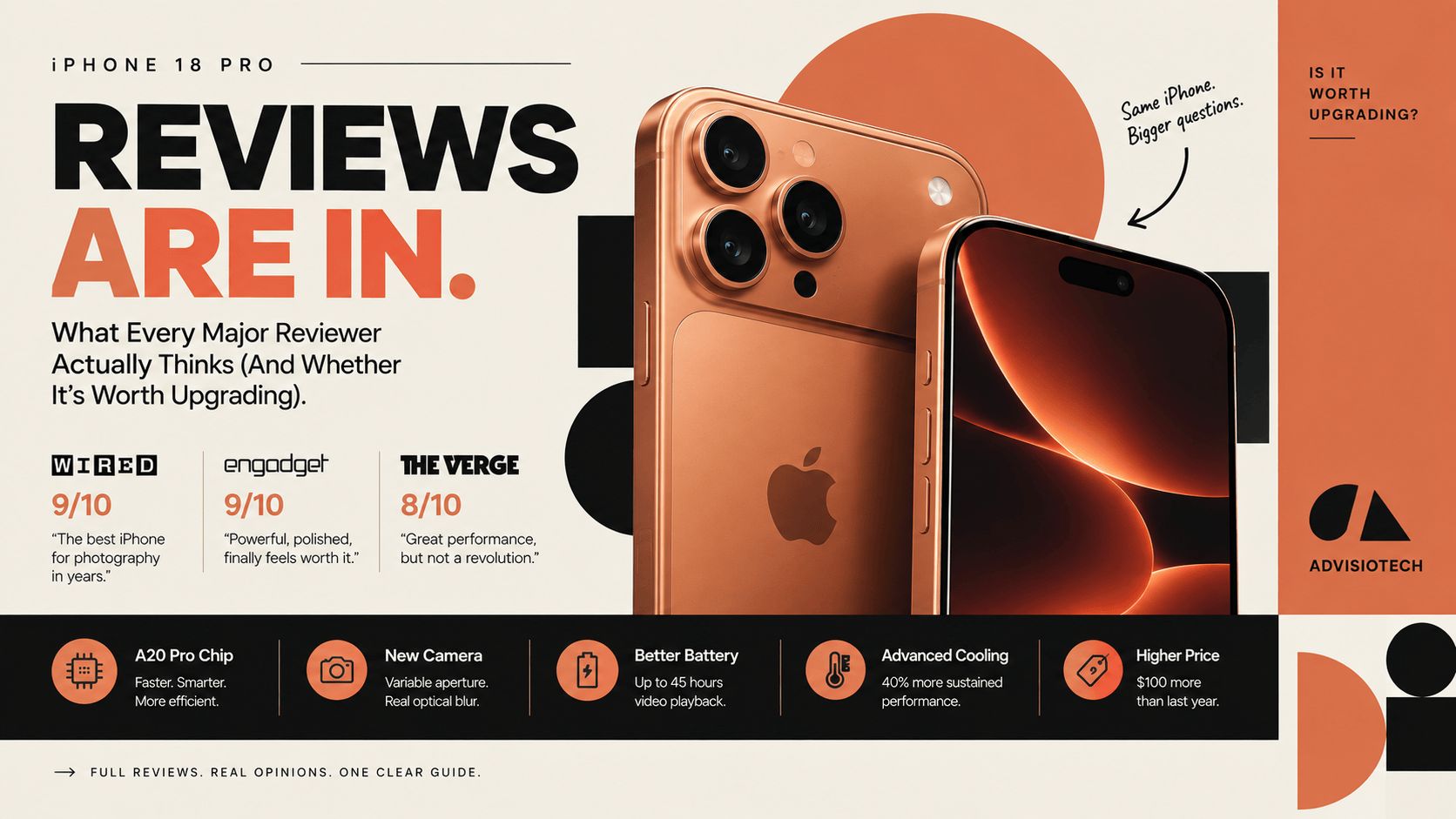
iPhone 18 Pro Reviews Are In: Here's What Every Major Reviewer Actually Thinks (And Whether It's Worth Upgrading)
The iPhone 18 Pro and iPhone 18 Pro Max officially hit store shelves today, and if you've been holding off on an upgrade to see what the reviewers actually think once the marketing keynote fades away, the verdict is finally in. It's a genuinely mixed one, not a disaster, not a slam dunk either, and that nuance is exactly why so many people are searching for real answers right now instead of just trusting Apple's own event.
Here's a complete, no-fluff breakdown of what changed, what every major outlet actually thinks after testing it, and whether it's worth your money.
First, What Actually Changed This Year
Apple unveiled the iPhone 18 Pro and Pro Max on September 9, 2026, at an event called "Surprise and Shine," notable for being new CEO John Ternus's very first keynote, just over a week after he officially succeeded Tim Cook, who has moved into the role of executive chairman. Preorders opened September 12, and today, September 18, the phones are officially on shelves in the US, with a wider international rollout following on September 25.
The headline upgrades are:
- **A20 Pro chip**: Apple's first chip built on a 2-nanometer manufacturing process, featuring a new six-core CPU, seven-core GPU, and a dual 16-core Neural Engine, alongside roughly 50% more memory bandwidth than last year's A19 Pro.
- **A physically variable aperture camera**: for the first time ever on an iPhone, the 48MP main camera can mechanically shift between four aperture settings, f/1.48, f/1.8, f/2.8, and f/4, instead of using a single fixed aperture like every iPhone before it.
- **A redesigned cooling system**: a larger internal vapor chamber, paired with new chip packaging inspired by Apple's M-series Macs, which Apple claims delivers up to 40% better sustained performance under heavy, prolonged use.
- **The largest battery gain in iPhone history**, according to Apple, driven mainly by the new chip's power efficiency rather than a larger physical battery, with the Pro Max reaching up to 45 hours of video playback.
- **A smaller Dynamic Island**, freed up by moving some Face ID components underneath the display, now capable of displaying up to three Live Activities at once.
- **Faster wired charging**, reaching 50% battery in around 15 minutes, down from roughly 20 minutes on last year's model, though wireless charging speeds are largely unchanged.
As for price, Apple raised the cost of both models by $100 compared to last year. The iPhone 18 Pro starts at $1,199, and the iPhone 18 Pro Max starts at $1,299, both for the base 256GB configuration, which is now the new storage floor across the lineup.
What The Reviews Actually Say
This is the part that matters most if you're trying to decide whether to buy one, so here's a genuine summary of where major outlets landed after actually testing the phones, not just reading the spec sheet.
**The scores were strong overall.** Wired and Engadget both rated the phones 9 out of 10, while The Verge landed at 8 out of 10. Across the board, reviewers praised the record-setting performance of the A20 Pro chip, the meaningfully improved battery life, the upgraded cooling system, and the addition of genuine manual camera controls for the first time.
**The variable aperture camera is the most talked-about feature, and opinions genuinely differ on how much it matters.** Wired's reviewer was particularly impressed, describing the manual aperture controls as one of the most interesting changes Apple has made to iPhone photography in years, and noted they'd nearly stopped using the standard Portrait Mode in favor of the new optical, physically-blurred background effect at f/1.48. Hands-on testers found the effect genuinely noticeable up close, food menus and background clutter photographed a few feet away blurred naturally at the widest aperture setting, while objects closer to the subject stayed sharp, confirming it's real optical blur, not just software simulation.
**But The Verge and Engadget were more reserved about how much it changes day-to-day photography.** Their assessment was that in most ordinary shooting conditions, the practical difference between f/1.48 and f/1.8 is fairly minimal, mainly because a phone's small sensor and heavy computational processing already do a lot of the work regardless of the physical aperture setting. Where the wider aperture genuinely helps is in low light, letting in significantly more light for better night shots and faster shutter speeds, while the narrower f/4 setting turns out to be more useful for group photos, text, or closely spaced objects where you want more of the frame in focus rather than a blurred background.
**Camera experts have also pushed back a bit on the hype.** Some independent testing found that getting real value out of the variable aperture requires understanding how aperture, shutter speed, and ISO interact, and that simply switching to a narrower aperture without adjusting for it can actually backfire, forcing a slower shutter speed or higher ISO that introduces motion blur or noise instead of the sharper result you were expecting. For most casual users, testers recommend just leaving the camera in Auto mode and letting the phone handle it, treating full manual control as a feature for people who actually want to learn and use it deliberately.
**On design, the reviews were fairly unified: it barely looks different.** The 6.3-inch and 6.9-inch OLED displays are unchanged in size, with the same 120Hz refresh rate, and the phone keeps the aluminum unibody design from last year. The most visible change from the front is the smaller Dynamic Island. Several reviewers pointed out that if you didn't know what to look for, you'd struggle to tell an iPhone 18 Pro apart from an iPhone 17 Pro at a glance.
**The honest criticisms that came up repeatedly**: the phones are heavier than last year's models, meaningfully more expensive at every storage tier, and for as impressive as the camera hardware sounds on paper, several reviewers noted the actual image quality difference in typical everyday photos is more modest than the marketing suggests, a genuinely interesting new tool rather than a dramatic leap in photo quality.
Should You Actually Upgrade?
Based on what reviewers are consistently saying, here's a straightforward way to think about it:
- **If you have an iPhone 16 Pro or older**, most reviewers agree this is a legitimate upgrade. You'll notice the chip speed, especially in sustained tasks like gaming or exporting video, and the battery life improvement alone is significant enough to matter in daily use.
- **If you have an iPhone 17 Pro from last year**, the consensus across reviews is that this is a much harder sell. The core design is nearly identical, the everyday camera difference is subtle rather than dramatic for most people's typical photos, and you're paying $100 more for it. Unless the variable aperture camera specifically excites you as a photography enthusiast, or you're someone who pushes your phone hard enough to actually feel the cooling and sustained performance improvements, it's reasonable to sit this generation out.
- **If you shoot a lot of photos, especially portraits, low-light shots, or manual-style photography**, the variable aperture camera is the single feature worth paying attention to. It's the first genuinely new hardware capability Apple's camera system has gotten in a long time, rather than another round of software-based computational tricks.
- **If battery life is your main frustration with your current phone**, this is likely the strongest generational improvement Apple has made in years on that front specifically, according to nearly every review.
The Bottom Line
The iPhone 18 Pro isn't a phone that reinvents what an iPhone is, and reviewers are largely in agreement on that. But it also isn't an empty marketing exercise. The A20 Pro chip and battery life improvements are real and measurable, and the variable aperture camera is a genuinely new piece of hardware, not just another software filter, even if its everyday impact is more nuanced than the keynote made it sound. Whether it's worth upgrading really comes down to which iPhone you're upgrading from, and how much you actually care about manual camera control versus simply wanting your phone to last longer between charges.
FAQ
When did the iPhone 18 Pro release?
It was announced on September 9, 2026, with preorders opening September 12, and it became available in stores in the US on September 18, 2026, followed by a wider international rollout on September 25.
How much does the iPhone 18 Pro cost?
The iPhone 18 Pro starts at $1,199 and the iPhone 18 Pro Max starts at $1,299, both for the base 256GB storage configuration, roughly $100 more than last year's iPhone 17 Pro models.
What is the biggest new feature on the iPhone 18 Pro?
The standout new feature is a physically variable aperture camera, the first of its kind on any iPhone, which can mechanically shift between four aperture settings (f/1.48, f/1.8, f/2.8, and f/4) depending on lighting conditions and the kind of shot you're taking.
Is the iPhone 18 Pro worth upgrading from the iPhone 17 Pro?
Most reviewers suggest it's a harder sell if you already own an iPhone 17 Pro, since the design is nearly identical and the everyday camera difference is fairly subtle, though photography enthusiasts may still value the new manual aperture controls.
How much better is the battery life on the iPhone 18 Pro?
Apple calls it the largest battery-life increase in iPhone history, with the Pro Max reaching up to 45 hours of video playback, an improvement reviewers have largely confirmed as genuinely noticeable in daily use.
What chip does the iPhone 18 Pro use?
It uses the new A20 Pro, Apple's first chip built on a 2-nanometer manufacturing process, paired with a redesigned cooling system that Apple says delivers up to 40% better sustained performance during demanding tasks.