India's DPDP Act Is Coming for Your Website, Here's What Every Business Needs to Fix Before 2027
India's Digital Personal Data Protection framework is moving from legislation to implementation, and that matters for almost every business collecting customer information online. From contact forms and lead-generation pages to customer accounts and marketing databases, here's what the DPDP Act and Rules could mean for your website and what businesses should start fixing before the main obligations take effect.
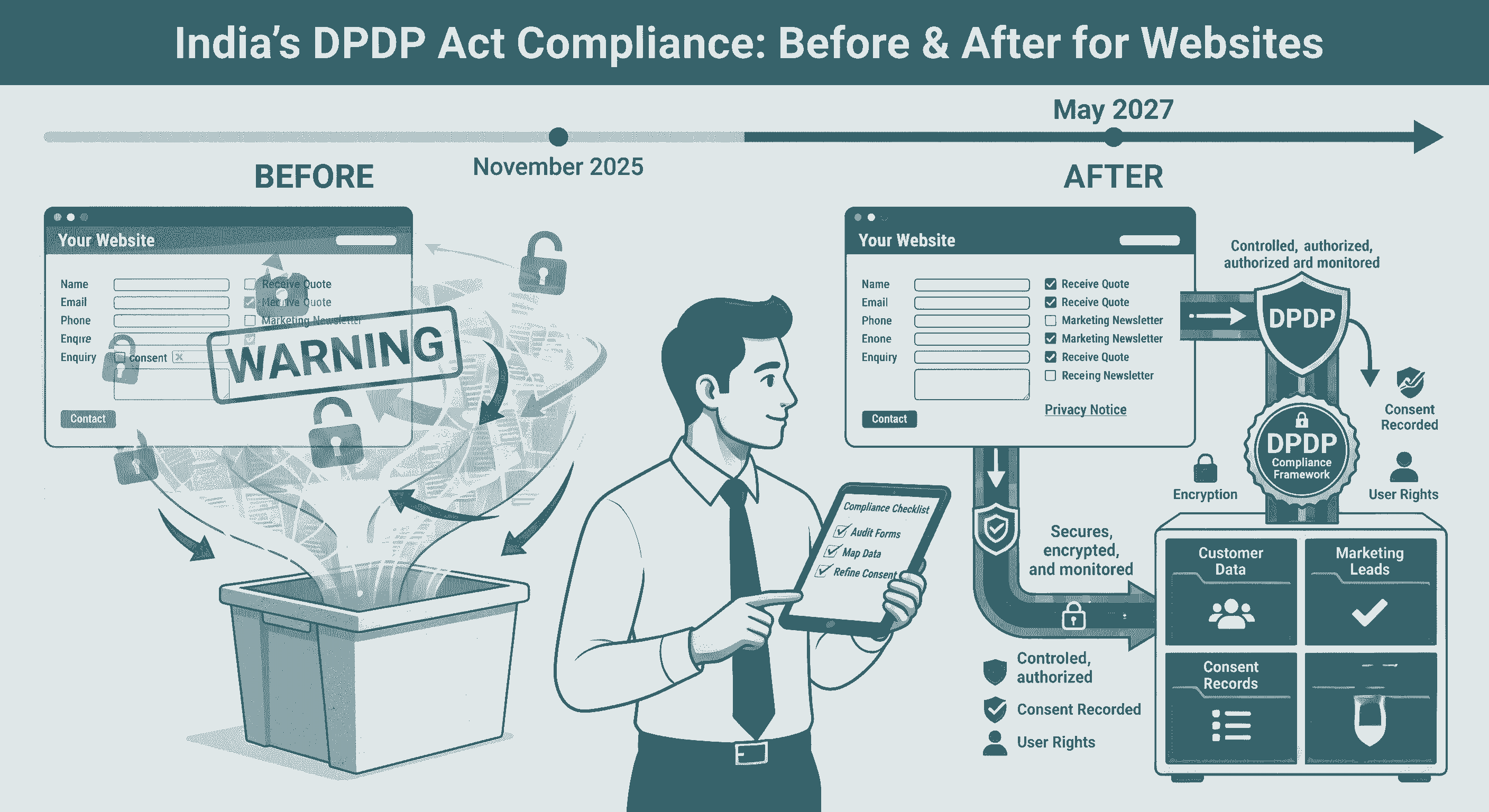
India's DPDP Act Is Coming for Your Website, Here's What Every Business Needs to Fix Before 2027
If your website collects a visitor's name, phone number, email address, enquiry details, account information, or other information that can identify a person, India's new data-protection framework is something you cannot simply ignore.
India's Digital Personal Data Protection Act, 2023 created the country's framework for processing digital personal data, and the Digital Personal Data Protection Rules, 2025 were officially notified by the Ministry of Electronics and Information Technology in November 2025.
But there is an important detail: the entire framework does not become applicable at once.
The government has introduced a phased implementation timeline, with many of the provisions that directly affect how businesses process personal data scheduled to come into force 18 months after the November 2025 notification.
That gives businesses time to prepare, but it does not mean they should wait until the last minute.
First: What Is the DPDP Act?
The Digital Personal Data Protection Act, 2023 is India's framework for regulating the processing of digital personal data.
In simple terms, it is about what organizations can do with information that identifies people and what responsibilities they have when collecting, using, storing, sharing, or otherwise processing that information.
The Act uses terms such as 'Data Principal' for the individual whose personal data is being processed and 'Data Fiduciary' for the organization that determines the purpose and means of processing personal data.
For a normal website owner, you do not need to memorize the terminology to understand the practical issue.
If your website collects information from people, you need to understand why you are collecting it, how you are using it, what you tell people about that processing, and how you protect the information.
When Does the DPDP Act Actually Apply?
This is where a lot of online explanations become confusing.
The government notified the commencement of different parts of the Act on different dates.
Some provisions came into force when the commencement notification was published in November 2025.
Another set of provisions is scheduled to begin one year after that notification.
The larger group of provisions, including key obligations relating to processing personal data, consent, notices, security safeguards, breach notifications, and individual rights, is scheduled to come into force 18 months after the November 2025 notification.
That means the main compliance window for these provisions reaches into May 2027.
The phased approach is important because businesses have time to review their systems instead of treating compliance as a last-minute website redesign.
What Does This Have to Do With Your Website?
More than you might think.
A modern business website can collect personal data in many different ways.
- **Contact forms:** Name, email address, phone number and enquiry details.
- **Lead forms:** Business information and contact details submitted in exchange for a quote, consultation, download or other offer.
- **Account registration:** Names, email addresses, login information and profile details.
- **E-commerce:** Customer information, order details and other information connected with purchases.
- **Newsletter subscriptions:** Email addresses and subscription preferences.
- **Booking forms:** Names, contact information, appointment details and other submitted information.
- **Customer support:** Information people provide when asking for help.
- **Analytics and tracking:** Depending on the technologies being used, websites may process information associated with visitors and their online activity.
The important point is that privacy compliance is not only an issue for giant technology companies.
A small business with a simple lead-generation website can still be processing personal data.
The Consent Problem Businesses Need to Understand
One of the central concepts in the DPDP framework is consent.
The Act provides that consent should be free, specific, informed and unambiguous, and it should involve a clear affirmative action.
That has practical implications for the way businesses design forms and consent interfaces.
A website should not treat privacy consent as an afterthought hidden somewhere in tiny text.
Businesses need to understand what data they are collecting and the purpose for which it is being processed, and communicate that information appropriately.
This is particularly important for websites that collect leads and then use those details for marketing.
Your Website Notice Matters
The DPDP Rules provide additional detail around notices and transparency.
The government's explanatory material says the notice should make information about the processing of personal data understandable to the Data Principal.
For businesses, this means the privacy information presented around a form or data-collection process should actually explain what is happening rather than simply displaying a generic block of legal language.
A visitor should be able to understand what information is being requested and why it is needed.
What About Marketing Data?
This is one area digital marketers should pay particular attention to.
Imagine a visitor fills out a website form asking for a service quotation.
The business now has that person's contact information.
The next question is what happens afterward.
Is the information used only to respond to the enquiry?
Is it added to a CRM?
Is it used for future marketing communications?
Is it shared with another service provider?
Is it connected to advertising or analytics systems?
Businesses need to understand these processing activities and make sure their practices align with the applicable requirements of the DPDP framework.
The lesson for digital marketers is simple: collecting a lead is not the end of the data-protection story.
Your Website May Need Better Data Controls
A privacy policy alone does not magically make a website compliant.
Businesses should also understand what happens to personal data after someone submits it.
- Where is the information stored?
- Who can access it?
- Is it transferred to a CRM?
- Which third-party services receive it?
- How long is it retained?
- What happens when the information is no longer required?
- How would the business respond if there were a personal data breach?
These questions require businesses to look beyond the visible front end of their website and examine the systems connected behind it.
Data Security Is Part of the Story
The DPDP framework also establishes obligations around reasonable security safeguards and personal data breaches.
That means businesses should not think of data protection as purely a legal-document problem.
Website security becomes part of the bigger picture.
Basic practices such as secure hosting, access controls, strong authentication, software updates, backups, appropriate permissions and monitoring can become important parts of protecting personal data.
The exact technical measures required will depend on the organization, the systems involved and the applicable requirements.
What Happens If There Is a Data Breach?
The DPDP Rules establish a framework for notifying the Data Protection Board and affected Data Principals in the circumstances specified by the Rules.
This means organizations should not wait for an incident to happen before thinking about what their response process looks like.
Businesses should know what data they hold, where it is stored, who can access it and who is responsible for responding if something goes wrong.
People Also Get Rights Over Their Data
The DPDP framework gives Data Principals rights in relation to their personal data.
The Rules also provide requirements around enabling individuals to exercise those rights.
The government's explanatory note states that Data Fiduciaries must clearly display contact information on their website or app for questions relating to the processing of personal data, including the designated person or Data Protection Officer where applicable.
That means a business website may eventually need to make its privacy-related contact route much clearer than simply providing a generic contact form.
What Should Businesses Start Doing Now?
Businesses do not need to wait for the final compliance date to begin preparing.
- **Audit your forms:** Make a list of every website form that collects personal information.
- **Map your data:** Understand where information goes after someone submits a form.
- **Review your privacy notice:** Make sure it accurately describes your actual data practices.
- **Review third-party tools:** Identify CRMs, analytics platforms, email tools, marketing systems and other services that process customer information.
- **Review access:** Make sure employees and vendors do not have unnecessary access to personal data.
- **Improve security:** Review hosting, passwords, authentication, software updates and access controls.
- **Create a breach process:** Know what your organization would do if personal data were accidentally exposed or accessed without authorization.
- **Review retention:** Understand how long different types of personal data are being kept and why.
- **Document your processes:** Keep an internal record of what information you collect and why.
The Biggest Mistake Would Be Waiting Until 2027
The main business mistake would be treating the DPDP framework as something that only needs attention when enforcement arrives.
Websites are often connected to dozens of other systems: hosting providers, CRMs, email platforms, analytics tools, advertising platforms, payment systems and customer-support software.
Changing all of those processes overnight can be much harder than gradually reviewing them.
Businesses that start by mapping their data now can identify problems before they become urgent.
What This Means for Small Businesses
A small company may assume data protection is something only banks, large technology companies or major e-commerce platforms need to worry about.
That is not a safe assumption.
A small business website that collects names, phone numbers and email addresses is still handling personal information.
The scale of the business may affect the specific obligations that apply, but the first step for every organization is understanding what personal data it actually processes.
What This Means for Digital Agencies and Website Developers
The DPDP framework also changes the conversation between businesses and the companies that build their websites and digital systems.
A website developer or digital agency may be involved in designing forms, connecting CRMs, installing analytics tools, configuring marketing systems or integrating third-party services.
That makes it important for businesses and their technology partners to clearly understand who is responsible for what.
Privacy should be considered during website planning rather than added as a final checkbox after the website is already built.
One Important Thing to Remember
The DPDP Act is a legal framework, and website owners should not treat a general blog article as a substitute for legal advice.
The exact obligations can depend on the organization's role, the type of processing involved, the data being handled, and other circumstances.
The practical purpose of this article is to help businesses understand why their website and digital systems deserve attention before the main compliance provisions take effect.
The Bottom Line
India's DPDP framework is moving from legislation toward implementation, and the government has deliberately created a phased timeline.
For businesses, the important takeaway is not simply 'get a privacy policy.'
It is to understand the entire journey of personal data through your website and digital systems.
What do you collect?
Why do you collect it?
Where does it go?
Who can access it?
How long do you keep it?
How do you protect it?
And what happens if someone asks about their data or something goes wrong?
The businesses that answer those questions before the compliance deadline will be in a much better position to adapt their websites and internal processes when the applicable DPDP obligations take effect.
FAQ
What is India's DPDP Act?
The Digital Personal Data Protection Act, 2023 is India's legal framework governing the processing of digital personal data and establishing rights and obligations for individuals and organizations.
When will the DPDP Act apply to businesses?
Different provisions have different commencement dates. The government notified a phased timeline in November 2025, with the larger group of operational provisions scheduled to come into force 18 months after the notification.
Does the DPDP Act apply to websites?
It can apply when a website is involved in processing digital personal data covered by the Act. The Act also covers certain processing outside India when it is connected with offering goods or services to individuals in India.
Does every website need a privacy policy?
Businesses should assess their specific obligations under the DPDP Act and Rules rather than assuming that a privacy policy alone satisfies all requirements. A privacy notice is only one part of a broader data-protection framework.
What personal information can a website collect?
Websites can collect many types of personal data, including names, email addresses, phone numbers, account information, enquiry details and other information relating to identifiable individuals. What can be collected and how it can be processed depends on the applicable legal requirements and purpose.
What should businesses do before 2027?
Businesses can start by auditing website forms, mapping where personal data goes, reviewing privacy notices, checking third-party services, improving access controls and security, reviewing retention practices and establishing processes for handling data-related requests and breaches.
Is the DPDP Act only for large companies?
No. The framework is relevant to organizations processing digital personal data, although the specific obligations that apply can vary depending on factors such as the organization's role and circumstances.
Does DPDP affect digital marketing?
It can. Digital marketing often involves collecting and processing contact information, customer data and information through websites, CRM systems, email platforms and other tools. Businesses should review how those systems process personal data under the applicable DPDP requirements.