Google Built an AI Hacker That Hunts Real Vulnerabilities, Here's How PageBreak Actually Works
Google has built an AI security agent called PageBreak that can search its own web applications for real, exploitable vulnerabilities. Unlike ordinary AI scanners that can produce convincing but incorrect bug reports, PageBreak tries to prove that a suspected flaw actually works before sending it to engineers. Here's what Google built, what it has already found, and why this could change how software security testing works.
Google Built an AI Hacker That Hunts Real Vulnerabilities, Here's How PageBreak Actually Works
Google is using AI to attack its own software before someone else can. The company has revealed PageBreak, an internal AI agent created by Google's Product Security team to autonomously search first-party web applications for security vulnerabilities.
The interesting part is not simply that an AI can look for bugs. Security researchers have been experimenting with AI-powered vulnerability discovery for some time. The bigger problem is that AI systems can generate large numbers of convincing security reports that turn out to be wrong.
Google built PageBreak around a different idea: don't just ask the AI whether a vulnerability might exist. Make the system prove that the vulnerability can actually be exploited.
Google says PageBreak began as a pilot in November 2025 and became a full project in January 2026. By September 2026, it had uncovered more than 500 Cross-Site Scripting vulnerabilities across Google's first-party web applications. :contentReference[oaicite:0]{index=0}
What Is Google PageBreak?
PageBreak is an internal AI agent designed by Google's Product Security team to test the security of Google's own web applications.
Google says most of its PageBreak usage relies on Gemini models, including Gemini 3.1 Pro and Gemini 3.5 Flash, although the system is designed to work with different models. The goal is to scale vulnerability discovery without requiring security engineers to manually investigate every possible lead. :contentReference[oaicite:1]{index=1}
That distinction matters because PageBreak is not simply a chatbot being asked to find security bugs. It is an agent connected to specialized security infrastructure that can investigate potential vulnerabilities and then pass them through deterministic validation.
The Problem With AI Security Scanners
Large language models are increasingly capable of understanding source code, application behavior and complicated attack paths. But there is a major problem: finding something that looks like a vulnerability is not the same as finding a vulnerability that actually works.
Google describes the resulting flood of unverified AI-generated security findings as "AI slop." A model may identify a suspicious piece of code and produce an impressive explanation, while the alleged attack cannot actually be performed against the running application. :contentReference[oaicite:2]{index=2}
For a security team, that creates another workload. Someone still has to determine which reports are real, which are false positives and which require deeper investigation.
PageBreak was designed to close that gap.
How PageBreak Actually Finds a Security Bug
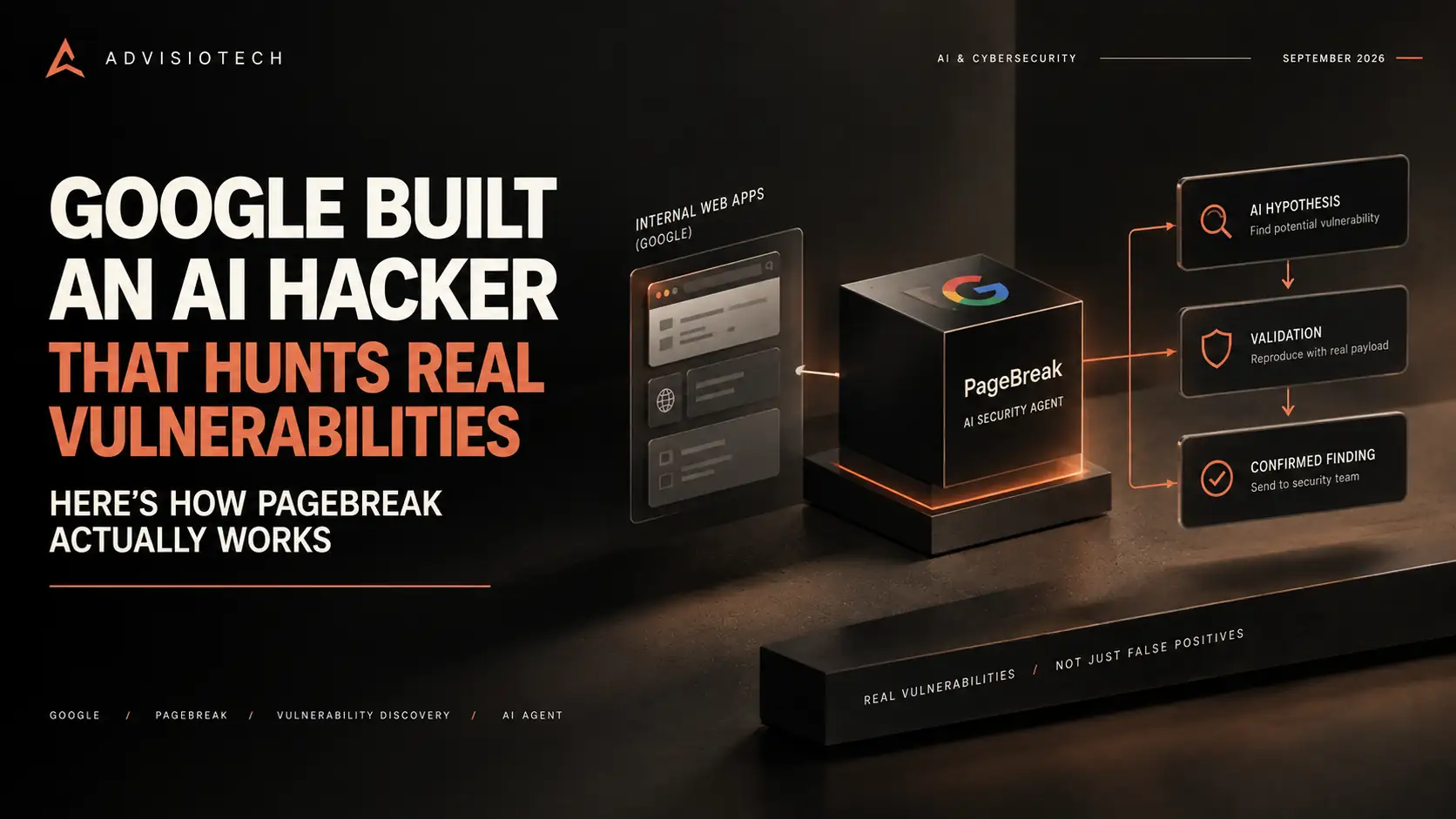
The system starts with an AI-generated hypothesis. The agent examines the application and searches for a potential vulnerability.
Instead of immediately reporting that vulnerability, PageBreak passes the hypothesis to a specialized validator.
The validator then attempts to reproduce the vulnerability against a running environment using a real test payload. If the exploit succeeds, the finding can be treated as a confirmed vulnerability. If it cannot be reproduced, the finding is not sent to the product team as a confirmed bug. :contentReference[oaicite:3]{index=3}
This is one of the most important ideas behind PageBreak. The AI does not get the final word simply because its explanation sounds convincing. The system requires evidence from an actual security test.
What Kind of Vulnerabilities Can It Test?
Google says PageBreak has specialized validators for multiple vulnerability classes.
For Cross-Site Scripting, the validator can inject a JavaScript payload and monitor whether that script actually executes.
For SQL injection, the validator can test whether database queries can be manipulated and examine the resulting behavior.
For path traversal, it can attempt to create and access files in locations that should not be available.
For Remote Code Execution, the validation process can look for evidence that code execution actually occurred, such as a controlled delay, file creation or an outbound request.
For Server-Side Request Forgery, the system can check whether the application causes an internal backend request to occur. :contentReference[oaicite:4]{index=4}
The important point is that these validators are not simply another language model guessing what happened. Google says the core validators are specialized, non-AI-written components designed to deterministically test specific vulnerability classes. :contentReference[oaicite:5]{index=5}
Google Says PageBreak Found More Than 500 XSS Vulnerabilities
The scale is what makes the project particularly interesting.
Google says PageBreak has uncovered more than 500 Cross-Site Scripting vulnerabilities across its first-party web applications, including vulnerabilities on sensitive domains. Google describes the system's false-positive rate as near zero because confirmed reports require successful deterministic validation. :contentReference[oaicite:6]{index=6}
That does not mean PageBreak finds every possible vulnerability. Google explicitly says its deterministic validators do not yet cover every vulnerability type or complex security scenario.
This creates an important tradeoff. A strict validator can dramatically reduce false positives, but anything the validator cannot reproduce may remain unresolved. Google therefore also uses unverified findings as seeds for future scans and as signals for where new validators are needed. :contentReference[oaicite:7]{index=7}
The Most Interesting Result Wasn't the 500 Bugs
There is another result in Google's disclosure that may be even more important for developers.
Google tested PageBreak against applications built using its high-assurance web frameworks. As of September 4, 2026, Google says PageBreak identified only two XSS vulnerabilities across hundreds of applications using those frameworks.
Both were limited to internal applications or debug endpoints with hardening gaps, according to Google. :contentReference[oaicite:8]{index=8}
Google is using this result as real-world validation of its secure-by-design approach: if an application framework prevents entire classes of vulnerabilities by default, an autonomous attacker has fewer weaknesses to discover.
That suggests the future of AI security may not simply be about building better AI hackers. It may also be about designing software so that AI hackers have fewer opportunities in the first place.
Is Google Using AI to Hack Its Own Websites?
Yes, but the important context is authorization.
PageBreak is an internal security system operated by Google's Product Security team and is designed to test Google's own first-party applications. It is not an AI system randomly attacking websites across the internet.
The distinction is fundamental. Security testing can involve techniques that resemble real attacks, but the legal and ethical boundary depends heavily on authorization, scope and the environment being tested.
PageBreak demonstrates what autonomous offensive techniques can look like when they are deliberately deployed as a defensive security capability.
Google Is Building the Other Half Too
Finding a vulnerability is only half the problem. Once a security team discovers a flaw, somebody still needs to fix it.
Google is therefore working to connect PageBreak with other agentic security initiatives, including CodeMender, which is designed to generate automated fixes.
Google says its longer-term goal is to reduce the amount of manual work required from product teams so engineers can focus on validating proposed fixes instead of investigating thousands of unverified reports. :contentReference[oaicite:9]{index=9}
This creates a much more interesting security pipeline than a simple AI vulnerability scanner.
An AI agent finds a possible weakness. A validator attempts to prove it. Another system can potentially generate a fix. A human can then review the confirmed vulnerability and proposed remediation.
The human is still important, but the amount of repetitive investigation can potentially shrink dramatically.
Google's New Cybersecurity Models Make This Bigger
PageBreak is not happening in isolation.
On September 2, 2026, Google introduced Gemini 3.8 Flash and Gemini 3.8 Flash Cyber. Google describes Gemini 3.8 Flash Cyber as a cybersecurity model designed for vulnerability detection and automated patching, with access being provided to trusted defenders through Google's Fairwind Program. :contentReference[oaicite:10]{index=10}
Google says Gemini 3.8 Flash Cyber achieved a success rate above 70% on one of its internal vulnerability-discovery benchmarks spanning complex codebases and 20 programming languages. Google also reports a 47.2% pass@1 result on the CWE-Bench patching benchmark, compared with 47.8% for a leading frontier model in the cited comparison. These are Google's reported benchmark results, so they should be treated as vendor-reported measurements rather than universal proof of superiority. :contentReference[oaicite:11]{index=11}
Google has also launched the Fairwind Program, which gives selected governments, critical infrastructure operators, software maintainers and other trusted partners access to advanced cyber-defense capabilities. Google says the program combines Gemini 3.8 Flash Cyber with CodeMender to help defenders find, verify and fix vulnerabilities at scale. :contentReference[oaicite:12]{index=12}
That means PageBreak looks less like an isolated Google experiment and more like part of a broader shift toward AI-assisted and increasingly agentic cybersecurity.
Can AI Replace Penetration Testers?
PageBreak does not demonstrate that human penetration testers are obsolete.
Google's own description points in the opposite direction. The system still has gaps in its validators, and complex vulnerabilities can require capabilities that the automated system does not yet have.
What PageBreak demonstrates is that AI can take over parts of the vulnerability discovery process, particularly when it is connected to the right tools, application environments and deterministic testing infrastructure.
The likely change is not simply humans versus AI. It is a security workflow where AI performs large-scale exploration, specialized systems verify what it finds and security professionals investigate the most important confirmed issues.
Why This Matters for Businesses
The technology is relevant even if a company never uses PageBreak.
AI agents are making it increasingly practical to scan software continuously rather than treating security testing as an occasional project. That changes the economics of vulnerability discovery.
A human security team may have limited time to inspect an enormous application. An agent can potentially repeat the process continuously and explore combinations of application behavior that would be difficult to test manually.
But automation also raises the importance of access controls and testing boundaries. An AI security agent with access to production systems needs carefully defined scope, authorization, credentials and monitoring. The same capabilities that make an AI useful for defense can become dangerous if an agent is allowed to operate outside its intended environment.
For businesses, the lesson from PageBreak is therefore not simply "use AI for cybersecurity." The more useful lesson is to combine AI discovery with strict authorization, controlled environments, deterministic verification and human review.
The Bigger Shift: From Finding Bugs to Proving Them
The most important part of Google's PageBreak project may not be the fact that an AI can search for vulnerabilities.
It is the decision to make verification part of the architecture.
Traditional AI security tools can produce plausible explanations. PageBreak tries to answer a harder question: can the suspected vulnerability actually be demonstrated?
That distinction could become increasingly important as AI-generated security reports become more common. If every security team receives thousands of AI-generated findings, the competitive advantage may not belong to the system that generates the most reports. It may belong to the system that can reliably determine which reports are real.
The Bottom Line
Google's PageBreak is an example of AI moving from security analysis into autonomous security testing. It can search Google's own applications, investigate potential vulnerabilities and use specialized validators to confirm whether suspected flaws can actually be exploited.
Google says the system has already validated more than 500 XSS vulnerabilities across its first-party web applications, while finding only two XSS vulnerabilities across hundreds of applications built on Google's high-assurance web frameworks as of September 4, 2026. :contentReference[oaicite:13]{index=13}
The bigger story is what happens when AI stops merely telling security engineers where a bug might be and starts gathering evidence that the bug is real.
That is a much more consequential step toward autonomous cybersecurity.
FAQ
What is Google PageBreak?
PageBreak is an internal AI agent developed by Google's Product Security team to autonomously search Google's first-party web applications for security vulnerabilities and validate suspected flaws.
How does Google PageBreak verify vulnerabilities?
PageBreak passes suspected vulnerabilities to specialized validators that attempt to reproduce the vulnerability against a running application using controlled security tests. Google says confirmed findings require successful deterministic validation. :contentReference[oaicite:14]{index=14}
How many vulnerabilities has PageBreak found?
Google says PageBreak has uncovered more than 500 Cross-Site Scripting vulnerabilities across Google's first-party web applications. :contentReference[oaicite:15]{index=15}
Is PageBreak an AI hacker?
It is reasonable to describe PageBreak as an AI-powered security testing agent because it searches for vulnerabilities and attempts to validate them using exploit techniques. However, it is an internal Google security system operating within authorized testing environments, not an unrestricted AI hacking system.
Can PageBreak find every type of vulnerability?
No. Google says its deterministic validators do not yet cover every vulnerability class or complex scenario. Unverified findings can instead be used to guide future scans and validator development. :contentReference[oaicite:16]{index=16}
Is Google replacing human security researchers with AI?
PageBreak automates parts of vulnerability discovery and validation, but Google's own description acknowledges limitations in automated validation and the continuing need for product teams to review and address findings. The project is better understood as an expansion of automated security testing rather than proof that human security researchers are no longer needed.
What is Gemini 3.8 Flash Cyber?
Gemini 3.8 Flash Cyber is a Google cybersecurity model designed for vulnerability detection and automated patching. Google says it is being made available to trusted defenders through the Fairwind Program. :contentReference[oaicite:17]{index=17}