The EU AI Act Just Became Enforceable, And Most Businesses Still Don't Know If It Applies to Them
On August 2, 2026, the EU AI Act's core enforcement powers, transparency rules, and penalty regime all became active, and it doesn't just apply to companies in Europe. If your business uses a chatbot, AI hiring tool, or AI ad system and has any European customers, this explains exactly what changed, what didn't, and whether you're actually affected.
The EU AI Act Just Became Enforceable, And Most Businesses Still Don't Know If It Applies to Them
Here's a genuinely confusing situation playing out right now: one of the most significant AI laws in the world just became enforceable, industry surveys suggest the large majority of organizations still aren't ready, and even the lawyers covering it can't fully agree on which parts are delayed and which aren't. If you run a business anywhere in the world and use AI in any capacity, a chatbot, an AI hiring tool, AI-powered ad targeting, this is worth five minutes of your time, because the honest answer to "does this apply to me" is more often yes than most people assume.
What The EU AI Act Actually Is
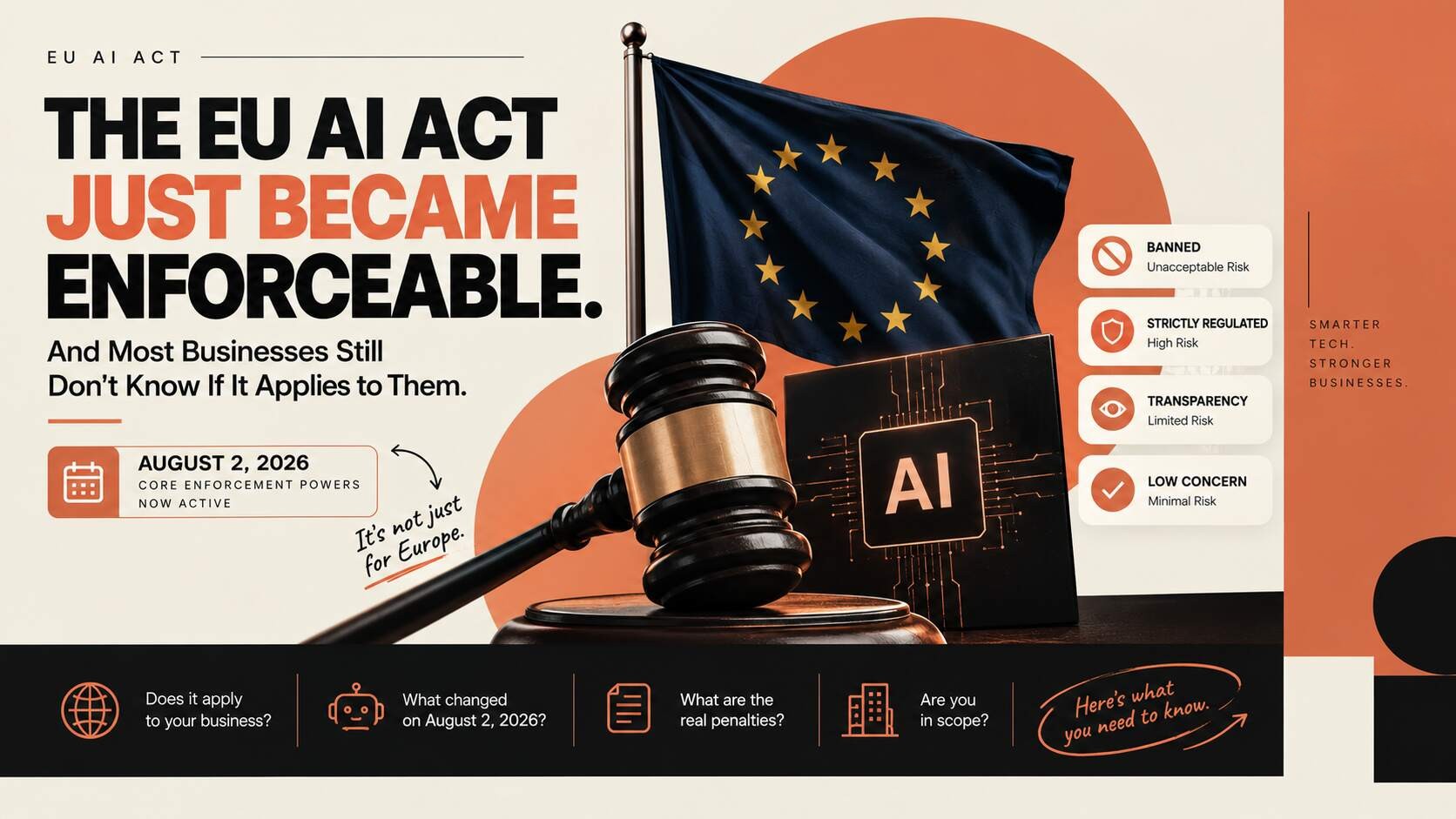
The EU AI Act is the world's first comprehensive, binding law regulating artificial intelligence. It was formally adopted by the European Union in 2024 and has been rolling out in stages ever since, rather than switching on all at once. Instead of treating all AI the same way, it sorts AI systems into four risk tiers, and how strictly a system gets regulated depends entirely on which tier it falls into.
- **Unacceptable risk**: banned outright. This covers things like AI-driven social scoring systems, manipulative AI designed to exploit vulnerabilities, and most forms of real-time biometric surveillance in public spaces.
- **High-risk**: heavily regulated, not banned, but subject to strict requirements. This includes AI used in hiring and employment decisions, credit scoring, insurance eligibility, education, critical infrastructure, and law enforcement.
- **Limited risk**: subject to transparency obligations. This is where most everyday business AI tools land, think chatbots, AI-generated content, and deepfakes, which must be clearly disclosed as AI-generated or AI-powered rather than presented as human.
- **Minimal risk**: largely left alone. Things like spam filters or AI features in video games mostly fall outside the law's real teeth.
Why August 2026 Specifically Matters
This is where the confusion really sets in, because two different things happened around the same date, and a lot of coverage has blurred them together.
As of August 2, 2026, the law's core enforcement machinery switched on: national regulators across EU member states officially gained enforcement powers, the full penalty regime became active, and a set of transparency obligations under the law's Article 50 became legally binding. Those transparency rules are the ones most everyday businesses will actually feel, requirements like clearly disclosing when someone is interacting with an AI chatbot rather than a human, and labeling AI-generated or manipulated content such as deepfakes.
Separately, the law's toughest requirements, the detailed compliance obligations for high-risk AI systems, were originally also supposed to fully apply from August 2026. In May 2026, EU lawmakers reached a provisional agreement to push most of those high-risk obligations back by sixteen months, to December 2027, with certain product-safety-related obligations pushed further still, to August 2028. That delay, part of a broader reform package known as the Digital Omnibus, has not been fully finalized through the EU's formal legislative process at the time of writing, which means businesses are in the uncomfortable position of planning around a deadline that may or may not still be legally binding depending on how those final negotiations land.
The practical takeaway: even with the proposed delay, August 2, 2026 was not a quiet date. Transparency obligations and enforcement powers are active now, regardless of what happens with the high-risk timeline.
Does This Actually Apply to My Business?
This is the single most common point of confusion, and it's understandable why. The EU AI Act is not limited to companies headquartered in Europe. It applies based on where the AI system's output is used, not where the company selling or building it is based.
In practice, that means a business anywhere in the world, the US, India, anywhere, can fall under the law's scope if it offers an AI-powered product to people in the EU, or if an AI system it deploys affects people located in the EU, even indirectly. A US company offering an AI tool that EU-based developers build on top of, or a business using an AI chatbot that EU customers interact with, can both be pulled into scope. This mirrors how GDPR worked, a law many businesses outside Europe eventually had to comply with simply because they had European users, even without any physical presence in the EU.
The law also distinguishes between a "provider," the entity that actually builds or develops an AI system, and a "deployer," the entity that uses one in a professional capacity. Deployers generally face lighter obligations than providers, but they are not exempt, and simply using someone else's AI tool doesn't automatically put a business in the clear.
What Happens If You Don't Comply
The penalties are steep enough to get any business owner's attention. Depending on the type of violation, fines can reach up to roughly €35 million or 7% of a company's global annual revenue, whichever is higher, for the most serious violations, such as deploying a banned AI practice. Lower-tier violations still carry meaningful fines, including penalties reaching several million euros even for administrative failures like providing false information to regulators. For context, even the lowest listed penalty tier is large enough to seriously damage an early-stage company.
Beyond fines, regulators have real operational power too: they can request detailed information from AI providers, demand direct access to a system, order corrective measures, and in serious cases, order an AI system removed from the EU market entirely.
Why So Many Businesses Are Still Behind
A few things have collided to create this level of confusion, and it isn't just businesses being careless.
- **The delay itself is still legally uncertain.** Treating the December 2027 high-risk deadline as settled fact, when it hasn't been formally finalized, is a real risk. Legal analysts have specifically warned businesses against assuming the extension is locked in.
- **EU member states themselves are behind schedule.** Reports from late 2025 found that over a dozen member states had missed their own deadline to appoint the national regulators responsible for enforcing the law in the first place, and several hadn't even passed the domestic legislation needed to enforce it. When the enforcers aren't fully ready, it's little surprise businesses trying to comply are confused too.
- **The rules genuinely require detailed, ongoing documentation**, not a one-time checklist. High-risk AI providers are expected to maintain a real, substantial technical file showing how a system was designed, how its training data was governed, and what fundamental rights risks were assessed, the kind of work that has to be built up over time, not assembled the week before an audit.
What Small and Mid-Sized Businesses Should Actually Do Right Now
You don't need a full legal compliance department to take a few sensible first steps:
- **Take an honest inventory of where you use AI.** Chatbots, AI-written marketing content, AI ad targeting, AI resume screening, anything that touches an EU customer or user counts.
- **If you use AI-powered chat or customer service tools, check your disclosures.** Under the transparency rules now in effect, people generally need to be told clearly when they're interacting with AI rather than a human.
- **If you use AI in hiring, credit decisions, or anything resembling a high-risk category**, treat the current delay as tentative, not settled, and don't wait until late 2027 to start preparing.
- **Talk to someone who actually understands both the compliance side and how your AI tools are actually built and deployed**, since the gap between "technically compliant on paper" and "actually compliant in how the system runs day to day" is exactly where most businesses get caught out.
The Bigger Picture
It's tempting to treat this as a European problem that doesn't concern businesses elsewhere, but that's exactly the assumption that caught a lot of companies off guard with GDPR a few years ago. The EU AI Act is widely expected to become a template other governments look to as they draft their own AI regulations, meaning the specific compliance work happening now may end up being useful well beyond just satisfying EU regulators. Businesses that build good AI transparency and documentation habits now are, in effect, getting ahead of a wave that's very likely still building elsewhere.
The Bottom Line
The EU AI Act didn't quietly slip into effect, it arrived in a genuinely confusing, half-delayed, half-active state that has left even seasoned compliance professionals debating the details. What's certain is this: transparency obligations and real enforcement power are live as of August 2026, the law reaches far beyond companies physically based in Europe, and the safest assumption for any business using AI in a customer-facing way is to check now, rather than find out the hard way later.
FAQ
What is the EU AI Act in simple terms?
It's the European Union's comprehensive law regulating artificial intelligence, sorting AI systems into risk categories, from banned practices to lightly regulated tools, with different obligations attached to each category.
Does the EU AI Act apply to businesses outside Europe?
Yes, potentially. The law applies based on where an AI system's output is used or who it affects, not where the company is headquartered, so a business based outside the EU can still fall under its scope if it offers AI-powered products or services to people in the EU.
What actually became enforceable on August 2, 2026?
National enforcement authorities gained their full enforcement powers, the complete penalty regime became active, and transparency obligations under Article 50, including AI chatbot disclosure and deepfake labeling requirements, became legally binding.
Was the EU AI Act delayed?
Part of it. EU lawmakers reached a provisional agreement in May 2026 to push back the toughest requirements for high-risk AI systems to December 2027, and further to August 2028 for certain product-safety obligations. As of the most recent reporting, this delay had not been fully finalized through the EU's formal legislative process.
What are the penalties for non-compliance?
Fines can reach up to roughly €35 million or 7% of a company's global annual revenue for the most serious violations, with lower but still substantial fines for other types of non-compliance.
What should a small business do first?
Start by identifying everywhere AI is used in the business, especially anything customer-facing that could touch EU users, check that AI chatbots and similar tools clearly disclose they're AI, and treat any part of the high-risk timeline as tentative rather than settled.