Digital Marketing for Small Businesses: A Practical Guide to What Actually Works
Most small business owners don't need more marketing advice, they need to know which channels are actually worth their limited time and budget right now. This guide breaks down local SEO, social media, paid ads, WhatsApp marketing, and AI automation in plain terms, with a clear way to prioritize based on your business type and stage.
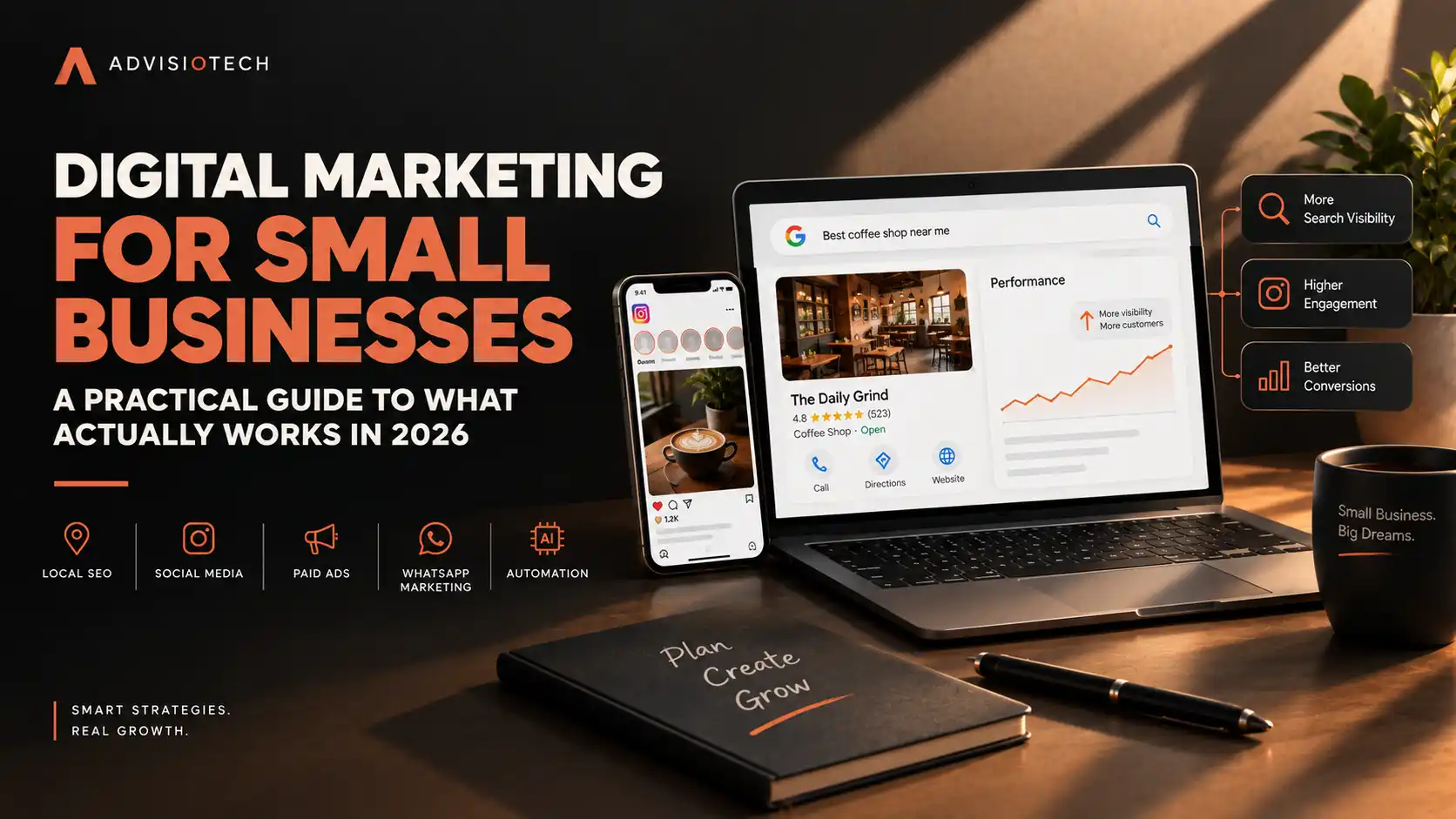
Digital Marketing for Small Businesses: A Practical Guide to What Actually Works in 2026
Ask ten small business owners what they're doing for digital marketing and you'll likely get ten different half-finished answers. A Google Business Profile that hasn't been touched in months. An Instagram account someone posts to occasionally. Maybe a WhatsApp broadcast list nobody's organized properly. This isn't a failure of effort, it's a symptom of there being too many channels, too much conflicting advice, and not enough clarity on what actually moves the needle for a business your size.
This guide is meant to cut through that. Not a list of generic tips, but a genuinely useful breakdown of what each major digital marketing channel actually does for a small business, what it costs in time or money, and how to think about which ones deserve your attention first.
Why This Decision Matters More Than It Seems
A large business can afford to run every channel at once and let data sort out what works. A small business usually can't. Spreading a limited budget and even more limited time across six different marketing channels at once typically means doing all of them poorly, which is often worse than doing two channels properly and ignoring the rest for now. The real skill in small business marketing isn't knowing every tactic, it's knowing which two or three actually fit your specific business, customers, and stage of growth.
Local SEO and Google Business Profile
For almost any business with a physical location or a defined local service area, a restaurant, a salon, a clinic, a repair service, a law firm, this is usually where to start, not because it's trendy, but because it captures people at the exact moment they're ready to buy. Someone searching "plumber near me" or "best dentist in [area]" isn't browsing, they're deciding.
A properly optimized Google Business Profile includes accurate, complete categories, a real street address or clearly defined service area, consistent business hours, regularly updated photos, and active management of reviews and customer questions. It also means your business name, address, and phone number match exactly across your website and every other directory you appear in, inconsistency here quietly undermines how much Google trusts your listing.
The honest limitation of local SEO is patience. It's rarely instant. A new or recently updated profile typically takes weeks to months to climb toward the top three positions that capture the overwhelming majority of local search clicks, and it requires ongoing maintenance, not a one-time setup, to hold that position once earned.
Social Media Marketing
Social media serves a genuinely different purpose than local SEO: it's not primarily about capturing someone actively searching, it's about staying visible and building familiarity with people who aren't searching for you yet, so that when they are ready, your business is already the one they think of.
For most small businesses, this means choosing one or two platforms deliberately rather than trying to maintain a presence everywhere. A visually driven business, food, fashion, beauty, home decor, generally benefits most from Instagram and short-form video. A business selling to other businesses, or offering professional services, often gets more genuine traction on LinkedIn or even a well-run WhatsApp presence than on Instagram.
The common mistake isn't posting too little, it's posting without a consistent point of view or purpose, a feed that alternates randomly between promotional posts, generic quotes, and the occasional product photo rarely builds the kind of following that actually converts into customers. A clearer content plan, specific content types posted on a specific rhythm, tends to outperform sporadic, higher-volume posting with no real pattern.
Paid Advertising (Google Ads and Meta Ads)
Paid ads solve a different problem than the first two channels: speed. Local SEO and social media are both compounding, longer-term plays. Paid advertising can put your business in front of the right person today, which makes it especially useful during a launch, a slow season, or when testing whether a new offer actually resonates before investing more heavily in it.
Google Ads tends to work best for capturing existing, active demand, someone already searching for what you sell. Meta Ads (Facebook and Instagram) tend to work better for creating demand, reaching someone who wasn't actively looking but is a strong match based on their interests or behavior. Many small businesses benefit from understanding this distinction before choosing where to spend a limited test budget, rather than defaulting to whichever platform they've heard of most.
The real risk with paid ads isn't the platform, it's running campaigns without tracking what actually happens after the click. Spending on ads while ignoring landing page quality, response time to leads, or whether the ad's promise actually matches the offer is one of the most common ways small businesses burn budget without seeing a return.
WhatsApp Marketing
This channel is particularly significant in markets like India, where WhatsApp isn't a secondary communication tool, it's often the primary one, used more consistently than email or even phone calls for many customers. A well-organized WhatsApp Business presence, a clear product or service catalog, prompt responses, and thoughtfully timed broadcast messages, can function as both a sales channel and a customer service channel simultaneously.
The common failure point here isn't technical, it's volume and tone. Sending too many promotional messages, or messages that feel impersonal and mass-produced, tends to generate blocks and spam reports quickly, which can put the entire number at risk. The businesses that get real value from WhatsApp marketing tend to treat it closer to a genuine conversation channel than a one-way broadcast tool.
AI Automation
This is the newest, and least standardized, piece of the small business marketing toolkit. In practice, it usually means using AI-powered tools to handle first-response customer questions, qualify leads before a human gets involved, or automate repetitive parts of content creation and scheduling, freeing up limited staff time for the parts of the business that genuinely need a human.
The realistic value here depends heavily on implementation. A poorly configured AI chatbot that gives vague or incorrect answers can damage trust faster than having no automation at all. Done well, it typically means a business responds to a customer inquiry within minutes instead of hours, without needing someone monitoring messages around the clock.
How to Actually Prioritize, Given Limited Time and Budget
A reasonable starting framework: if your business depends on local, nearby customers, start with your Google Business Profile before anything else, it's often the highest-return, lowest-cost channel available, and many of the basics can be improved without any paid spend at all. Once that foundation is solid, layer in one social media platform chosen deliberately based on your business type, not based on what's trending. Consider paid ads once you have a clear, specific offer worth testing, and a landing page ready to actually convert the traffic you'd be paying for. Bring in WhatsApp marketing seriously if your customers already communicate with you that way, rather than forcing it onto a business where it doesn't naturally fit. And treat AI automation as something to add once your core channels are generating enough volume that manual handling has genuinely become a bottleneck, not as a replacement for getting the fundamentals right first.
Where AdvisioTech Fits Into This
Most small business owners don't struggle with understanding that digital marketing matters, they struggle with having the time, specialized knowledge, and bandwidth to execute it consistently across several channels at once while also running the actual business. That's the specific gap AdvisioTech works in: hands-on management of Google Business Profile optimization and local SEO, social media strategy and content execution, paid Google and Meta ad campaigns, WhatsApp marketing setup and ongoing management, and AI automation built around how a specific business actually operates, rather than a generic template applied the same way to every client.
The right starting point genuinely depends on your business, its customers, and what's currently working or not working for you, which is exactly the kind of assessment worth having a real conversation about rather than guessing at from a generic checklist.
FAQ
Which digital marketing channel should a small business start with?
For most businesses with a physical location or local service area, Google Business Profile optimization and local SEO typically offer the strongest starting point, since they capture customers who are already actively searching and ready to make a decision.
How much should a small business budget for digital marketing?
This varies significantly by industry, location, and goals, but a practical approach is starting with the lowest-cost, highest-return channels first, such as Google Business Profile optimization, before committing a meaningful budget to paid advertising, and scaling spend based on what's actually converting.
Is social media or Google Ads better for a small business?
They generally serve different purposes rather than competing directly. Google Ads tends to capture people already searching for what you offer, while social media and social ads are typically more effective at building awareness and demand among people who aren't actively searching yet.
How long does local SEO take to show results?
Local SEO is generally a weeks-to-months process rather than an immediate one, particularly for a newer or recently updated Google Business Profile competing for the top local search positions.
Is WhatsApp marketing worth it for a small business?
It can be highly effective, particularly in markets where customers already rely on WhatsApp as a primary communication channel, but it requires careful message frequency and a conversational tone to avoid spam reports and potential account restrictions.
Do small businesses actually need AI automation?
It depends on scale and current bottlenecks. AI automation tends to provide the most value once a business has enough customer inquiry volume that manual response handling has become a genuine constraint, rather than as a starting point before core marketing channels are established.