Chinese AI Models Went From Niche to Dominant in Under a Year, Here's the Full Story Nobody's Fully Connected Yet
In February, Chinese AI models were a small slice of global developer traffic. By September, they're the majority on two of the biggest AI platforms in the world. This isn't a story about which AI is smarter, it's about price, openness, and a geopolitical fight that just framed a summit between the US and Chinese presidents. Here's the complete picture.
Chinese AI Models Went From Niche to Dominant in Under a Year, Here's the Full Story Nobody's Fully Connected Yet
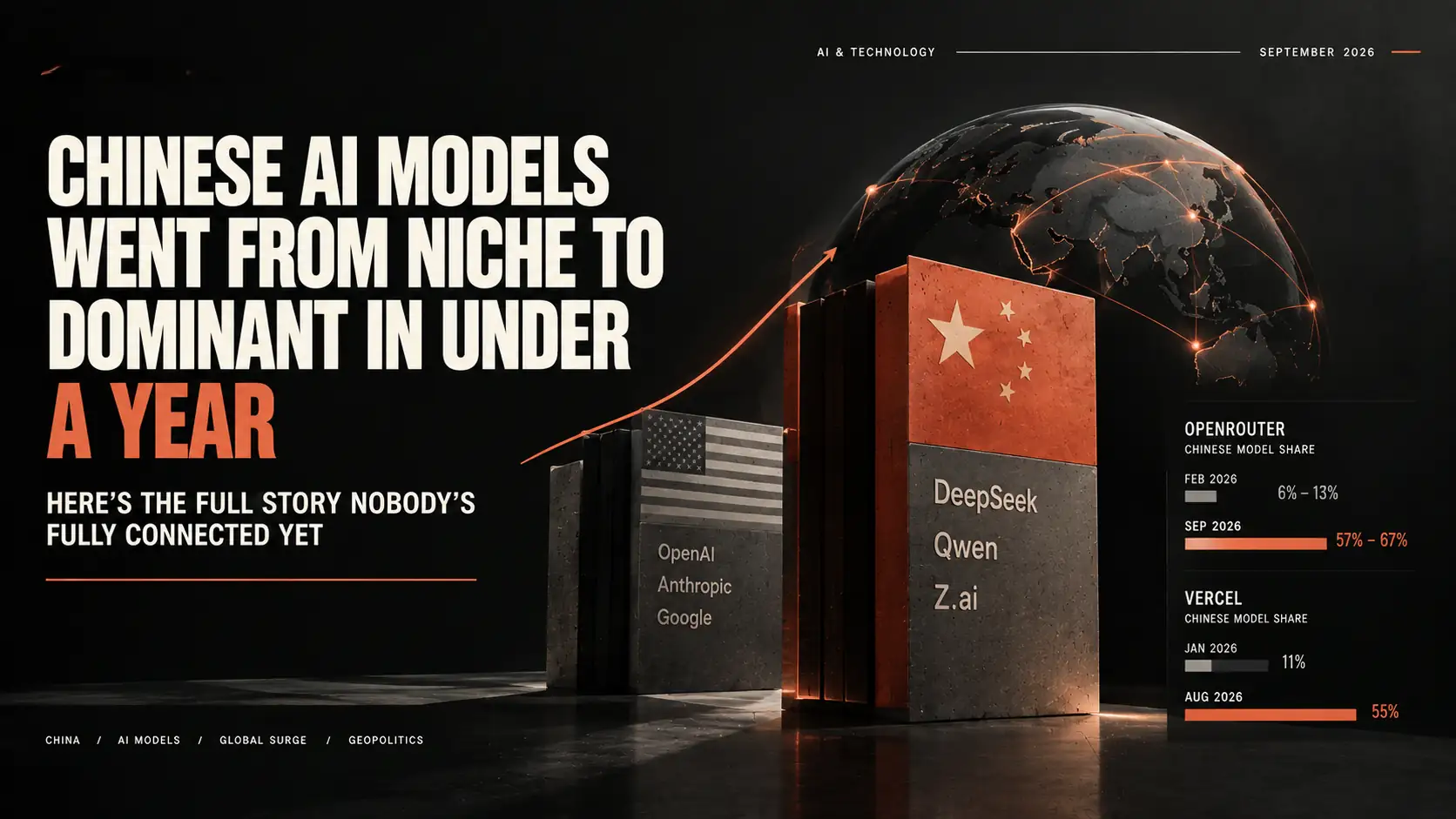
Here's a number worth sitting with: in February 2026, Chinese AI models made up somewhere between 6% and 13% of all AI traffic flowing through OpenRouter, one of the largest platforms developers use to access AI models from different companies. By the second week of September, that share had climbed to somewhere between 57% and 67%. On Vercel, another major developer platform, Chinese models went from 11% of traffic in January to 55% by August.
That's not a gradual shift. That's a takeover, and it happened in roughly seven months. Most of the coverage so far has reported this as a single data point, a surprising statistic in an otherwise busy AI news cycle. It deserves more than that, because understanding why this happened, and why it has two full US House committees investigating it, requires connecting several different threads that don't usually get explained together.
What's Actually Driving This
The models at the center of this shift come primarily from three Chinese companies: DeepSeek, Alibaba's Qwen, and Z.ai. On OpenRouter specifically, DeepSeek alone accounted for roughly a quarter of all text requests during the week beginning September 14. Alibaba's Qwen has become a particularly popular foundation for other developers to build on, with more than 100,000 derivative models created from it worldwide.
According to Peter Walker, head of insights at OpenRouter, the driving factor isn't that these models have leapfrogged the best American ones in raw capability, US frontier models still generally lead on most benchmarks and still attract more overall spending. What's changed is that Chinese open-source models released this year have become genuinely capable of handling advanced, real-world tasks, particularly coding and other agentic work, at a small fraction of the cost.
The Real Difference Isn't Intelligence, It's the Business Model
This is the part that gets lost when the story is reduced to a single statistic, and it's genuinely the most important piece to understand. Most leading American AI models, from OpenAI, Anthropic, and Google, are closed-source or closed-weight, meaning the company controls exactly how you can access the model, typically through a paid API, and keeps the underlying system proprietary.
Chinese AI companies have taken a fundamentally different approach: releasing many of their most capable models as open-weight, meaning developers can actually download the model itself and run it on their own hardware, modify it, or host it wherever they choose, often for free or at dramatically lower cost than a comparable closed model. That single structural difference changes the entire calculation for a developer or business deciding which AI to build with. It's not just about which model answers a coding question slightly better, it's about who can actually afford to run the model constantly, customize it for their specific needs, and avoid being locked into one company's pricing and infrastructure.
As one analysis from the Brookings Institution put it, describing China's approach: it's allowed models that are generally still lagging behind the very best American systems to catch up dramatically in terms of real-world adoption and global reach, because the AI race isn't only about which model is objectively the best, it's about who actually ends up using it, and how widely.
Why Washington Is Genuinely Alarmed
This trend has become significant enough that two separate US House committees are now investigating the rising global use of Chinese AI systems, and it framed a meeting between President Trump and Chinese President Xi Jinping this week, though that summit reportedly produced little beyond an agreement to keep talking.
The concern isn't just abstract national pride about who's "winning" the AI race. According to Daniel Remler, a senior fellow at the Center for a New American Security, the integration of Chinese AI models into global infrastructure represents genuine economic and security risk, tied to a few specific worries:
- **Technology dependency.** As more businesses and even government-adjacent systems around the world build on Chinese-made AI infrastructure, that creates a form of dependency that's difficult to reverse later, similar to concerns raised previously about Chinese-made telecom equipment.
- **Chip export control workarounds.** The US has spent years restricting Chinese companies from buying the most advanced AI chips directly. Washington is specifically concerned Chinese firms may be accessing those same restricted chips indirectly, through overseas data centers, effectively working around the restrictions rather than being blocked by them.
- **Model "distillation."** This refers to a technique where a newer AI model is trained to mimic and learn from an already-established, more advanced model. US officials are examining whether Chinese companies are using this approach to make faster technical progress than their own hardware restrictions would otherwise allow.
Why This Matters Beyond Government Policy
It's easy to read this as a story that only matters to lawmakers and AI company executives, but the practical reality touches anyone building on AI right now, including small businesses experimenting with AI automation tools. A huge, rapid shift toward cheaper, open-weight models genuinely changes what's economically viable for a business deciding whether to build an AI-powered tool, chatbot, or automation workflow, and which underlying model that tool actually runs on increasingly matters for reasons beyond just performance: cost, data handling, and now, geopolitical scrutiny are all part of that decision.
It's also a preview of a tension likely to keep surfacing: as AI becomes deeply embedded in everyday business tools, the question of which country's models power the infrastructure underneath isn't purely technical anymore, it's becoming a live policy and security question being actively debated in the same week world leaders are meeting to discuss it directly.
The Bottom Line
The headline statistic, Chinese AI models going from a small slice to the majority of traffic on major developer platforms in under a year, is genuinely remarkable on its own. But the full story is really about a fundamental strategic bet: while American AI companies have largely competed on being the most powerful, proprietary option available, Chinese companies bet on being open, customizable, and cheap enough that adoption could outpace raw capability. Seven months of data suggest that bet is working, at least in terms of who's actually using these models, and Washington's response over the coming months will likely shape how this plays out next.
FAQ
How much have Chinese AI models grown in global usage?
According to usage data reported by CNBC, Chinese AI models grew from roughly 6% to 13% of OpenRouter's developer traffic in February 2026 to between 57% and 67% by mid-September 2026. On Vercel, another major developer platform, their share grew from 11% in January to 55% by August.
Which Chinese AI companies are driving this growth?
The main companies are DeepSeek, Alibaba's Qwen, and Z.ai. DeepSeek alone accounted for roughly a quarter of text requests on OpenRouter during the week of September 14, 2026, while Qwen has become a widely used foundation, with more than 100,000 derivative models built on it by developers worldwide.
Why are Chinese AI models gaining popularity if US models are still more advanced?
The primary driver is cost and openness rather than raw capability. Many Chinese models are released as open-weight, meaning developers can download and run them independently at much lower cost, and often customize them, compared to proprietary, closed American models.
Why is the US government concerned about this trend?
Two US House committees are investigating the rise of Chinese AI adoption due to concerns about technology dependency, the possibility of Chinese companies indirectly accessing restricted advanced chips through overseas data centers, and the use of AI "distillation" techniques to accelerate development despite export restrictions.
What is AI model "distillation"?
It's a technique where a newer AI model is trained to mimic and learn from an already-established, more advanced model, potentially allowing faster progress without needing to independently develop equivalent underlying technology.
Did this come up during the Trump-Xi summit?
Yes, the growing adoption of Chinese AI models reportedly framed discussions during this week's summit between President Trump and Chinese President Xi Jinping, though the meeting reportedly resulted in little beyond an agreement to continue dialogue on the issue.