Europe's Most Valuable Company Just Sold Zero Chip Machines at Home, Here's the Deeper Story Behind That Number
ASML makes the only machines on Earth capable of producing the world's most advanced AI chips, and it's Europe's most valuable public company. It's also having a record global year. And for two straight quarters, it sold exactly zero of those machines inside Europe. Here's what that genuinely strange fact reveals about a much bigger problem.
Europe's Most Valuable Company Just Sold Zero Chip Machines at Home, Here's the Deeper Story Behind That Number
Here's a sentence that sounds like it shouldn't be possible: the single most important company in the entire global chip industry, the one company every advanced chipmaker in the world depends on, sold none of its machines in its own home continent for two consecutive quarters, while simultaneously having one of the best years in its history everywhere else.
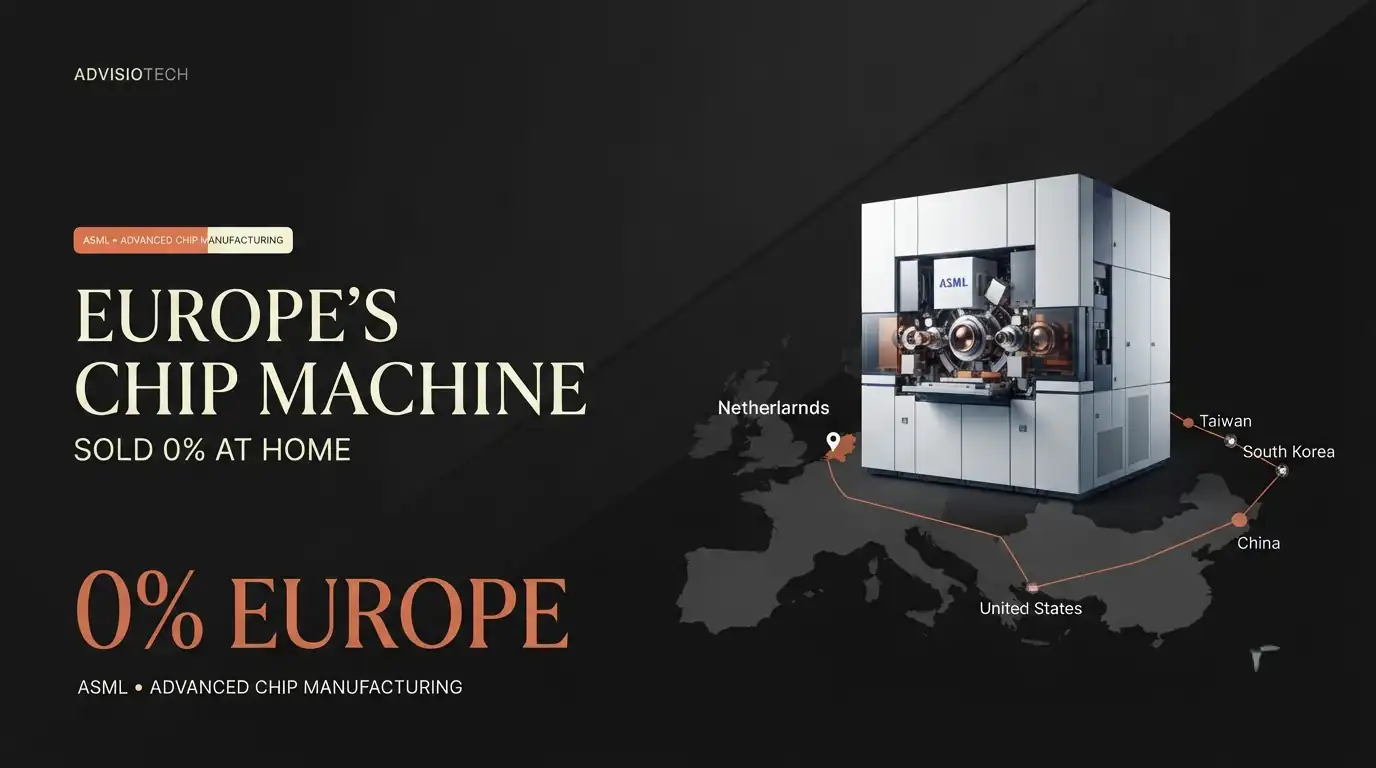
That company is ASML, a Dutch firm most people outside the tech industry have never heard of, despite it being Europe's most valuable publicly traded company, worth roughly twice as much as Roche, the next largest. And the number really is zero. Not a decline, not a slowdown, zero percent of ASML's net system sales in the first and second quarters of 2026 came from Europe.
This isn't really a story about one company's sales figures. It's a genuinely revealing window into a much bigger question Europe has been struggling to answer: can you build an AI-powered future on a continent that isn't actually building the infrastructure that future requires?
Why ASML Matters More Than Almost Any Company You've Never Heard Of
ASML makes extreme ultraviolet lithography machines, extraordinarily complex equipment used to print the microscopic circuit patterns onto the most advanced computer chips in the world, the kind that power everything from smartphones to the AI data centers currently driving a global investment boom. It's not an exaggeration to say ASML is a genuine chokepoint in the global technology supply chain: no other company on Earth currently makes machines capable of producing chips at the most advanced nodes. Every leading-edge chipmaker, whether in Taiwan, South Korea, or the US, depends on ASML equipment to produce their most advanced products at all.
The Numbers, Laid Out Plainly
Speaking at a public event in Amsterdam on September 21, ASML's executive vice president for public affairs, Frank Heemskerk, put it about as bluntly as a corporate executive ever does. He stated the company is selling absolutely nothing in Europe, explaining plainly that Europe simply isn't investing, and no chip factories are being built there.
The company's own quarterly figures back this up completely. In the second quarter of 2026, ASML's regional sales breakdown looked like this: South Korea led with 43% of system sales, followed by Taiwan at 30%, China at 14%, the United States at 9%, and Japan at 4%. Europe's share: zero.
This wasn't a sudden collapse either, it's the continuation of a steady decline that's been building for years. Europe accounted for roughly 5% of ASML's system sales in 2024, 4% in 2023, and had already fallen to about 1% in 2025 before hitting zero in the first half of 2026.
Meanwhile, the rest of ASML's business is genuinely booming. The company raised its full-year 2026 revenue guidance twice this year, from an initial range around €34 to €39 billion, up to €43 to €45 billion by the time its second-quarter results came in, driven by surging global demand tied directly to the AI infrastructure buildout happening in Asia and the US.
Why Europe Simply Isn't Buying
The core reason is refreshingly simple, if uncomfortable: ASML's most advanced machines are built for manufacturing cutting-edge chips, and Europe currently has no active construction of the kind of advanced semiconductor fabrication plants, commonly called fabs, that would actually need them. European chip manufacturing has historically focused on mature, less advanced chip technology, often used in automotive applications, which doesn't require ASML's flagship extreme ultraviolet equipment at all.
This creates a genuinely strange dynamic: a European company sits at the absolute top of the global semiconductor supply chain, supplying the machines that make the world's most advanced AI chips possible, while having no customer for that same technology in its own backyard.
The Policy Gap This Exposes
This lands as a particularly uncomfortable data point for the European Union specifically, since it directly undercuts the stated goals of the bloc's own Chips Act 2.0 proposal, presented earlier this year with the explicit aim of strengthening Europe's semiconductor industry and reducing dependence on other countries for critical chip technology. The EU has set a target of reaching a 20% share of global microchip production value by 2030. According to the European Court of Auditors, that target is currently considered highly unlikely to be met at the pace Europe is actually investing.
Heemskerk's comments pointed to exactly this gap: he argued that simply trying to attract investment on the supply side isn't enough, Europe needs to actively create real demand for advanced chips too, something the current policy approach hasn't managed to do.
Other Countries Are Actively Trying to Poach ASML Itself
Perhaps the most striking detail in Heemskerk's remarks wasn't about sales figures at all, it was about where ASML's own engineering and manufacturing work might end up in the future. He described China and India as rolling out, in his words, the reddest of red carpets to attract ASML's operations, while the United States, where ASML already conducts roughly a quarter of its research and development, has been pushing to raise that share significantly higher, potentially toward half.
In other words, while Europe isn't buying ASML's machines, other major economies are actively competing to pull the company's actual engineering and manufacturing footprint away from its European home base entirely. For a company this central to global chip production, that's a genuinely significant signal about where the center of gravity in advanced semiconductor manufacturing may be heading.
Why This Matters Beyond Europe
This story is a concrete, real-world illustration of something playing out more broadly across the global AI boom: the infrastructure required to actually build and run advanced AI, the chips, the data centers, the manufacturing capacity, is concentrating heavily in a small number of places, primarily Taiwan, South Korea, China, and increasingly the US, while other major economies risk becoming purely dependent consumers of that infrastructure rather than producers of it. Europe's position here is a particularly stark example, given that it's home to the single most critical company in the entire supply chain, and still isn't managing to build the demand needed to keep that expertise, and that manufacturing capability, anchored at home.
The Bottom Line
A single statistic, zero percent, rarely tells a complete story on its own, but this one genuinely does capture something real: Europe possesses one of the most strategically important companies in the entire global technology industry, and currently isn't building the infrastructure needed to actually benefit from having it. ASML's global business has never been stronger. Its home market, for now, simply isn't part of that story, and with other countries actively courting the company's engineering talent and manufacturing footprint, that gap is a genuine, unresolved question about where Europe's place in the AI era actually ends up.
FAQ
What is ASML and why is it important?
ASML is a Dutch company that manufactures extreme ultraviolet lithography machines, the only equipment in the world currently capable of producing the most advanced computer chips, including those used in AI data centers. Nearly every leading global chipmaker depends on ASML's technology to manufacture their most advanced products.
Did ASML really sell zero equipment in Europe?
Yes. According to the company's own reported figures, Europe accounted for 0% of ASML's net system sales in both the first and second quarters of 2026, down from about 1% in 2025, 4% in 2023, and 5% in 2024.
Why isn't Europe buying ASML's machines?
According to ASML executive Frank Heemskerk, it's because Europe currently isn't investing in or building the advanced semiconductor fabrication plants that would require ASML's most advanced equipment, with existing European chip manufacturing largely focused on less advanced, mature chip technology.
Is ASML's overall business struggling?
No, the opposite. ASML has raised its full-year 2026 revenue guidance twice this year, to a range of €43 to €45 billion, driven by strong global demand, particularly from South Korea, Taiwan, China, and the US.
What is the EU's Chips Act 2.0?
It's a European Commission proposal aimed at strengthening the EU's semiconductor industry and reducing dependence on other countries for critical chip technology, with a stated goal of reaching a 20% share of global microchip production value by 2030, a target the European Court of Auditors considers unlikely to be met at the current pace of investment.
Are other countries trying to attract ASML away from Europe?
According to ASML's own executive, yes. China and India have reportedly been actively courting the company's operations, while the United States has been pushing to significantly increase ASML's research and development presence there.