Apple's New Siri Is Finally Here: What the Gemini-Powered AI Upgrade Actually Means For You
After years of promises, Apple has started rolling out the biggest Siri overhaul since 2011, built on a custom Google Gemini model. Here's what's actually changed, which devices get it first, and why this matters even if you don't own an iPhone.
Apple's New Siri Is Finally Here: What the Gemini-Powered AI Upgrade Actually Means For You
If you've had an iPhone for more than a few years, you already know the feeling: you ask Siri a simple question and get back something unhelpful, or worse, "I found this on the web." That's about to change. Apple has begun rolling out a completely rebuilt version of Siri, powered under the hood by a custom AI model built with Google, and it's the biggest change to the assistant since it first launched back in 2011.
This isn't a minor update. It's Apple finally catching up to the ChatGPT and Gemini era, and because Apple's devices are used by well over two billion people worldwide, this single update is about to become one of the most-used pieces of AI software on the planet, whether people realize it or not.
What Actually Changed
The old Siri could set timers, send texts, and occasionally understand what you meant. The new Siri is built to actually hold a conversation. It can follow a back-and-forth exchange across more than 20 turns without losing the thread, understand what's currently on your screen, and carry out multi-step tasks across different apps instead of just answering one question at a time.
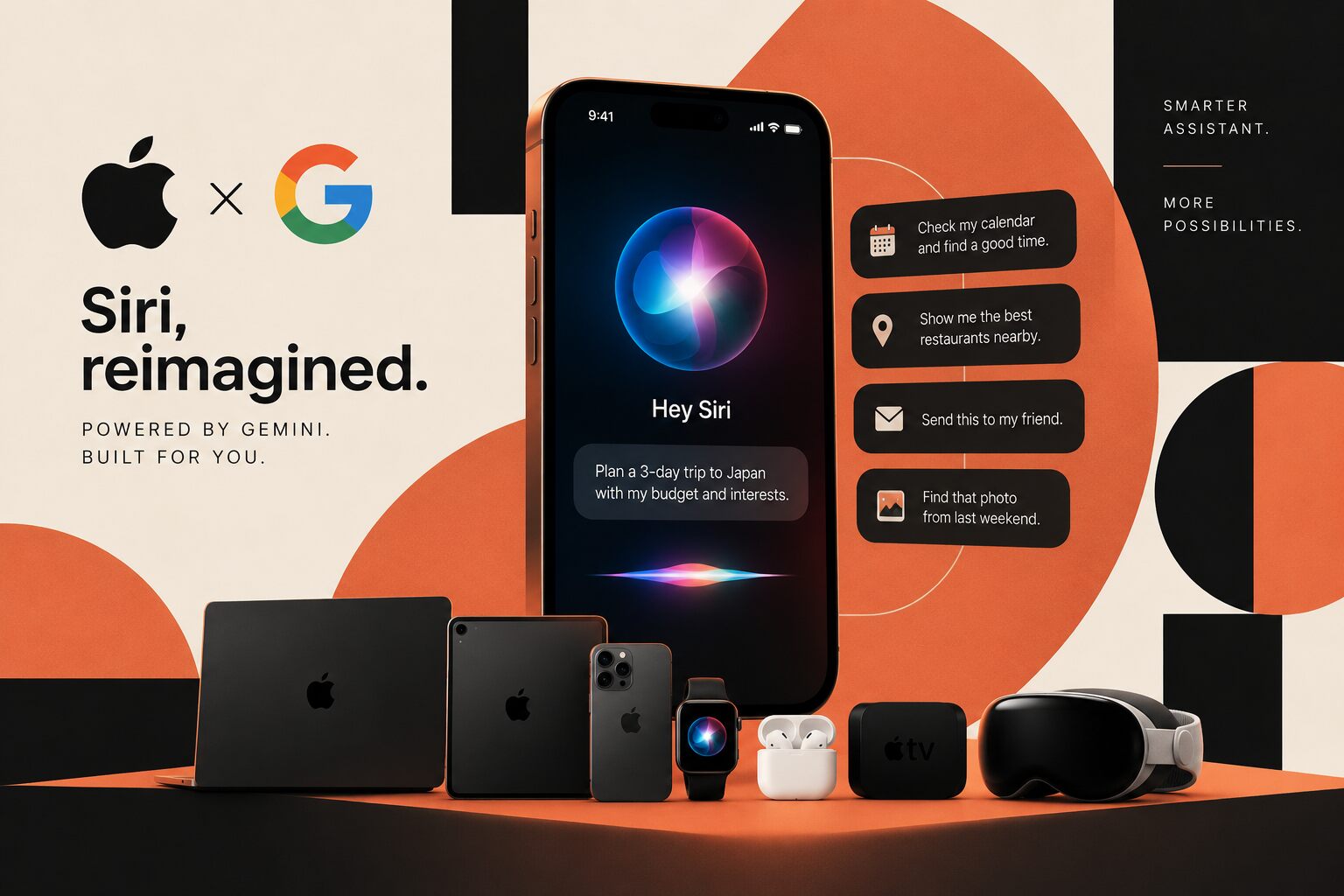
Apple has also given Siri its own standalone app for the first time, similar to how you'd open ChatGPT or Gemini directly, alongside the assistant remaining built into the rest of the operating system. The new Siri is available not just on iPhone, but across iPad, Mac, Apple Watch, CarPlay, AirPods, Apple TV, and Vision Pro, meaning the upgrade touches almost every device Apple makes.
Wait, Google Is Powering Siri Now?
Yes, and this detail alone has been the subject of endless online debate. Apple and Google signed a multi-year partnership, reportedly worth around a billion dollars a year on top of Apple's existing multi-billion dollar search placement deal, to let Apple build custom AI models on top of Google's Gemini technology.
Apple has been careful to point out that this isn't simply Google's Gemini rebranded. The models were distilled and rebuilt specifically to run efficiently on Apple's own chips, using Apple's own data, and processed through what Apple calls Private Cloud Compute, a system designed so that your requests are de-identified before they're processed and nothing is stored afterward or used to train Google's models. Whether users will fully trust that explanation is, understandably, a separate question that's already generating plenty of discussion.
Who Gets It First
The rollout is happening in phases rather than all at once. Newer devices are getting priority: iPhone 15 Pro and newer, along with recent iPads and Macs, get full functionality right away, while older compatible devices are expected to receive it gradually, sometimes with more limited features or a heavier reliance on cloud processing.
The public beta of the new Siri has started in English first, with other languages expected to follow in the coming months. It's also worth knowing the rollout isn't uniform everywhere: some features are currently excluded in the EU on certain platforms, and the update remains on hold in China, so availability will look different depending on where you are.
Why This Matters Even If You Don't Care About Siri
Here's the part that goes beyond just "cool, my phone is smarter now." This update quietly changes how a huge share of the world finds information.
When someone asks the new Siri a question, the answer can now show up directly inside the assistant itself, pulled together and summarized on the spot, instead of sending the person to a website to read the answer themselves. For businesses, publishers, and anyone who relies on people clicking through to their website from a search, this is a meaningful shift. It's part of a broader move happening across AI assistants where the assistant tries to just answer you directly, and the traditional "search, click a link, read the page" habit slowly becomes less automatic.
This is also why more businesses have started paying attention not just to ranking on Google, but to how AI assistants like the new Siri, ChatGPT, and Gemini describe them when someone asks a related question. Being findable is starting to mean being understandable to an AI, not just indexable by a search engine.
What You Should Actually Do About It
If you're just a curious iPhone owner, there's nothing you need to do except update when the option appears and try asking it something more complex than you would have bothered asking the old Siri.
If you run a business, the more useful takeaway is this: AI assistants are becoming a genuine new front door to how people discover information and services, alongside traditional search. That doesn't mean panic, it means it's worth understanding how your business shows up when someone asks an AI assistant a question related to what you offer, the same way you'd care about showing up on Google.
The Bottom Line
Apple spent years being criticized for falling behind in the AI race, and this release is its clearest answer yet. Whether the new Siri actually lives up to the hype will come down to how it performs once millions of ordinary people start using it daily, not just how it looked in a keynote demo. But one thing is already certain: AI assistants are no longer a niche tool for tech enthusiasts. With this update, they've just become the default way thousands of millions of people will interact with their phones every single day.
FAQ
Is the new Siri actually Google Gemini?
Not exactly. It runs on a custom AI model that Apple built specifically for its own devices, distilled from Google's Gemini technology using Apple's own data. Apple states it is not simply a rebranded version of Gemini running on Google's servers.
Which iPhones support the new Siri?
iPhone 15 Pro and newer models get full support first, along with recent iPads and Macs. Older compatible devices are expected to gain access gradually, sometimes with more limited functionality.
Is the new Siri available in India right now?
The public beta has started in English first, with broader language and regional rollout continuing over the coming months, so availability can vary depending on your device and region.
Does the new Siri cost extra?
No. It's included as part of the free iOS update for compatible devices, with no additional subscription required to use the core assistant.
Is my data shared with Google when I use the new Siri?
Apple states that requests are de-identified before being processed and that Google cannot see your name, contacts, or personal information, nor use your interactions to train its own models. As with any new AI system, it's reasonable for users to want to see this play out before fully trusting it.
What does this mean for businesses and website traffic?
As AI assistants increasingly answer questions directly instead of sending users to a website, businesses may see a shift in how people discover them. It's becoming important to be understandable to AI systems, not just visible in traditional search rankings.