Anthropic Is Betting $518 Billion on AI Infrastructure, Here's Where the Money Is Going
Anthropic's latest IPO disclosures reveal at least $518 billion in long-term cloud, computing and infrastructure commitments over roughly the next decade. The number is enormous, but it is not a $518 billion bill due today. Here's what Anthropic has actually committed to, why so much compute is being reserved, and what the spending tells us about the economics of building frontier AI.
Anthropic Is Betting $518 Billion on AI Infrastructure, Here's Where the Money Is Going
Anthropic is preparing for a future in which running advanced AI models requires enormous amounts of computing capacity. Its latest IPO disclosures show just how large that bet has become: the company expects at least $518 billion in cloud, computing and related infrastructure obligations over roughly the next seven to ten years.
That figure has understandably attracted attention, but there is an important distinction to make at the start. Anthropic is not saying it has already spent $518 billion, and the number is not a single bill that arrives tomorrow. It represents long-term contractual commitments and infrastructure obligations that stretch years into the future.
According to Reuters, about 80% of the reported amount is non-cancelable or requires payment regardless of actual usage. Anthropic's filing says the reason for securing so much capacity is straightforward: the company expects access to compute to become a major constraint on the development and operation of increasingly capable AI systems.
What the $518 Billion Actually Represents
The $518 billion figure covers long-term commitments connected to cloud services, computing capacity, data centers and related infrastructure. Reuters reported that the commitments involve six partners and extend over approximately the next decade.
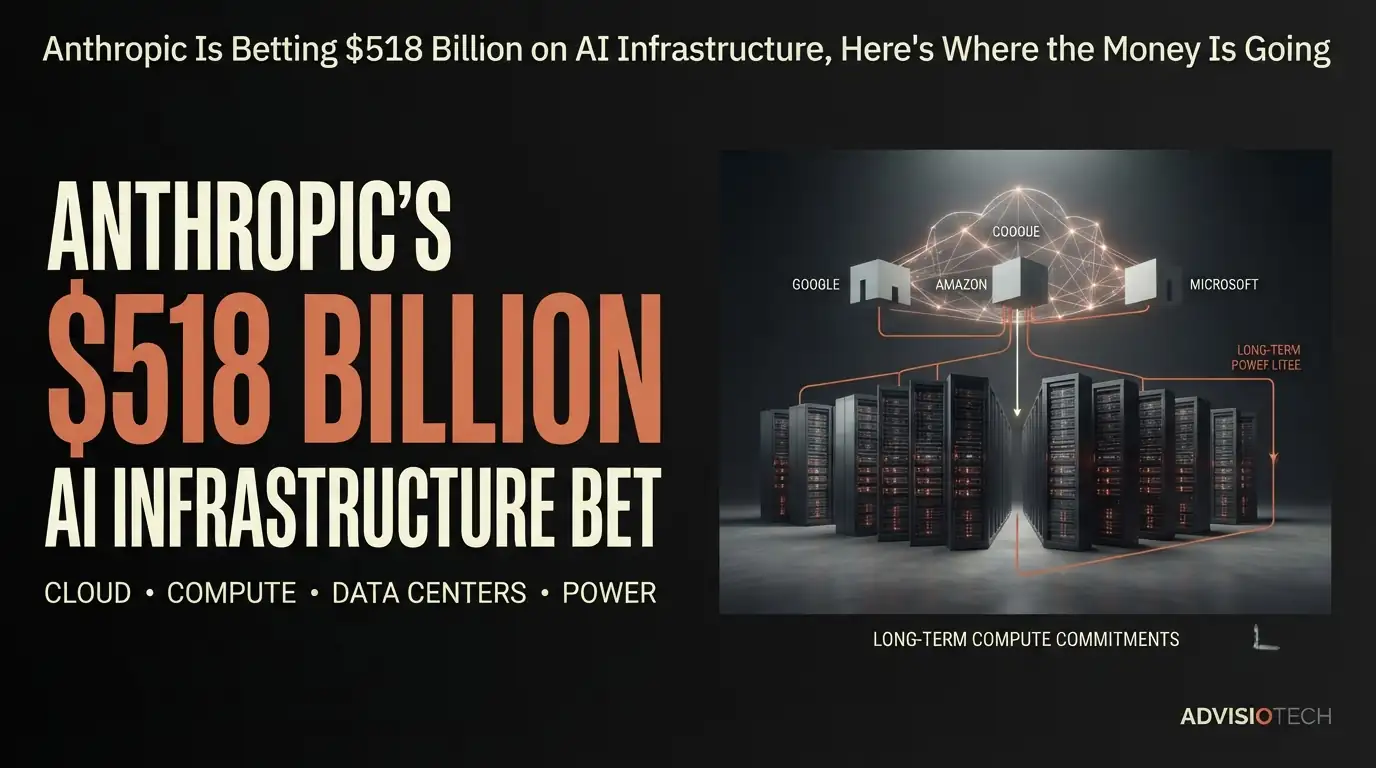
Some of the largest disclosed obligations include at least $111.1 billion with Alphabet's Google, $110 billion with Amazon and $31.4 billion with Microsoft. Those figures are described as long-term infrastructure service obligations and include payments that Anthropic says it expects to make regardless of usage.
That distinction matters because the headline number can otherwise create the impression that Anthropic has transferred $518 billion into data centers or chips. It has not. The figure is primarily about future contractual commitments for infrastructure capacity.
Why Does an AI Company Need This Much Compute?
Modern AI systems require enormous computing resources at several different stages. Models need large amounts of compute during training, but compute does not stop being important once a model is released.
Every time a user sends a request to Claude, the system needs computing capacity to process that request and generate an answer. As AI products become more capable and are used for longer-running tasks, coding, research and autonomous workflows, the amount of computation required can also increase.
That creates a very different infrastructure problem from a traditional software company. A conventional application can often add servers as demand grows. Frontier AI companies need access to specialized accelerators, networking, storage, data-center capacity and electricity at a scale that can take years to build.
Anthropic's own disclosures increasingly frame compute availability as a strategic constraint. The company's infrastructure strategy therefore involves securing capacity well before all of that capacity is necessarily needed.
Anthropic Is Not Building All of This Alone
One of the most important details in the disclosure is that Anthropic is relying on a network of infrastructure providers rather than constructing every part of its computing system itself.
Anthropic already operates across multiple cloud platforms. In February, the company said Claude was available through Amazon Web Services, Google Cloud and Microsoft Azure, while its models were being trained and run across AWS Trainium, Google TPUs and NVIDIA GPUs.
That diversification gives Anthropic access to different hardware and cloud environments rather than making the company dependent on one type of accelerator or one infrastructure provider.
The company's infrastructure expansion also extends beyond the three largest cloud relationships. Separate public announcements have shown Anthropic making large commitments involving additional infrastructure providers. For example, Akamai announced a $11.6 billion seven-year agreement with Anthropic in September 2026 to support growing CPU workloads, with a potential expansion of up to another $9 billion.
The Number Looks Even More Extreme When Compared With Revenue
Anthropic's infrastructure commitments become easier to understand when the time periods are kept separate.
Reuters reported that Anthropic generated nearly $4.6 billion in revenue during 2025, while the company reported a net loss of roughly $42 billion for that year. The reported loss included a large accounting charge related to the valuation of financing instruments, so it should not be interpreted simply as $42 billion of cash disappearing from the business.
Anthropic also reported that its 2025 computing and infrastructure costs were about $7.33 billion, more than half of its total operating expenses for the year.
Those figures show why the $518 billion number needs context. The $4.6 billion figure represents revenue from one year. The $518 billion figure represents long-term infrastructure obligations extending across many future years. Comparing the two as though they describe the same period would give a misleading picture.
Why Lock In Infrastructure Years in Advance?
The basic business logic is capacity planning. If an AI company expects demand for its models to grow faster than the available supply of computing resources, waiting until capacity is needed can create a serious bottleneck.
A new data center cannot be switched on overnight. Land, power connections, cooling systems, networking equipment, chips, construction and regulatory approvals all take time. Even when the physical facility exists, specialized AI hardware can be difficult to obtain at the required scale.
Long-term contracts can therefore give an AI company greater certainty that computing resources will be available when its products need them.
The trade-off is equally important. A long-term infrastructure commitment creates obligations even if demand changes. If model economics, customer demand, hardware efficiency or the competitive landscape develops differently from expectations, reserved capacity can become expensive.
That is why Anthropic's disclosures are significant beyond the headline dollar figure. They show that frontier AI development increasingly involves infrastructure planning on a scale more commonly associated with major industrial projects.
The Hidden Constraint Is Not Just GPUs
It is tempting to reduce the AI infrastructure race to a shortage of GPUs, but the real system is considerably larger.
AI infrastructure requires processors, high-speed networking, memory, storage, data-center space, cooling and reliable electricity. A company can have access to advanced accelerators and still be constrained by another part of the infrastructure chain.
Power is particularly important because large AI data centers can require enormous amounts of electricity. Anthropic has previously said that training a single frontier model could soon require gigawatts of power and has discussed the need for new generation and grid infrastructure as the US AI sector expands.
This is why the AI infrastructure race is increasingly connected to energy projects, transmission capacity, data-center construction and long-term power planning rather than being purely a semiconductor story.
What This Means for the AI Industry
Anthropic's commitments illustrate a broader change in how frontier AI companies are being built. The competitive advantage is no longer determined only by which company develops the most capable model.
Access to compute can influence how quickly a company can train new models, serve customers, experiment with larger systems and deploy increasingly demanding AI applications.
That creates a feedback loop. More customers can create more demand for compute. More compute can allow a company to offer more capable products. More capable products can attract additional customers. But the infrastructure has to be available before that demand can be served.
The risk is that companies can also commit too far ahead of actual demand. AI infrastructure has a long useful life, while AI models and customer preferences can change much faster.
What the $518 Billion Figure Does Not Mean
The $518 billion figure does not mean Anthropic has already spent $518 billion.
It does not mean Anthropic will necessarily consume every unit of computing capacity associated with the commitments at maximum utilization.
It also does not mean Anthropic's annual infrastructure bill will suddenly become $518 billion. The obligations stretch across years and involve different contracts, services and payment structures.
Most importantly, the figure should not be treated as a prediction that Anthropic will definitely generate enough revenue to make every commitment economically successful. That remains a business question, and the long-term outcome depends on customer demand, model economics, infrastructure costs and the company's ability to use the capacity efficiently.
The Bigger Story Behind Anthropic's Infrastructure Bet
The most important part of Anthropic's disclosure may not be the $518 billion headline itself. It is what the number reveals about the direction of the AI industry.
Building frontier AI is becoming an infrastructure business as much as a software business. Model research still matters, but the ability to train and operate those models increasingly depends on access to enormous pools of compute, power and physical infrastructure.
Anthropic is effectively making a long-term bet that demand for advanced AI will grow enough to justify securing that capacity today. Whether that bet pays off will depend on how quickly AI usage expands and how efficiently the industry turns computing capacity into useful products.
What Happens Next
Anthropic's infrastructure commitments will become easier to evaluate as more information about its public offering and financial performance becomes available. The company has already confidentially submitted a draft S-1 to the US Securities and Exchange Commission, although the eventual public offering remains dependent on regulatory review and market conditions.
For the AI industry, the more important question will be whether infrastructure supply can keep pace with demand. If compute remains the limiting factor, companies with access to large amounts of capacity could have an important advantage. If hardware efficiency improves rapidly or demand develops differently, some of today's enormous commitments could look very different several years from now.
The Bottom Line
Anthropic's reported $518 billion infrastructure commitment is not a $518 billion spending bill arriving today. It is a long-term collection of cloud, compute and infrastructure obligations designed to secure capacity for the company's future AI operations.
The scale nevertheless matters. It shows how quickly the economics of frontier AI are moving beyond model development and into data centers, chips, networking, electricity and long-term infrastructure planning.
For businesses adopting AI, the lesson is simple: the AI products users see on a screen are increasingly backed by an enormous physical infrastructure layer underneath them. The companies building that layer are now making commitments measured in hundreds of billions of dollars.
FAQ
Is Anthropic actually spending $518 billion right now?
No. The $518 billion figure refers to reported long-term cloud, computing and infrastructure obligations extending across roughly the next seven to ten years. It is not money Anthropic has already spent.
Why does Anthropic need so much computing infrastructure?
Anthropic needs computing capacity to train and operate advanced AI models and to serve customers using products such as Claude. As model usage and more demanding AI workloads grow, the company expects compute availability to become an important constraint.
Who is Anthropic buying infrastructure from?
Reuters reported major long-term obligations involving Google, Amazon and Microsoft, among other partners. Anthropic has also publicly announced infrastructure relationships with companies including Akamai and has said its models run across AWS Trainium, Google TPUs and NVIDIA GPUs.
Is the entire $518 billion commitment guaranteed to be spent?
The reported commitments are long-term contractual obligations with different terms. Reuters reported that about 80% is non-cancelable or requires payment regardless of usage. That does not mean every dollar represents the same type of infrastructure purchase or that all of the capacity will be used in the same way.
Why is compute becoming so important for AI companies?
Advanced AI requires large amounts of computing power for training and inference. When demand grows faster than available computing capacity, securing infrastructure becomes a strategic constraint rather than simply an operating expense.
Has Anthropic officially filed to go public?
Anthropic announced in June 2026 that it had confidentially submitted a draft Form S-1 to the US Securities and Exchange Commission. The company said at the time that a public offering would depend on SEC review, market conditions and other factors.