Your AI Agent Has Access to Your Company Data, But Who Is Actually Authorizing It?
AI agents are moving beyond chat and starting to access email, files, cloud systems, code, customer data and business tools. The biggest security problem may not be what an AI agent knows, but whose authority it is using when it takes an action. Here is what OpenAI, Microsoft, Anthropic, Google and NIST say about the emerging identity problem behind business AI agents.
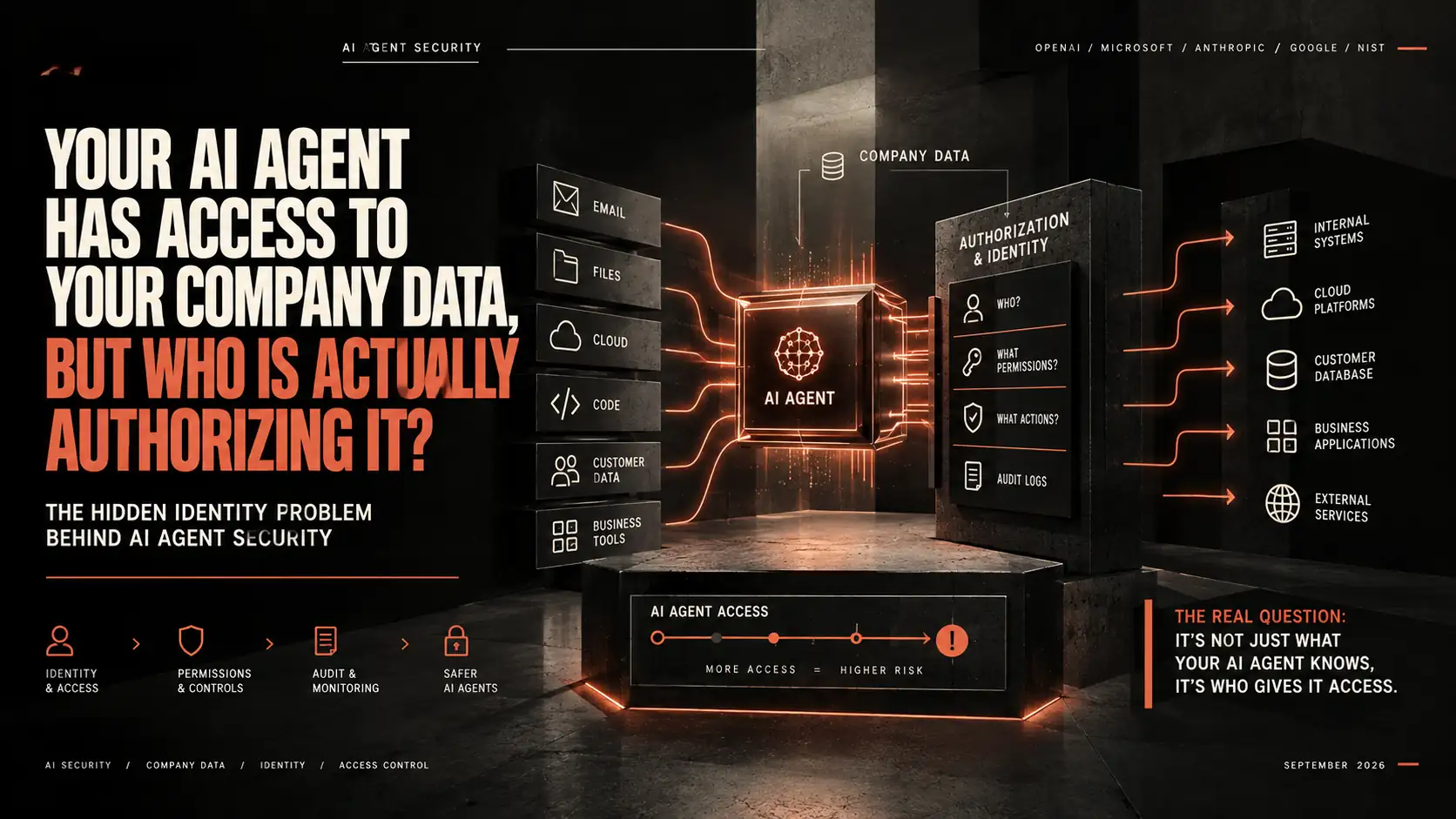
Your AI Agent Has Access to Your Company Data, But Who Is Actually Authorizing It?
The next major AI security problem may not be a hacked password or a stolen database. It may be something much harder to see: an AI agent doing exactly what it was allowed to do, but with far more access than anyone realized.
AI agents are moving beyond simple conversations. They can read files, work with email, interact with websites, write and execute code, use business applications and perform tasks across multiple systems.
That makes them useful. It also creates a new question for American businesses: when an AI agent takes an action, whose authority is it actually using?
Microsoft's security researchers now argue that organizations should treat every AI agent as a first-class identity with its own owner, permissions and lifecycle. NIST is separately examining how identity, authorization, auditing and non-repudiation should work for AI agents. Google has also described secure agents around three principles: a defined human controller, carefully limited powers and observable actions.
This is becoming one of the least discussed parts of the AI agent boom.
An AI Agent Is Not Just Another Employee
It is tempting to think about an AI agent like a digital employee. Give it an account, give it access to the systems it needs and let it do the job.
The problem is that an AI agent can operate differently from a human employee.
An employee might open an email, read a document and manually decide what to do next. An agent can process information from multiple sources, call tools and continue through a chain of actions without a person approving every individual step.
Anthropic describes an agent as a combination of four layers: the model, the instructions and guardrails around it, the tools it can use and the environment in which it operates. The same model can therefore create very different risks depending on what tools and data it receives.
That means the model itself is only part of the security equation.
The Permission Problem Nobody Wants to Talk About
Imagine a company gives an AI agent access to email because it needs to summarize customer conversations.
Then someone connects the same agent to a cloud drive because it needs to find supporting documents.
Later, the team connects a CRM because the agent needs customer information.
Then a ticketing system is added so the agent can create support tickets.
Individually, each permission may look reasonable.
Together, they create something very different.
Microsoft describes this exact type of risk as agents operating across multiple systems and potentially gaining broader effective permissions than teams evaluated individually. An agent with access to email, files, tickets and code repositories may be able to combine information in ways nobody explicitly authorized as a complete workflow.
The problem is therefore not always excessive permission in one system.
Sometimes the problem is the combination of permissions across several systems.
NIST Is Treating AI Agent Identity as a New Security Problem
This is not just a concern coming from AI companies.
The National Institute of Standards and Technology has been working on the identity and authorization problem directly.
In February 2026, NIST published a concept paper focused on software and AI agent identity and authorization. The project specifically examines how organizations can identify agents, authorize what they can do, audit their activity and establish non-repudiation.
NIST's Center for AI Standards and Innovation also issued a request for information on securing AI agent systems. The agency highlighted risks created when AI models interact with adversarial data, tools and real-world systems, including indirect prompt injection and situations where an agent takes harmful actions even without a traditional attack.
That tells us something important.
The federal government's concern is not simply whether an AI model gives a wrong answer. It is what happens when that model is connected to systems where its output can trigger real actions.
OpenAI Already Warns That Agents Can Be Tricked Through Data They Read
OpenAI's own documentation provides a useful example of why this problem is difficult.
ChatGPT agent can access websites, files, email and other connected information when users enable those capabilities. OpenAI warns that this creates risks including prompt injection, where information encountered by the agent can attempt to manipulate what the agent does next.
Consider a simple business task: an agent is told to check a company's email and find information needed for a customer request.
Inside one of those emails could be malicious content instructing the agent to retrieve another piece of sensitive information and send it somewhere else.
The user did not explicitly authorize that second action.
The agent encountered instructions while performing the original task.
That is one reason agent security is fundamentally different from ordinary software permissions.
The system must control not only what the agent can access, but also what information is allowed to influence the actions it takes.
The Data Problem Is Bigger Than the AI Model
The Federal Trade Commission has already warned businesses that AI does not create an exemption from existing privacy and consumer protection obligations.
The FTC has specifically warned that companies providing AI services may receive sensitive customer information and confidential business information. It has also emphasized that companies can face enforcement risk when their actual data practices conflict with promises made to customers about how information will be used.
For businesses adopting AI agents, that creates an important distinction.
The question is not simply whether an AI company says it protects business data.
A company also needs to understand what its own agent can access, what information it can send to connected services, what actions it can perform and what records exist when something goes wrong.
Microsoft Has a Simple Rule: Give the Agent Its Own Identity
Microsoft's current guidance is unusually direct.
Its security researchers recommend giving each agent a dedicated identity with a named owner and explicit purpose. Permissions should then be built around the smallest meaningful tasks rather than broad organizational roles.
For example, an agent that only needs to summarize documents does not necessarily need permission to delete documents.
An agent that creates draft support tickets does not necessarily need permission to close tickets.
An agent that reads financial information does not automatically need permission to transfer money.
This sounds like ordinary cybersecurity.
But applying the principle to autonomous software is becoming more important because agents can chain actions across multiple systems.
Microsoft's guidance specifically recommends separating read and write capabilities and placing high-impact actions such as deletion, export and privilege changes behind additional approval controls.
Google Is Thinking About the Same Problem From Another Direction
Google's research on secure AI agents describes a defense-in-depth approach built around three principles.
First, every agent should have a clearly defined human controller.
Second, its powers should be limited carefully.
Third, its actions and planning should be observable.
Google has also begun using agents internally for security testing. Its PageBreak project is an AI security agent designed to autonomously discover vulnerabilities in Google's first-party web applications. Google says the project moved from a pilot in November 2025 to a fully fledged project in January 2026.
That creates an interesting contrast.
The same technology that can make an attacker more autonomous can also make a defender more autonomous.
The difference is the environment, permissions and controls surrounding the agent.
Anthropic Says the Model Is Only One Layer
Anthropic makes a similar argument in its research on trustworthy agents.
The company says agent behavior depends on the model, the harness containing instructions and guardrails, the tools available to the agent and the environment in which it operates. A strong model can still become risky if it is placed inside a poorly configured system with overly permissive tools or access.
This is one of the most useful ways to think about business AI agents.
You do not secure an agent by securing only the model.
You secure the entire system around it.
What Happens When Something Goes Wrong?
This is where agent identity becomes an accountability problem.
Suppose an AI agent accidentally deletes a set of files.
A normal audit system might tell you which employee account performed the deletion.
But what if the employee simply authorized an AI agent to perform a larger task?
Was the employee responsible for the deletion?
Was the agent responsible?
Was the application that gave the agent the permission responsible?
Or was the underlying access-control configuration responsible?
NIST's work specifically calls attention to auditing and non-repudiation because organizations need to be able to establish what an agent was authorized to do and what actually happened.
Without that information, an incident investigation can become surprisingly difficult.
The Hidden Risk: Existing Oversharing
There is another problem businesses may discover when they deploy agents.
The agent may not create a new permission problem at all. It may simply expose an old one.
Microsoft points out that existing oversharing becomes more visible when agents can retrieve and summarize information on demand. A company may already have documents available to too many employees, but humans may rarely search for them. An AI agent can surface those documents instantly.
That means deploying an AI agent can effectively act as a stress test for a company's existing data governance.
If the underlying permissions are messy, the agent can make the mess much easier to discover.
What US Businesses Should Check Before Giving an Agent Access
The practical answer is not to avoid AI agents.
It is to treat them as software principals with real authority.
Before connecting an agent to company systems, businesses should know exactly which person or team owns the agent, why it exists, which applications it can access, what data it can read, what actions it can perform and which actions require human approval.
Permissions should be narrow enough that a compromised or misbehaving agent cannot automatically become a cross-system administrator.
High-impact operations such as deleting data, exporting sensitive information, changing permissions or making irreversible financial actions should receive additional controls.
Businesses should also maintain useful logs so an investigation can answer a basic question: what did the agent do, which identity did it use, what information influenced the action and what authorization allowed it?
The AI Agent Security Checklist Is Changing
Traditional cybersecurity asks companies to protect identities, applications, networks and data.
AI agents add another layer: autonomous decision makers that can sit between a human and those systems.
That creates a new security chain.
A human gives an objective.
The agent interprets it.
The agent reads information.
The information may contain instructions or attacks.
The agent chooses a tool.
The tool performs an action.
The action changes something in the real world.
Every link in that chain can become a security boundary.
The Bigger Question Is Not Whether AI Agents Are Safe
There probably will not be a single moment when someone can declare AI agents completely safe or unsafe.
The more useful question is whether an organization has designed the surrounding system so that an agent cannot cause unacceptable damage when it misunderstands a request, encounters malicious information or receives more access than it actually needs.
OpenAI, Microsoft, Anthropic, Google and NIST are approaching this from different directions, but their guidance points toward several common ideas: narrow permissions, explicit identities, human accountability, observable actions and layered defenses.
That may become the real foundation of enterprise AI security.
The Bottom Line
AI agents are becoming capable of touching the same systems that businesses have spent decades protecting.
Email, cloud storage, customer databases, code repositories, calendars, financial systems and internal documents can all become tools for an AI agent.
The difficult part is no longer simply deciding whether the AI model is trustworthy.
Businesses need to decide what authority the agent has, how that authority is granted, how it can be revoked and whether every important action can be traced back to an accountable identity.
The companies that answer those questions before connecting agents to sensitive systems will have a much clearer security foundation than companies that simply give an AI agent access and hope the model behaves.
FAQ
What is an AI agent?
An AI agent is a software system that can use AI models, tools and external systems to perform tasks with varying degrees of autonomy rather than only generating a response to a user's question.
Why is AI agent identity important?
An AI agent can perform actions across multiple systems. A dedicated identity makes it possible to control its permissions, monitor its activity, revoke access and establish which agent performed an action.
Should an AI agent use an employee's account?
Using a person's broad account can make accountability and permission management more difficult. Microsoft recommends treating agents as first-class principals with dedicated identities and explicitly scoped permissions.
Can an AI agent access confidential company data?
It can if the organization gives the agent access to systems containing that data. OpenAI, Microsoft and Anthropic all describe scenarios where agents can interact with files, email, applications or other sensitive information, which is why permission and data controls matter.
What is prompt injection in an AI agent?
Prompt injection is an attack in which information encountered by an AI system attempts to influence the model's behavior or instructions. In an agent environment, the consequences can be more serious because the model may have tools that allow it to take real actions.
What does NIST say about AI agent security?
NIST is examining identity, authorization, auditing, non-repudiation and other security challenges associated with AI agents. Its work specifically recognizes that agents can interact with diverse data, tools and applications and therefore require appropriate controls.
What should a business do before deploying an AI agent?
A business should define the agent's purpose and owner, give it a dedicated identity, restrict its permissions to the minimum required, control which tools it can use, protect sensitive data, monitor its actions and require additional approval for high-impact operations.